Czech Manganese Misses 2030 Target
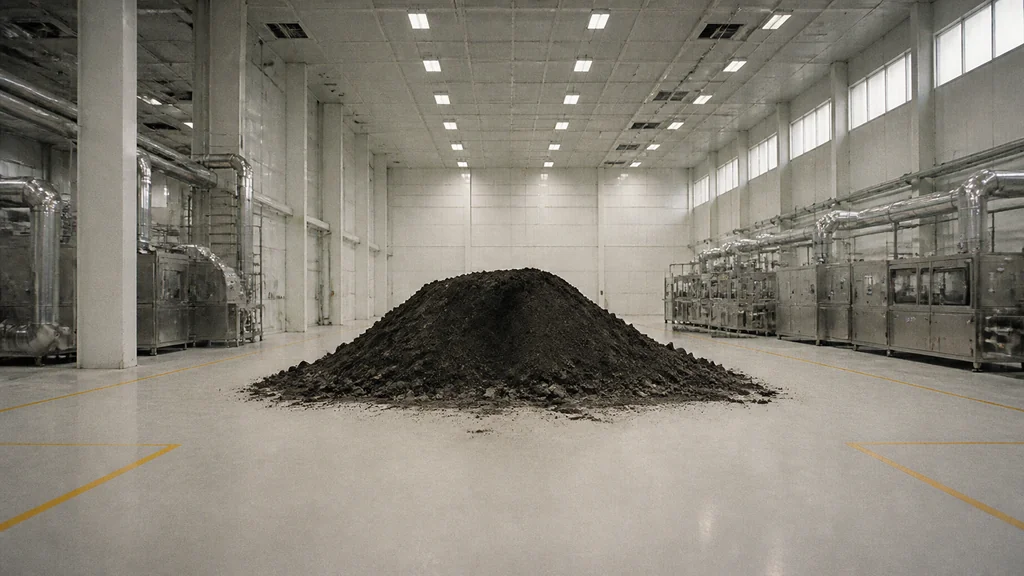
Europe’s battery ambitions wait beside the material they cannot yet process.
Cumadóireacht íomhá · tobriefCzech authorities have cleared the site for a manganese processing plant near Chvaletice, in the Pardubice region east of Prague. In plain terms, the state has accepted that this kind of project can belong on this land (iROZHLAS, Zdarbuh). It has not cleared the project to break ground.
That distinction matters. The scheme, run by a Czech subsidiary of Canada-listed Euro Manganese, still needs a building permit, a mining-operations licence, financing, binding purchase agreements and a board decision to put capital behind it. Commercial production is pencilled in for 2032 (Mining Weekly, Smallcaps).
The difficulty is the date. The EU’s Critical Raw Materials Act, the regulation designed to reduce Europe’s dependence on foreign suppliers for battery ingredients, sets its supply-security benchmarks for 2030 (Eur-Lex). Chvaletice contributes nothing by then.
Clean Logic, Slow Calendar
On paper, Chvaletice is close to the ideal Brussels project. It is not a new mine being dug into untouched ground. It would reprocess roughly 27 million tonnes of tailings, the waste left behind by Cold War-era mining between 1951 and 1975, into high-purity manganese chemicals used in electric-vehicle battery cathodes (iROZHLAS, Newsfile).
Its two planned products, a sulphate precursor and an ultra-clean metal, need refining well beyond the grade used by steelmakers. That is why they sit on the CRMA’s strategic list (Euro Manganese).
The project has EU strategic-project status and Czech national designation. It is exactly the sort of asset the regulation was written to push along: domestic supply, cleaner feedstock, and less reliance on China-linked processing chains (Mining Weekly, European Commission).
The company’s 2026 preliminary economic assessment says the plant could produce 150,000 tonnes a year, enough for about 20% of projected European demand for battery-grade manganese. Phase-one construction would cost about $627.5 million (Smallcaps, National Law Review).
But a preliminary assessment is not a feasibility study. The filing warns that it contains no proven mineral reserves and that the projected economics may never be realised (Barchart). The company expects to apply for its final building permit around the turn of 2027 and 2028 (iROZHLAS). Its only named customer arrangement, a non-binding term sheet with US-based 6K Energy, fixes neither volumes nor prices (The Globe and Mail).
Factories Before Feedstock
Europe has been quicker at building battery factories than at securing the materials that make them useful. Germany shows the problem clearly. PowerCo, Volkswagen’s battery subsidiary, has started production at its Salzgitter gigafactory using nickel-manganese-cobalt cathodes, while processed raw materials and parts of the production technology still come from China (Volkswagen Group, FAZ).
German industry is more than 99% import-dependent for some strategic inputs, including lithium, nickel and rare earths (BDI). For Ireland, which has no large automotive industry but depends heavily on open European supply chains, this is not a distant German manufacturing issue. It is about whether the single market can hold on to strategic production when the valuable parts of the chain sit elsewhere.
The money explains the imbalance. Between 50% and 60% of a battery’s value is in material extraction and processing. Cell assembly, the stage Europe has put most energy into, accounts for 15% to 30% (Chemietechnik, Deloitte). Europe built the visible factories first, while leaving much of the higher-value material chain outside its control.
Running Past Its Own Deadline
The CRMA sets a clear 2030 test: at least 10% domestic extraction, 40% domestic processing and 25% recycling of strategic raw materials, with no more than 65% dependence on any single non-EU country at any processing stage (Eur-Lex, European Commission). These are not production targets in the old industrial-planning sense. They are resilience thresholds, meant to stop one supplier or one geopolitical shock from holding up an entire sector.
Even if Chvaletice reaches its full projected output, it would cover a fifth of Europe’s battery-grade manganese needs only after the target date has passed.
The project may yet become a real part of Europe’s battery answer. To get there, it must clear the remaining permits, raise roughly $670 million, sign binding purchase agreements and reach a final investment decision. On the present timetable, Chvaletice looks less like a solution to the EU’s 2030 raw-materials problem than a test of whether Europe can build the next stage any faster than it built the last one.
Details about this article
- Model:
- claude-opus-4-6
- Generated:
- 8/31/2026, 1:54:13 AM
- Pipeline run:
- eu_pipeline_20260831_005006
- Watermark:
- SynthID (Google's invisible watermark)
- Human review:
- None before publication