Drought Drains Europe’s Buffers
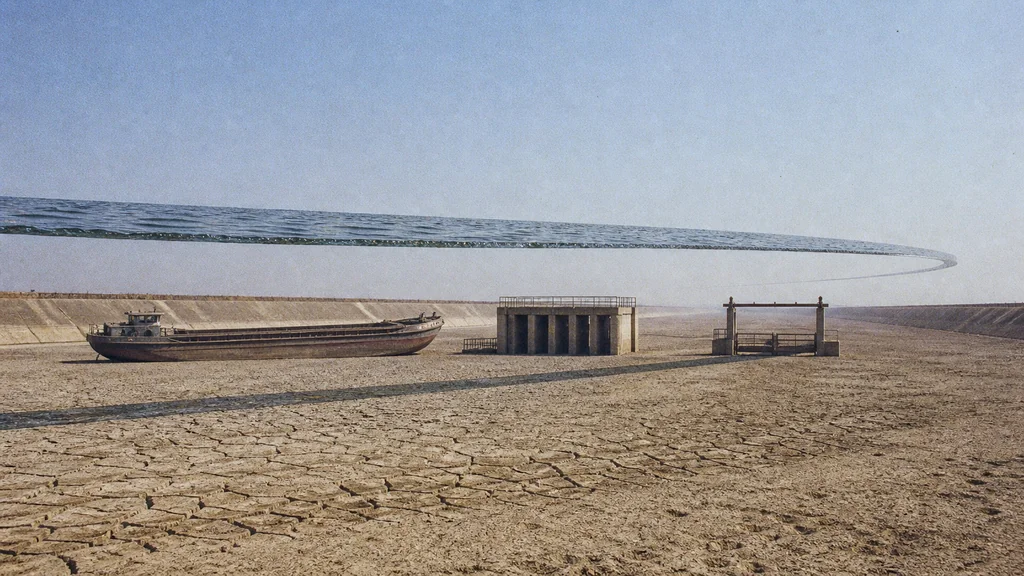
Europe’s rivers retreat beyond the systems that depend on them.
Cumadóireacht íomhá · tobriefAt Cremona, the Po is running at 193 m³/s, about a third of its historical average (Il Giorno). That is not just a local Italian problem. The Po waters some of Europe's most productive farmland, drives hydropower and holds back seawater from the delta. Further east, the Danube has fallen below the level needed to cool Romania's only nuclear plant. Further north, the Rhine at Kaub, the pinch point that determines how much freight can move through western Germany, has dropped past historic lows.
All three river systems are being hit at once. On 12 August, the EU's Joint Research Centre said drought now covered 50% of EU and UK territory (JRC). Rivers do much of Europe's industrial work quietly: they cool power stations, carry cargo, irrigate crops and generate electricity. When they fail, those stresses arrive together.
Power stations without enough river
The sharpest damage is showing up in electricity. Romania's Cernavodă nuclear plant, which normally provides about a fifth of the country's power, shut down completely on 13 August after both reactor units lost enough cooling water from the Danube (Le Monde, Al Jazeera). Nuclear reactors produce huge heat. Some of it becomes electricity; the rest has to be carried away through condensers by river water. If the river drops below the intake pumps, the plant stops.
Hungary's Paks plant, which produces nearly half of national electricity, is facing the same physics. Output fell from about 965 MW to 240 MW in early August as the Danube hit historic lows. The government tried to buy a few centimetres by sinking rock-loaded barges and building a temporary sill on the riverbed near the cooling intake (ABC News, Telex).
France has a different version of the problem. Its rivers are still deep enough, but sending heated cooling water back into them risks breaching temperature limits designed to protect aquatic life. By 12 August, 13 of 57 French reactors were affected, while environmental limits, together with jellyfish clogging cooling intakes at Gravelines, had taken a record 20.4% of French nuclear capacity offline (Boursorama/AFP, Euronews).
When cheap nuclear generation disappears, countries lean on Europe's coupled electricity market. Power moves across borders towards the highest accepted bids, and prices rise when traders have to turn to dearer plants or imports. French day-ahead power rose 34% in a single day to €126/MWh on 10 August, according to France Épargne. Bulgaria's Kozloduy plant, still operating on the Bulgarian stretch of the Danube, faced export demand of 3,500–4,000 MW from Romanian and Hungarian traders (Mediapool). Bulgaria has become a regional shock absorber, but only for as long as Kozloduy itself can keep running.
Barges half-empty, fields going salt
On the Rhine, Germany's Federal Institute of Hydrology confirmed that water levels had reached or fallen below the lowest known levels over long stretches (BfG). One vessel designed to carry 1,200 tonnes passed Kaub with just 180 tonnes on board (Argus Media). Covestro, the chemicals producer, said raw-material traffic was already limiting production (Tagesschau).
Some freight can move by road or rail, but the arithmetic gets ugly quickly. A 25% fall in Rhine freight means roughly 3 million tonnes a month, or about 120,000 extra truckloads for a road network that cannot easily take them (WDR). Berlin now treats low water as a recurring risk to the economy, not an awkward summer interruption (Handelsblatt).
In Italy's Po basin, the pre-Alpine lakes that feed summer irrigation are close to empty: Maggiore at 5.3%, Como at 5.9%, Iseo at 5% (Il Sole 24 Ore). Seawater has pushed 20–25 km inland up the Po Delta, turning irrigation water unusable for rice farmers already on rationed supply (Pianura Reno). Italian hydropower fell 14.9% year on year in July (Affaritaliani), tightening a power system already being squeezed elsewhere by the same drought.
Coping is not adapting
Each country has found something that gets it through the day. Hungary built a sill. France remained a net power exporter. Romania filled gaps with imports. The weakness is that every fix assumes someone else still has room to manoeuvre.
Emergency river engineering can lift water at one intake, but it does not create flow. Thermal exemptions keep plants running by shifting more stress onto ecosystems. Imports work only while a neighbour has spare capacity. Europe has become practised at borrowing that slack during drought. This summer is showing the limit: adaptation has to happen before every neighbour needs the same cushion at the same time.
Details about this article
- Model:
- claude-opus-4-6
- Generated:
- 8/17/2026, 1:54:03 AM
- Pipeline run:
- eu_pipeline_20260817_005006
- Watermark:
- SynthID (Google's invisible watermark)
- Human review:
- None before publication