Balkan Gas Corridor Pushes South
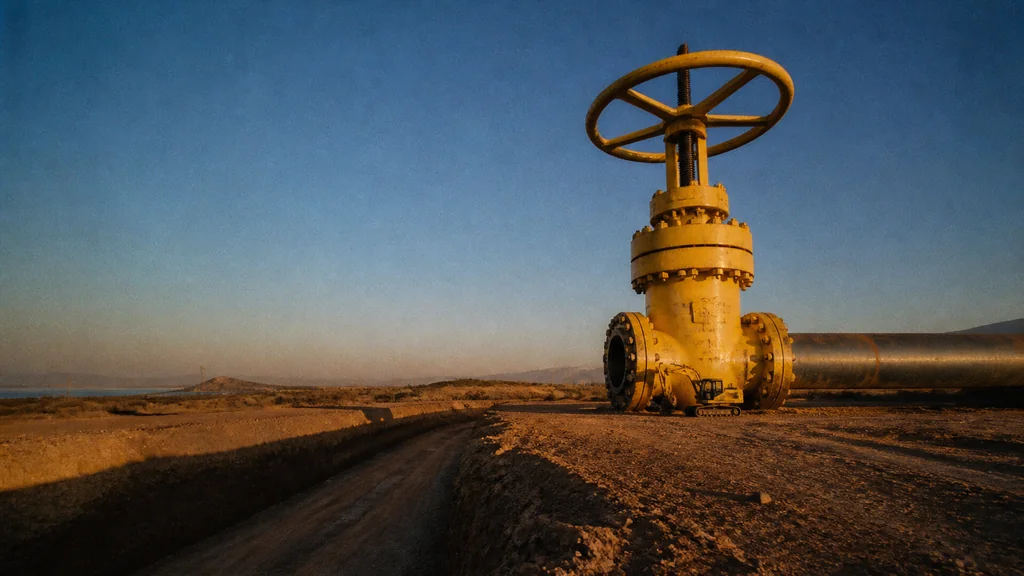
Europe enlarges the gateway before completing the route beyond it.
Cumadóireacht íomhá · tobriefEleven gas-system operators, the companies that run national pipeline networks, signed a cooperation agreement in Thessaloniki on 4 September to push the Vertical Gas Corridor further into the Western Balkans (Novini.bg, Powergame). The corridor is not a single pipeline. It is a chain of national gas grids, cross-border links and LNG terminals, held together by bilateral agreements and the shared need to move non-Russian gas northwards.
For landlocked countries in southeastern Europe, that need is becoming harder to postpone. EU law is now putting a clock on Russian gas, with deadlines arriving in 2027. Thessaloniki widened the political map of the route. The engineering map is less complete: several of the pipes the corridor relies on are still promises, contracts or construction sites.
The southern links work
At the southern end, the infrastructure is no longer theoretical. Greece's Alexandroupolis terminal, a floating unit that turns shipped liquefied natural gas back into pipeline gas, has been operating since late 2024 with 5.5 bcm per year of capacity (Adevarul). The older Revithoussa terminal near Athens has nearly all its unloading slots booked through 2040 (OT, Serbia Energy). Traders are not treating this as a short-term workaround.
The route north through Bulgaria is also being used. The IGB interconnector has carried more than 39 million MWh since it began operating (ICGB). As we reported in July, traders booked 46% of available Greek-Bulgarian border capacity for several years ahead, which is usually a better test of seriousness than a signing ceremony (To Brief).
Bulgaria is the immediate choke point. Bulgartransgaz completed duplicate pipe on a constrained stretch between Kulata and Kresna on 1 September, allowing more gas to move north. The larger upgrade, almost doubling capacity at the Romanian border to 9.4 bcm per year, still depends on construction running into 2027–28 (Economic.bg, Jurnalul).
Further along the chain, Moldova has begun selling time-limited rights for traders to move gas through its network towards Ukrainian storage. In March 2026, a record booking reserved 25,500 MWh per day on one route (Moldpres). These are modest volumes, but they show the system can work end to end.
The Western Balkans branch is still mostly on paper
The Thessaloniki agreement brought North Macedonia's NOMAGAS and Serbia's Transportgas Srbija into the group. At a July meeting in Athens, operators had already been working through the practical questions: how much capacity exists at each border, what tariff rules apply, and when each section might be ready. They also set up a joint working group (Gastrade).
Greece and North Macedonia are building a 123 km interconnector from Nea Mesimvria to Negotino, backed by financing from the EIB and EBRD (NOMAGAS). North of that, NOMAGAS has awarded a €29.4 million contract for its 22.4 km section of a link to Serbia, with completion targeted for Q4 2028 (Balkan Green Energy News). The Serbian section, at roughly 144 km, does not yet have the same level of public contracting detail.
Serbia shows the corridor's problem in miniature. Srbijagas has booked 300 million cubic metres per year at Alexandroupolis for ten years (Vreme). That is a real commercial commitment, but it covers only about a tenth of Serbia's annual consumption. Belgrade is still extending short-term supply deals with Gazprom (Enerdata). For now, the corridor gives Serbia leverage in negotiations. It does not yet give it a full alternative.
Who gains, who pays
The EU's Russian-gas phase-out regulation, adopted in January 2026, bans long-term Russian LNG contracts from January 2027 and sets a pipeline gas phase-out by late 2027 (European Commission, European Parliament). That is the legal pressure behind the corridor.
Greece and Bulgaria stand to gain hub status and transit fees. Romania benefits first as a transit state and later as a producer, once the Neptun Deep offshore field starts pumping, with production targeted for 2027 (OMV). North Macedonia shifts from being a dead-end market to a possible transit country.
Hungary and Slovakia sit closer to the political edge of the project. Both still rely on Russian gas through TurkStream, the pipeline running from Russia through Turkey into southeastern Europe. Slovakia's main transit operator moved only about 5.4 bcm in 2025, down from 17.8 bcm after Ukrainian transit stopped (Pravda.sk). Croatia's Krk LNG terminal, meanwhile, offers a rival non-Russian route, with capacity due to double in late 2026 (HRT).
The awkward detail is in the market data. When Ukraine auctioned two transit routes in December 2025, no company booked a single cubic metre (LIGA.net). Cooperation agreements, working groups and tariff discounts can open a route, but they cannot force traders to use it if price, timing and demand do not line up. Thessaloniki made the corridor politically wider. It has not yet made it physically complete, or commercially certain.
Details about this article
- Model:
- claude-opus-4-6
- Generated:
- 9/5/2026, 1:41:44 AM
- Pipeline run:
- eu_pipeline_20260905_005005
- Watermark:
- SynthID (Google's invisible watermark)
- Human review:
- None before publication