EU Power Shift Moves Ahead
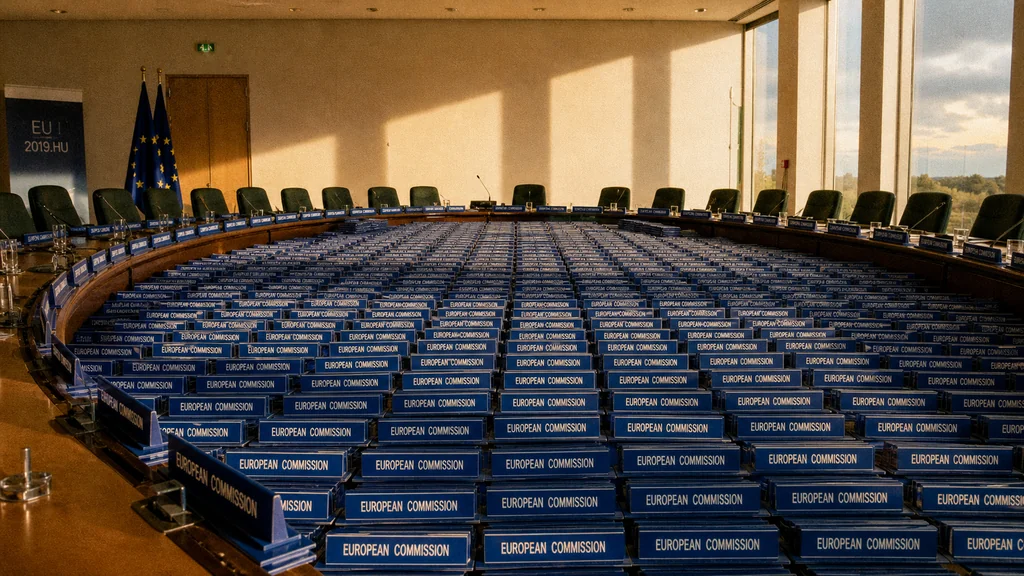
Commission machinery multiplies while national seats disappear from view.
Cumadóireacht íomhá · tobriefThe point of a Gymnich is that ministers can talk more freely than they would across the formal Council table. No laws are made, no communiqués carry the force of decision, and the choreography is deliberately softer. So when EU foreign ministers came to Druids Glen in Wicklow on 1–2 September for the twice-yearly informal meeting, the useful question was not what they decided. They were never meant to decide anything. It was which ideas had enough weight behind them to travel from conversation into machinery (EEAS, The Journal).
Two proposals were in the air. Both are meant to make EU foreign policy quicker and less fragmented. But they are not equal. The reform that can actually move would draw more power into the Commission. The harder one, limiting the national veto, remains trapped by the very unanimity rule it is trying to soften.
Kallas has the title but not the tools
Kaja Kallas carries the grand title: High Representative of the Union for Foreign Affairs and Security Policy. In theory, she is the person meant to pull together what the EU does in the world. In practice, many of the levers that matter sit elsewhere. Development aid, defence industry, humanitarian relief and neighbourhood policy are backed by budgets and officials in Commission departments she does not directly run (Le Monde, Euronews).
France and Germany want to change that. Their July ministerial-council conclusions called for reform of the EU's external-action structures, with the October European Council, the summit where heads of government set political direction, pencilled in as the moment to begin formal work (Elysée, Bundesregierung). The reported answer is to bring those instruments closer to Kallas. The price is that Kallas would also sit more clearly inside Commission President Ursula von der Leyen's chain of command (Politico).
That matters because the EU's diplomatic service, the EEAS, is not a normal foreign ministry. It is a hybrid, built from national diplomatic services, the Commission and the Council secretariat. Under the reported plan, it would be pushed more towards strategy and military missions, and away from budgets and programmes. Kallas might gain access to more tools, while the service she heads loses some control over money, staff and the agenda (EUPerspectives). No public Franco-German paper has been released, so the design is still known through leaks and reporting rather than confirmed text.
This is why the proposal has a real chance of moving. It would require revising the 2010 Council decision that created the EEAS, not reopening the EU treaties (Council Decision 2010/427/EU).
The veto problem stays locked
The second track goes closer to the bone. A non-paper from 11 countries, including France, Germany, Austria, the Netherlands, Spain and Sweden, proposes a code of conduct against obstructive vetoes in foreign policy (ANSA, Euronews). The treaty rule is simple enough: on foreign and security policy, the EU usually needs unanimity. One government can hold up sanctions or a crisis response even if the other 26 are ready to move (Article 31 TEU).
The non-paper pushes governments towards constructive abstention, where a country stands aside rather than blocks a decision. It also asks capitals not to use foreign-policy files as bargaining chips for unrelated demands, and it calls for work on qualified majority voting, where decisions pass by weighted majority rather than consensus. There is precedent for the softer route: Cyprus, Ireland, Austria and Malta have each stepped aside on particular decisions rather than vetoing them (Euronews).
The catch is familiar. The escape route also needs unanimity. The countries protected by the veto would have to agree to dilute it. That leaves the proposed code of conduct looking more like political pressure than an enforceable fix.
Who pays
The two reforms would shift power in different ways. The machinery reform strengthens the Commission presidency as the command point for EU foreign policy. For smaller member states, including Ireland, that is not a dry institutional matter. The High Representative now answers both to the Commission and to member states through the Council. If the role becomes more tightly bound to the Commission, capitals such as Dublin or Tallinn have less direct grip on decisions that may affect them quickly and practically.
Estonia shows the dilemma. Tallinn wants faster sanctions coordination and has said openly that Hungary and Slovakia slowed important Ukraine decisions (Estonian Government). It has good reason to want speed. But if speed comes through a stronger Commission hierarchy, it may weaken the Council channel where smaller states have a formal seat and a habit of being heard (ERR).
The veto track creates a different set of losers. Cyprus sees its veto as insurance on EU-Turkey files; weakening it would remove one of a small state's strongest diplomatic tools (RIK, Kathimerini). Hungary has used the veto to delay sanctions packages. For both, the current system is not an embarrassment in need of repair. It is leverage.
Wicklow produced no decision, as a Gymnich is not meant to (Irish Times). The October European Council is the next moment that matters. The likelier reform is the tidier chain of command, because it needs a Council decision rather than treaty change. The EU may manage to rearrange who holds the files long before it changes how the 27 decide what to do with them.
Details about this article
- Model:
- claude-opus-4-6
- Generated:
- 9/2/2026, 2:02:29 AM
- Pipeline run:
- eu_pipeline_20260902_005006
- Watermark:
- SynthID (Google's invisible watermark)
- Human review:
- None before publication