EU buys its Greenland foothold
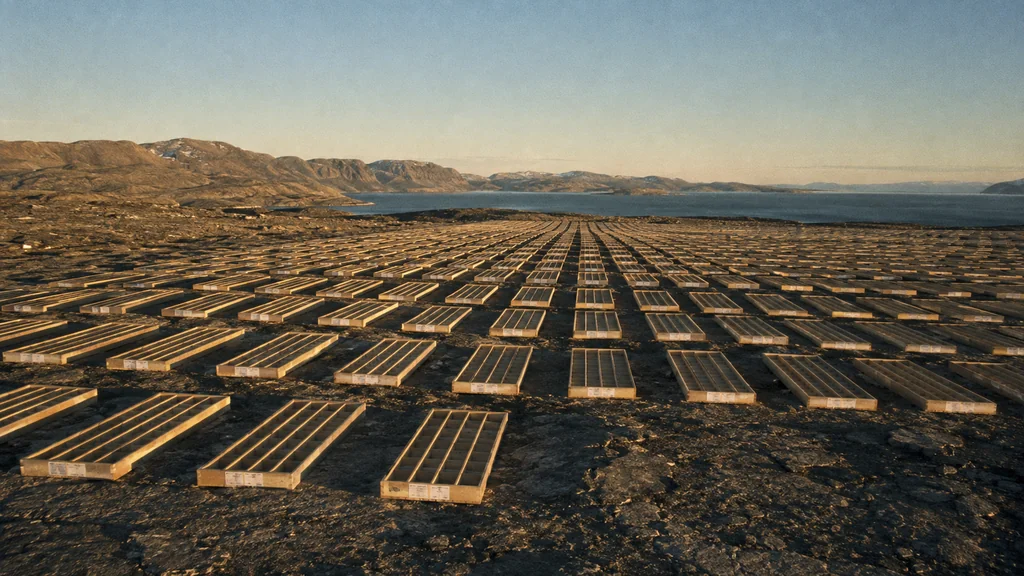
Europe funds the search while Greenland’s buried wealth remains beyond reach.
Cumadóireacht íomhá · tobriefUrsula von der Leyen went to Greenland this weekend with a reported €200 million package for 2026 and 2027, aimed at satellite links, subsea cables, data centres, renewable energy and critical raw materials (EU Perspectives, Le Figaro). The timing was not accidental. After months of Donald Trump talking in public about the island as if it were a property transaction waiting to happen, the Commission president arrived with the language of family solidarity (Brussels Times). The money, though, tells a more careful story.
Three Pots of Money, One Still Imaginary
The €200 million is fresh spending over two years. It comes on top of €225 million already going to Greenland under the current EU budget, through the bloc’s funding route for overseas countries and territories linked to member states but outside the Union (EU-OCT Partnership).
There is a bigger number in the background. The Commission has proposed €530 million for Greenland in the next long-term EU budget, running from 2028 to 2034 (European Parliament Legislative Train, EUR-Lex COM(2025)599). That still needs the unanimous approval of all 27 EU governments. Stack the three figures together and they come close to a billion euro. But the first is new, the second was already committed, and the third is still a proposal rather than agreed spending.
The EU is not buying minerals with this money. It is buying the circumstances in which minerals, infrastructure access and political trust may become available later. Commissioner Jozef Síkela put the point plainly at the Arctic Forum: Europe wants to "strengthen the ability of Arctic communities to decide for themselves, and to back those decisions with investment" (IEU Monitoring).
Why the Minerals Are Years Away
Greenland has 25 of the 34 critical raw materials the EU regards as strategically important, including rare earths, graphite and molybdenum (European Sustainable Energy Week). On a Commission slide, that looks like a solution to Europe’s dependence on China. On the ground, Wood Mackenzie’s assessment is more sobering: there is no rare-earth mine operating on the island, and polar conditions, weak infrastructure and regulatory limits mean any such mine is years away (Wood Mackenzie). Only two mining projects currently operate there, producing anorthosite and gold (CSIS).
Greenlandic foreign minister Múte Bourup Egede told MEPs that about 60% of Greenland’s subsurface remains unmapped and that its 56,000 people live in settlements without road links between them. His message to Brussels was practical, and pointed: European investment needs to be matched by European companies ready to buy what Greenland produces. "If there are no European companies, there are others interested" (Demócrata).
The Kvanefjeld rare-earth deposit shows where Greenland draws its own lines. The project has been blocked under the territory’s uranium legislation, a reminder that global demand does not trump local environmental law (Wood Mackenzie). Europe has its own credibility problem on this front. In Sweden, LKAB’s planned rare-earth mine near Kiruna threatens the last reindeer migration corridor of a Sami community and has drawn repeated UN criticism (SVT).
A Foothold, Not Access
The spending announcement arrived beside a military signal. Finnish forces joined Arctic Endurance 26, a Danish-led exercise training for the defence of Greenland with troops from France, Germany, Sweden, Norway, the Netherlands, Iceland and Belgium (Yle). The exercise annoyed Washington earlier this year; Finland’s defence minister described it as normal allied activity (Iltalehti). Taken together, the visit and the exercise show European governments trying to make Greenland harder to treat as an American bargaining chip.
Greenland is not an EU member state. It left the European Community in 1985 after a referendum driven by fisheries policy. But Greenlanders hold Danish nationality, which makes them EU citizens, and Denmark remains responsible for Greenland’s defence within the Danish Realm (European Parliament Think Tank, Verfassungsblog).
Brussels can provide finance, reduce risk for investors and put projects on the table. It cannot order Greenland to open its resources. By the time von der Leyen visited, no published line-item breakdown, disbursement schedule or procurement rules for the reported €200 million had emerged (European Commission Representation in Denmark). The declaration was signed. Until Premier Jens-Frederik Nielsen’s government accepts projects, permits and buyers on Greenlandic terms, Brussels has bought a seat at the table, not access to the island’s resources.
Details about this article
- Model:
- claude-opus-4-6
- Generated:
- 9/7/2026, 1:35:39 AM
- Pipeline run:
- eu_pipeline_20260907_005005
- Watermark:
- SynthID (Google's invisible watermark)
- Human review:
- None before publication