€3 Duty Cuts Parcels, Not Cargo
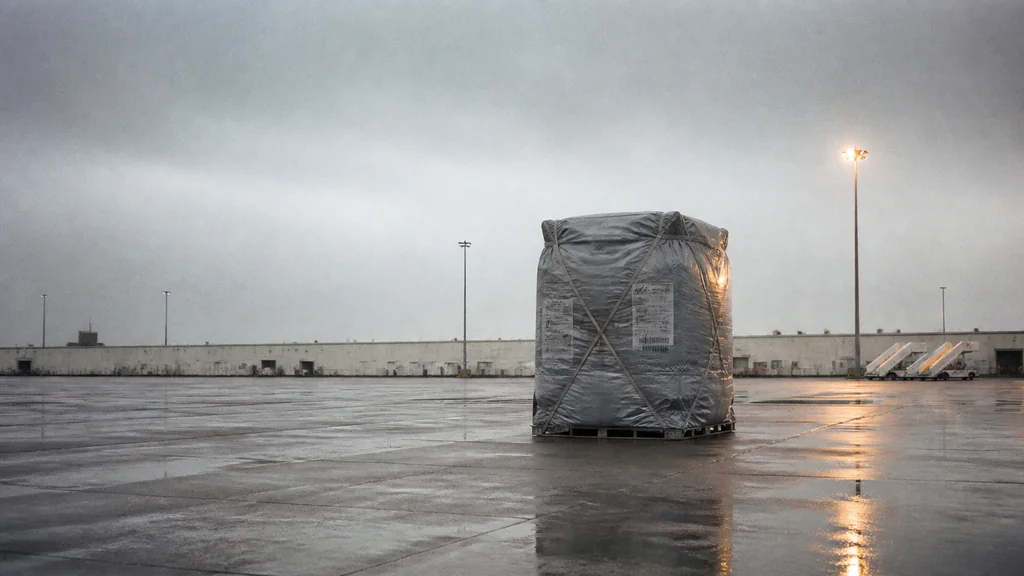
Fewer parcels cross the border, while the goods find another form.
Cumadóireacht íomhá · tobriefThe first signs of Europe’s new tax on cheap online imports are coming not from Brussels, but from customs sheds and airport cargo halls.
In July, Slovenia’s customs authority processed 8,955 low-value import shipments, about 40% fewer than in June (24ur). Belgium, which is a much bigger gateway for e-commerce, saw much the same pattern. Parcels moving through Liège Airport fell 41% in a month, while customs declarations in the Liège zone were down 67% compared with June (RTBF, La Libre). These are among the first hard figures showing what changed after the EU began charging a flat duty on low-value imports.
The mechanism is blunt enough. Since 1 July, every parcel worth up to €150 sent from outside the EU to a buyer inside the bloc faces a flat €3 customs duty per product category, meaning per type of good in the box (EUR-Lex, Ship24). Five identical T-shirts count as one charge. A parcel containing a phone case, a charger and sunglasses counts as three (CEC Spain). The duty comes on top of import VAT, the sales tax already due when goods enter the EU, and replaces the old exemption that allowed these low-value goods in duty-free. Brussels has framed it as a two-year bridge while it builds a broader customs data system (EUR-Lex), as we covered when the measure and France’s separate environmental surcharge came into force (To Brief).
Fewer parcels, not necessarily fewer goods
Belgium’s figures tell a more complicated story than a simple consumer retreat. While small e-commerce parcels through Liège dropped sharply, total cargo tonnage rose 4%. Shipments worth more than €150 increased 10% (Breakbulk News, L'Avenir). Fewer cheap parcels were being declared at the border, but that does not mean fewer goods were entering Europe.
The likely adjustment is logistical. Sellers can bundle orders into larger consignments, clear customs once, and then split the goods for delivery after they are inside the EU. Platforms such as Shein and Temu can also move stock into European warehouses, so the final delivery to the buyer is treated as an intra-EU shipment and never shows up in these customs counts (Business Insider Polska).
There is some evidence, though, that shoppers have changed behaviour too. In Poland, Temu’s user base fell from 16.68 million in June to 13.6 million in July, a drop of more than 20%. AliExpress lost more than 15% (RMF24, Puls Biznesu). Those are audience figures rather than transaction records, so they do not settle the question. But they suggest that at least part of the disruption is real demand, not just clever routing. Germany, the EU’s largest consumer market, has not yet published comparable data.
A flat fee that hits cheapest purchases hardest
Belgium collected €42.5 million from the new duty in July alone (RTL, L'Avenir). EU-based retailers are the obvious winners. The old exemption allowed non-EU sellers to send goods into the single market duty-free while European competitors carried the full burden of tax, labour and compliance costs. That gap has now narrowed.
The losers are buyers of the cheapest goods. On a €5 item, a €3 duty adds more than half the original price before VAT and delivery are considered. Shein has already indicated that it will raise European prices (Cinco Días). Because the charge is flat rather than percentage-based, it bears down hardest on the smallest purchases.
Large platforms have another advantage. Shein and Temu can absorb the administrative burden, rework their supply chains and place stock in European warehouses, turning imports that would have been dutiable into deliveries within the EU. Smaller cross-border merchants do not have the same room to manoeuvre (DHL). The policy reduces one unfair advantage enjoyed by non-EU sellers, but it may also strengthen the platforms big enough to build around the rule.
The first month shows that the duty has changed how goods cross the EU border. It does not yet show that European demand for cheap online imports has collapsed. To answer that, you would need platform transaction data, carrier volumes and consumer spending figures. Customs authorities, carriers and platforms have pieces of that picture, but they have not yet released them.
Details about this article
- Model:
- claude-opus-4-6
- Generated:
- 8/17/2026, 2:03:42 AM
- Pipeline run:
- eu_pipeline_20260817_005006
- Watermark:
- SynthID (Google's invisible watermark)
- Human review:
- None before publication