French reactor squeeze drives power past €300
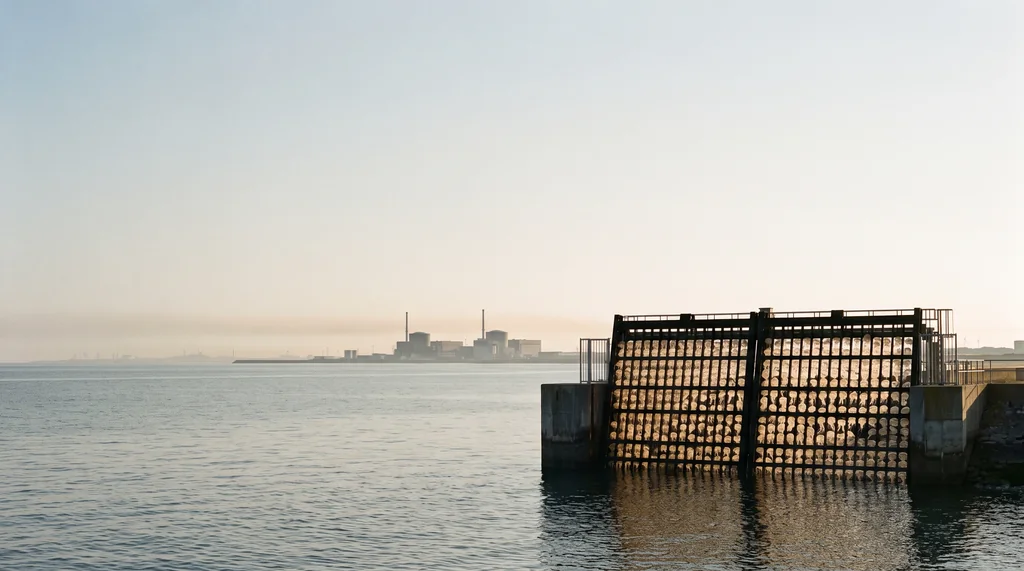
A narrow cooling bottleneck sends the price of power across borders.
Cumadóireacht íomhá · tobriefThe 20.4% figure that made the headlines was true, but only in the way a photograph is true. AFP calculated it from EDF reactor notices before 10:00 on 12 August, the moment when the largest share of France’s nuclear fleet was marked unavailable for environmental reasons (Europe 1, France 24). Some reactors were still producing, just not at full strength. The harder story is what happened when that missing output met high demand.
Day-ahead electricity prices, the price buyers pay today for power delivered tomorrow, rose 21.8% in France to €142.50/MWh and 22.8% in Germany to €138.50/MWh (Euronext/Reuters, Oilprice). By evening, solar generation was fading but air-conditioning demand was still there. Same-day trading prices in both countries climbed above €300/MWh (The Edge).
13 reactors, two problems
France has 57 nuclear reactors. On the day in question, 13 were affected: eight fully stopped and five running below capacity (Euronews, Barron's).
The familiar problem was hot rivers. French nuclear stations use river or sea water to cool their systems, then return that water warmer than before. Environmental rules cap the temperature of the water going back into rivers, because fish and downstream ecosystems cannot simply be asked to cope with the arithmetic of the power market. When the Garonne reached 28°C, the Golfech plant had to reduce output.
At Chooz, near Belgium, low flow on the Meuse triggered a Franco-Belgian water-sharing agreement. The reactor stopped entirely to preserve supply for downstream users in both countries (EDF Chooz, Franceinfo). Plants on the Rhône faced similar constraints.
The less familiar problem was jellyfish. At Gravelines, France’s largest nuclear site on the North Sea coast, a mass arrival blocked cooling-water intake pumps. EDF shut three units and reduced a fourth, pushing environmental unavailability above the previous record of 15.6%, set only two days earlier (EDF, Le Figaro).
Scarcity in France, higher bills next door
Europe’s power markets are tied together through daily auctions, so a shortage in France does not stay politely inside France. When cheap nuclear generation falls away, more expensive gas-fired plants are called on. In the usual market design, the last plant needed to meet demand sets the price for that hour. That means gas can price the whole market even when much of the electricity is coming from cheaper sources.
The squeeze became tighter because German wind output fell to 4.7 GW, about 60% below the seasonal norm (Euronext/Reuters). Two of Europe’s biggest sources of low-cost electricity weakened at the same time. Then evening arrived, and solar did what solar does.
The European Commission said on 11 August that the system remained stable, with interconnectors moving power towards the regions under most pressure (European Commission). No country lost supply. But an electricity system can keep the lights on and still send a nasty bill afterwards.
Dutch households on dynamic contracts, where the retail price follows wholesale rates hour by hour, felt that most directly (NL Times, Welingelichte Kringen). Italy, a large buyer of French power, saw available exports shrink in a similar June episode from around 10–12 GW to roughly 3 GW (DW). Romania’s Cernavoda Unit 2 was already offline after drought on the Danube cut its cooling supply, tightening southeastern Europe separately.
There were winners too. Gas plant owners and battery operators sold into those higher prices. Their fuel costs, or the cost of stored power, did not rise in the same hour, so the spread between what they paid and what they earned widened.
Small annual losses, expensive hours
EDF’s argument is that climate constraints make only a small dent in annual output. The historical record largely backs that up. Losses stayed below 1% of French nuclear production in almost every year from 2000 to 2022, reaching about 1.5% only in the extreme summer of 2003 (DW). The company plans to spend roughly €9 billion over 15 years adapting its fleet to higher temperatures (Le Monde).
The annual average, though, is a comfortable place to hide an uncomfortable cost. The pain falls on households and businesses buying electricity in the hours when several reactors cut output at once. Annual nuclear losses can remain small while the market impact is large, because electricity becomes expensive quickly when low-cost supply disappears during peak demand.
Whether EDF’s adaptation spending reduces those expensive peak-hour losses, or mainly limits the total amount of energy lost across the year, will be the test. RTE, France’s grid operator, and the market data from future heatwaves will show which version is true.
Details about this article
- Model:
- claude-opus-4-6
- Generated:
- 8/13/2026, 1:59:59 AM
- Pipeline run:
- eu_pipeline_20260813_005005
- Watermark:
- SynthID (Google's invisible watermark)
- Human review:
- None before publication