Freyja’s €1 Million Gap
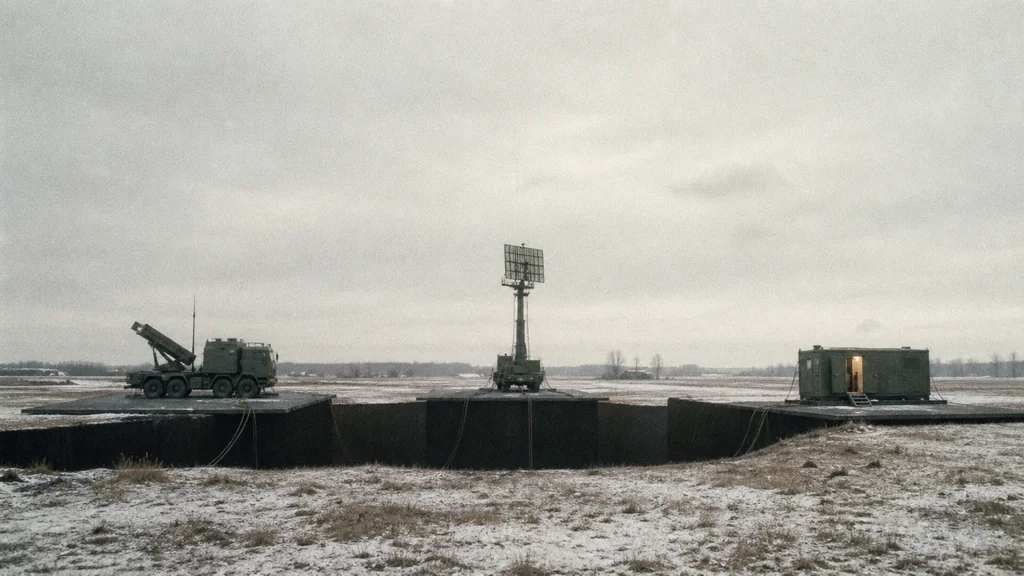
Europe has assembled the partners, but not yet the shield.
Cumadóireacht íomhá · tobriefEurope has spent much of the war in Ukraine learning the same hard lesson: air defence is never just about missiles. A missile on a launcher is only the visible part of the system. The harder work is making radar, sensors, command software and guidance talk to one another quickly enough to hit something moving at ballistic speed.
That is the gap at the centre of Freyja, the Ukrainian-led plan to build Europe a cheaper shield against ballistic missiles. Ten governments are attached to it. The industrial names are no longer vague. But the proof that would move Freyja from promise to capability has not yet been shown: there has been no demonstrated intercept in which the missile, radar, seeker and command centre work together against a ballistic target.
Fire Point, the Ukrainian company behind the FP-7X interceptor, told Reuters in early August that it had signed agreements with more than a dozen European defence firms (Boursorama/Reuters). Its chief executive, Iryna Terekh, described the present stage to Defense News as the hardest part: integrating the Ukrainian missile with European-built radars, seekers and command systems (Defense News).
The political cover arrived on 13 July, when Ukraine, Denmark, France, Germany, Italy, the Netherlands, Norway, Spain, Sweden and the UK launched an Integrated Anti-Ballistic Missile Coalition in Paris (President of Ukraine, Forces News). The coalition is broad. The practical work is much narrower.
Three companies hold the chokepoints
Ukraine is building the missile and launcher. The European partners are being asked to provide the parts that turn a missile into a usable defence system: radars, seekers, sensors and the software that links them (Censor.NET). So far, three companies carry most of the known weight.
Germany’s Hensoldt has agreed to integrate its TRML-4D radar. Its chief executive, Oliver Dörre, said the project had political momentum, while also warning that it was too early to talk about revenue (defence-industry.eu). Norway’s Kongsberg is building the command centre, the point at which radar information becomes a firing decision (RBC Ukraine). Germany’s Diehl Defence is linked to seeker and guidance work. Fire Point’s production targets depend on German-made infrared seekers arriving at its assembly line (TVP World, Interfax-Ukraine).
Fire Point says it has conducted at least five interceptor tests. The available evidence points to missile or subsystem tests, rather than a full system-level ballistic intercept (English NV).
Frontline states are watching, not buying
The countries closest to the Russian missile threat are treating Freyja as a project for Ukraine, rather than a procurement route for themselves. Poland’s debate is still centred on deeper Patriot cooperation with the US and Ukraine, not on entering Freyja’s supply chain (Rzeczpospolita, Militarnyi). Romania is framing it in much the same way: useful for Ukraine, while its own air defence remains tied to Patriot (Digi24).
That matters because political sponsorship is not the same as industrial commitment. Most of the ten signatory governments are lending weight to the idea. The real engineering burden sits with a small number of firms in three countries.
The sequence that has not started
Fire Point is aiming for its first ballistic-target intercept around mid-2027. If it succeeds, it would prove the concept can work once. It would not, by itself, make Freyja operational (Defense News, Battle Policy).
The promised price is below €1 million per interceptor, roughly a quarter to a sixth of the cost of a Patriot round. That figure depends on serial production. It is not a price proven by today’s tests (Army Recognition, Boursorama/Reuters).
The headline goal of 2,000 interceptors a year also depends on imported German seekers. That makes Freyja a licensing and supply-chain problem before it becomes a factory problem (Tiscali). Terekh has said herself that Fire Point is trying to compress a programme that would normally take decades into a few years.
The European Commission’s latest defence disbursement follows the same broad logic: build production capacity rather than empty Western stocks (European Commission). That logic will be familiar to any smaller European state watching the war and wondering how long US-made stocks can remain the answer.
But Freyja’s credibility depends on a sequence that has not yet begun: a live intercept, repeated tests, signed production orders and parts delivered at scale. Until Fire Point and its European partners can show that chain, Freyja is an integration project, not a defence layer. The technical answers are owed by Hensoldt, Kongsberg and Diehl. The political answers sit with the ten governments: money, export licences and binding orders.
Details about this article
- Model:
- claude-opus-4-6
- Generated:
- 8/9/2026, 1:53:29 AM
- Pipeline run:
- eu_pipeline_20260809_005005
- Watermark:
- SynthID (Google's invisible watermark)
- Human review:
- None before publication