Germany’s €500bn Fund Delivers Little
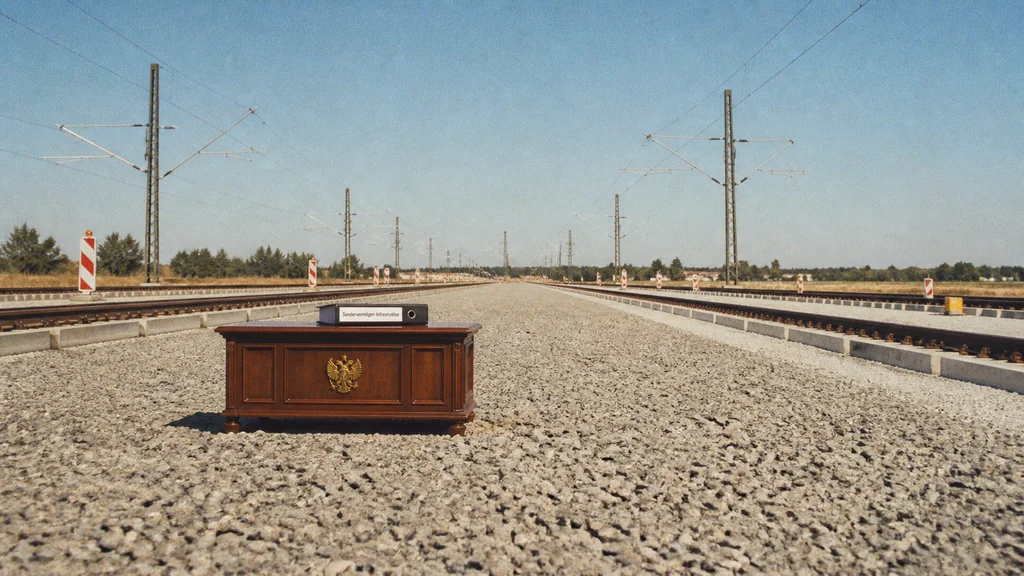
Germany’s borrowing apparatus arrives before the infrastructure it promised.
Cumadóireacht íomhá · tobriefGermany’s €500 billion infrastructure fund sounds, at first hearing, like the kind of fiscal bazooka Berlin usually tells other countries to put away. It is not cash in reserve. It is permission to borrow, written into the German constitution in March 2025, so the federal government can raise debt for roads, railways, hospitals and climate projects over twelve years.
That matters because Germany normally lives under the debt brake, a constitutional rule that limits the federal structural deficit to 0.35% of GDP (Bundestag WD 4-032-26). The new fund sits outside that rule. The federal budget pays the interest, while repayments begin no earlier than 2044.
The split is clear enough: €300 billion for federal investment, €100 billion for state and local governments, and €100 billion for the Climate and Transformation Fund (BMF FAQ, Bundesregierung). The promise is enormous. The first year tells a more awkward story.
Borrowed Money That Replaced Old Spending
In 2025, the German government borrowed €24.3 billion through the fund. Federal investment, however, rose by only €1.3 billion on the previous year (ifo). The ifo Institute’s conclusion was blunt: 95% of the new debt did not finance additional infrastructure. It replaced spending that had already been planned in the normal budget.
The IW economic institute, using a different method, reached a similar place. It put the substitution rate at 86%, finding that about €12 billion had simply taken over items the ordinary budget would previously have covered (Tagesschau).
The trick lies in the mechanism. The law says the ordinary budget must keep investment above 10% of total spending before money from the fund can be used. For 2026, the government reports 10.5%, just over the threshold (BMF Sollbericht 2026).
The Bundesbank’s point is that this proves less than it seems. That ratio was already above 10% before the fund existed (Bundesbank). Berlin can therefore pass the legal test while shifting existing investment into the new vehicle, leaving more space in the regular budget for other spending.
The Finance Ministry rejects that interpretation. Its April 2026 analysis says €168.3 billion in planned fund investments between 2025 and 2028 are genuinely additional, about 95% of the total (BMF April 2026). But the ministry is counting allocations on paper. Its critics are looking at what has actually changed in spending.
Germany’s federal auditor, the Bundesrechnungshof, took the critics’ side. It identified roughly €16 billion in rail construction grants for 2026 as a prominent case of relabelling: expenditure already under way, now booked through the fund (Handelsblatt).
By late July 2026, €51.1 billion had been disbursed, about a tenth of the total envelope (Zeit).
Why the Rest of Europe Is Watching
If the money eventually turns into real construction orders, the effects will not stop at Germany’s borders. About 28% of Polish exports go to Germany, much of it industrial components, so a genuine investment push would feed directly into Polish suppliers (Rzeczpospolita). The Bundesbank estimates that infrastructure and defence spending together could add around 1.3 percentage points to German GDP over 2025–2028 (Bundesbank).
For the rest of the EU, the sharper issue is political. Germany has created a constitutional route around its own fiscal rules while remaining the member state most associated with resistance to looser EU-wide borrowing limits.
France cannot simply copy the move. It is already in the EU’s excessive-deficit procedure, the process used when a member state breaches the bloc’s deficit or debt rules. Paris is paying 4.10% on ten-year bonds, against Germany’s 3.25%, and the public-debt gap between the two countries is more than 50 percentage points of GDP (Le Monde, Sénat).
Italy has spotted the asymmetry too. Finance minister Giancarlo Giorgetti has argued that if the EU allows borrowing flexibility for defence, the same logic should apply to energy security (ANSA). Germany can borrow cheaply for priorities it defines as strategic. Higher-debt countries that try the same approach face a heavier bill because markets charge them more.
Ireland’s interest is less immediate than Poland’s, but the principle is familiar. EU fiscal rules are never just about numbers; they decide which states can invest through a downturn and which must ask permission. Dublin learned that during the Troika years, even if Ireland’s argument today is usually made from a stronger place.
The German fund is real law, backed by the constitution. What it has not yet shown is that it can deliver genuinely new investment on the scale implied by the borrowing. In 2025, €24 billion in debt produced roughly €1 billion to €2 billion in extra spending. If 2026 follows the same pattern, Germany will have built an elaborate legal machine for borrowing at scale while its roads, bridges and railways improve at only a fraction of the pace the debt suggests.
Details about this article
- Model:
- claude-opus-4-6
- Generated:
- 8/24/2026, 1:50:46 AM
- Pipeline run:
- eu_pipeline_20260824_005006
- Watermark:
- SynthID (Google's invisible watermark)
- Human review:
- None before publication