Greece’s €3bn Air Shield Gap
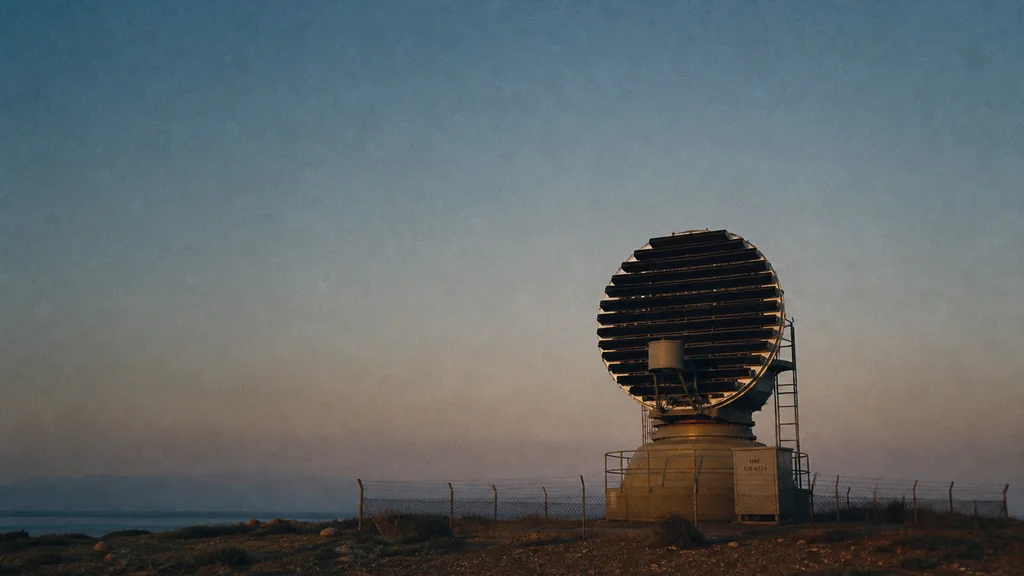
Greece buys a shield while its terms remain beyond public view.
Cumadóireacht íomhá · tobriefThe signing room and the questions left outside it
On 31 August in Tel Aviv, Greek and Israeli defence officials put their names to what both governments are presenting as one of their biggest arms agreements: a €3.035 billion contract for a layered air-defence system built around Israeli technology (Defense News, Jerusalem Post). Israeli prime minister Binyamin Netanyahu cast it as part of the Eastern Mediterranean alignment with Greece and Cyprus (ProtoThema English). A separate €26 million Drone Dome contract will protect strategic sites against unmanned threats (euronews.com).
A signed contract, though, is not the same thing as a working shield. The agreement gives a 35-month delivery horizon, taking Greece roughly to July 2029. Before then, Athens has to build a national command network, integrate radars and data links, train crews, buy and store interceptors, and pass acceptance tests. Poland's comparable Wisla programme, as described by GeekWeek/Interia, ran from a 2018 contract to initial readiness only in December 2024. The Greek timetable is a promise of delivery, not a battlefield capability.
The system brings four elements under one command structure: SPYDER for low-flying aircraft and drones, BARAK MX for cruise missiles and tougher aerial targets, David's Sling for ballistic missiles, and Drone Dome for point defence (Meta-Defense). The military logic is straightforward enough. You match the cost of the interceptor to the value of the threat, rather than using expensive missiles to shoot down cheap drones.
What Athens won't publish
The most serious accountability problem is the part the public cannot examine. No published annex says how many launchers, missiles or radars Greece is buying. The deployment sites, reload stocks and long-term maintenance costs remain classified (Naftemporiki, Strategist Cyprus).
The software question may matter even more than the hardware list. Athens says it has secured "source-code access", but it has not said whether that means full access to the code, escrow rights, permission to make local changes, or only control over interface-level settings (Strategist Cyprus). That difference decides whether Greece controls its own threat libraries and software updates, or remains dependent on Israeli vendors for the lifetime of the system. The government says 19 Greek companies will receive more than 25% of the contract value (ERTNews). Industrial workshare is not the same thing as sovereign control.
The secrecy gives opposition parties two lines of attack: the relationship with Israel and the absence of public scrutiny. New Left said Athens is tying the country's defence to a state accused of genocide in Gaza, while KKE described the strategic partnership as an escalation (in.gr).
National urgency vs. European solidarity
The deal tells a wider European story. Greece is not the only NATO member buying Israeli systems: Germany bought Arrow interceptors through the European Sky Shield Initiative, Berlin's coalition for joint air-defence procurement (BMVg). Athens, however, has gone further by building an entire national shield around non-European suppliers.
That sits awkwardly beside Brussels' push for Europeans to buy more defence equipment together, and from European producers, through programmes such as EDIP, the European Defence Industry Programme, and SAFE, the EU's new fund for defence investment (European Commission, Council). Irish readers will recognise the tension in a different register: EU defence co-operation is increasingly practical and industrial, but it still lands differently in member states with different threat perceptions and political traditions.
France has most reason to feel the rub. Paris renewed its strategic partnership with Athens in April 2026, and Greece has already spent billions on French Rafale jets and Belharra frigates (Marine & Océans). A French Senate report identifies air and missile defence as precisely the area where Europe should stop buying fragmented national systems (Sénat). France's own SAMP/T system was a direct competitor.
Athens made another calculation. Israel is selling systems tested in real missile warfare, and Greece believes it faces immediate threats. European industrial solidarity loses ground when capitals under pressure can find proven non-European suppliers faster and cheaper.
Cypriot coverage welcomed the agreement as a regional signal, but researchers found no evidence that the system will operationally cover Cyprus or its critical infrastructure (PhileNews). As DW reported, this is a bilateral contract, not an alliance umbrella.
Greece has committed €3 billion to an air-defence system whose sovereignty terms remain buried in unpublished annexes. The Greek parliament should see those terms before approving the spending. EU defence officials, meanwhile, have to explain how their joint-procurement agenda survives when member states facing real threats continue to buy national shields from outside Europe.
Details about this article
- Model:
- claude-opus-4-6
- Generated:
- 9/1/2026, 2:03:24 AM
- Pipeline run:
- eu_pipeline_20260901_005007
- Watermark:
- SynthID (Google's invisible watermark)
- Human review:
- None before publication