Hungary Stalls Ukraine’s EU Talks
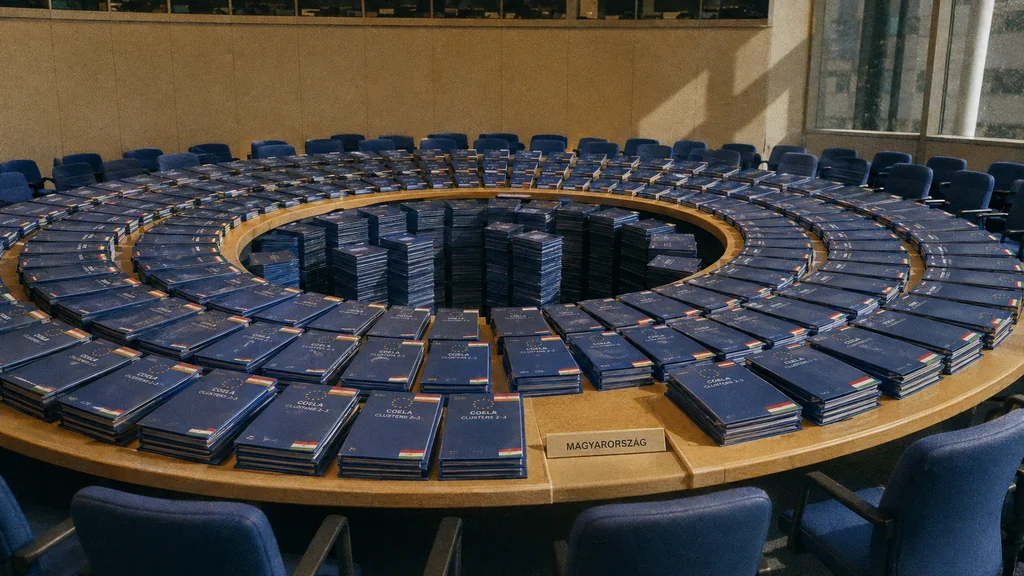
Hungary’s repeated reservation buries Ukraine’s cleared negotiations beneath procedure.
Cumadóireacht íomhá · tobriefHungary did not kill Ukraine's EU bid on 1 September. It did something narrower, and in Brussels terms more effective: it stopped the Council from converting the European Commission's technical sign-off into real negotiations on the rules that make the single market work (European Pravda, Euronews Germany).
Kyiv had passed the exam. Budapest blocked the meeting where the result was meant to count.
The Gate That Requires Every Government to Say Yes
EU accession is not decided in one dramatic vote. It is a long procession through locked gates, and every one of the 27 governments has a key. Ukraine applied in February 2022, received candidate status that June, and opened its first cluster of EU law in June 2026. A cluster is a thematic bundle of rules a candidate country must take into domestic law. A second cluster followed in July.
Before any cluster opens, member-state diplomats must approve the Commission's screening work. That happens in COELA, the Council working party that handles enlargement. The Commission finished screening Ukraine in September 2025 and judged it technically ready to move on. But the Commission cannot open talks by itself. Each national government must consent. Hungary refused. By 2 September, Ukraine and Moldova had reportedly been removed from the next COELA agenda.
The two blocked clusters are the substance of membership, not diplomatic decoration. Cluster 2 covers the internal market: free movement of goods, workers, services and capital, as well as competition and financial-services rules. Cluster 3 covers taxation, social policy, education and the customs union (EUR-Lex). Together, they are the practical work of preparing Ukraine to operate inside the EU economy.
Budapest's Condition — and Romania's Alternative
Hungary says the issue is minority rights. It wants Ukraine to show visible progress on a bilateral deal agreed in June 2026, covering education, language use and political representation for roughly 100,000 ethnic Hungarians in Transcarpathia (444, Budapest Times). Ukraine's ambassador said Kyiv would start implementing the first tranche in September, with other points running to May 2027 (ua.news).
The complaint is not made up. Ukraine's 2017 education law restricted minority-language schooling, and the Venice Commission, the Council of Europe's constitutional advisory body, has recognised progress in later reforms while asking for further safeguards. What changed is the test Hungary is applying. Budapest has moved from seeking commitments to demanding visible implementation before any new cluster can open.
Romania shows the choice involved. Bucharest has its own dispute with Kyiv over Romanian-language education. But it has used a bilateral strategic partnership and a revived joint minority commission to press the issue, without blocking Ukraine's EU track (Agerpres, DW România). The grievance is of the same family. The instrument is different. Bucharest is using pressure; Budapest is using a brake.
Hungary also tried to let Moldova's cluster move while keeping Ukraine's blocked, a split most member states rejected (European Pravda). That makes it harder to present the veto as a neutral application of enlargement standards.
No Bypass, No Fix
There is no clean legal route around Hungary. Article 49 of the EU Treaty, the accession clause, leaves member states in control of enlargement, and there is no verified mechanism for 26 governments to open Ukraine's clusters over a Hungarian objection (Article 49 TEU). Germany's foreign minister has argued for reducing unanimity in the EU, but that push concerns foreign and security policy decisions, not enlargement (Tagesschau). Lithuania sees the block as a geopolitical delay that helps Moscow (LRT). Poland supports strict accession conditions, but opposes one state turning bilateral demands into a stop sign for the whole Union (RMF24).
The timing is awkward for another reason. Budapest is also negotiating over its own EU funds, having claimed on 31 August that it had met all conditions to unlock about €10 billion in frozen recovery money. There is no public evidence linking the Ukraine veto to a funds-for-veto bargain. Still, the two files are open in the same building, in front of the same governments, at the same time.
Minority rights absolutely belong in accession talks. The EU's weakness is institutional. Its treaties still offer no good answer when a legitimate condition becomes a national veto over the pace of a wartime candidate's integration.
How was this article?
Help us get better
Help us get better
Details about this article
- Model:
- claude-opus-4-6
- Generated:
- 9/3/2026, 2:03:51 AM
- Pipeline run:
- eu_pipeline_20260903_005007
- Watermark:
- SynthID (Google's invisible watermark)
- Human review:
- None before publication