Ireland’s Export Slump Misleads
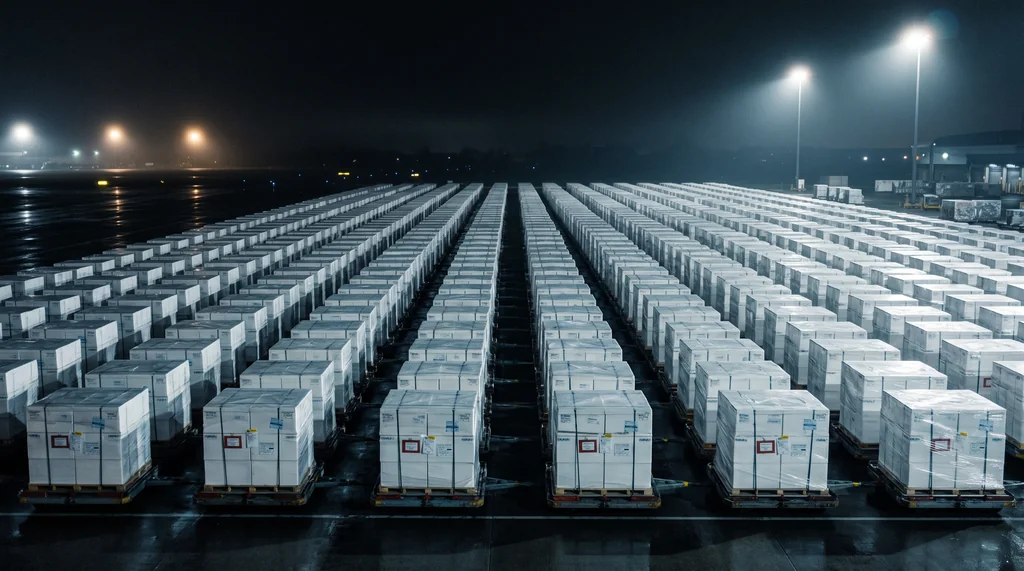
A rush of shipments leaves Ireland counting an artificial collapse.
Cumadóireacht íomhá · tobriefIrish goods exports to the United States fell 65.1% in the first half of 2026 compared with the same period last year. The provisional figure, from the Central Statistics Office, is real (CSO, The Journal). It is also one of the easiest trade numbers in Europe to misread.
What happened was not a straightforward collapse in demand. In early 2025, pharmaceutical companies pushed shipments into the US ahead of expected tariff increases. That practice, known as front-loading, means goods are shipped early to avoid a looming cost. It lifted Irish exports to the US to about €75.1bn between January and June 2025. Once that rush passed, exports in the first half of 2026 fell back to €26.2bn (CSO, Irish Examiner). The 65.1% figure is measuring the gap between an inflated peak and something closer to normal shipping behaviour.
June gives a better sense of the current run-rate. Ireland shipped about €4.3bn of goods to the US that month, just 1% below the same month a year earlier. A CSO spokesperson said comparison with 2025 "remains difficult" because the tariff-related figures were so inflated (Irish Times).
Why Ireland exaggerates the signal
Ireland’s trade figures are unusually exposed to decisions made by a small number of multinationals in pharmaceuticals, chemicals and technology. A change in inventory planning by one large company can move the national numbers by billions. Medical and pharmaceutical exports fell by more than half to €38.8bn in the first half of the year. Computer exports, meanwhile, rose from €3.5bn to €8.8bn (Independent.ie). That had little to do with tariffs. It reflected AI hardware demand and the product cycles of a few firms.
This is familiar territory for Irish readers. The headline trade and output figures often tell you more about multinational logistics than about the domestic economy. Ireland’s GDP, already distorted by multinational accounting and inventory shifts, followed the same pattern: a 7% fall in the first quarter as stockpiling unwound, followed by a 3.9% rebound in the second quarter, according to CSO estimates (RTE).
The US route fell sharply, but the rest of the map did not. The decline in exports to the US alone came to €48.9bn. Total Irish goods exports fell by €45.4bn (CSO, The Journal). Exports to Great Britain rose 42.6%, while exports to the rest of the world increased 23% (Irish Examiner). Non-US destinations together added roughly €3.5bn.
Across the EU, the story looks much less dramatic. Eurostat’s first estimate shows extra-EU goods exports down just 2.1% in the first half of 2026. In June, EU exports to the US rose 10.8% year-on-year to €45.7bn (Eurostat). Ireland magnifies the transatlantic signal because so much of its export performance is concentrated in a few multinational supply chains. Europe’s average condition is far milder.
Where the damage is quieter and more real
The tariff damage is clearer in places where front-loading cannot hide the underlying pressure. Germany’s goods exports to the US fell by about 6% in the first half of the year. That is a smaller headline than Ireland’s, but it is spread across a much broader industrial base. German direct investment into the US dropped 65% to €4.3bn, according to IW analysis of Bundesbank data (WirtschaftsWoche, Zeit). The auto industry had lost 42,300 jobs by the end of June, down 5.8% from a year earlier (Handelsblatt). Those are factory jobs, not booking entries.
Italian wine exporters have felt the pressure too. Exports to the US fell 15.4% in value between January and May, while the average price per litre dropped from €5.57 to €5.01 (Vinetur). When volume and pricing weaken together, the problem is margins, not timing.
Scale decides who can carry the cost. In the Netherlands, multinationals including Heineken and Philips recovered US tariff overpayments through import subsidiaries (NRC). Brouwerij Huyghe, a Flemish brewer, got several hundred thousand euros back, but told reporters the economic damage had already been done: lost orders and damaged customer relationships that a refund months later could not repair (Nieuwsblad).
The Irish figures are provisional and will be revised. Even taken at face value, the 65.1% fall overstates the current collapse while still revealing the real advantage in a tariff shock. The firms best placed to cope are those large enough to front-load shipments, absorb delays and reclaim duties. Smaller European exporters face a harder equation. Lost orders and thinner margins do not correct themselves.
Details about this article
- Model:
- claude-opus-4-6
- Generated:
- 8/19/2026, 1:58:27 AM
- Pipeline run:
- eu_pipeline_20260819_005007
- Watermark:
- SynthID (Google's invisible watermark)
- Human review:
- None before publication