Italy Leaves SAFE Loans Untapped
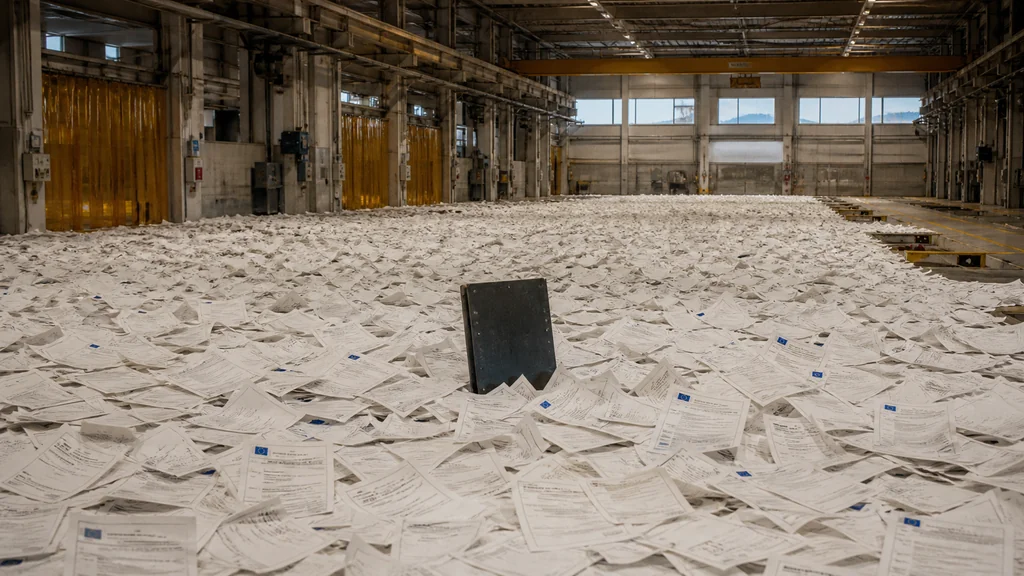
Rome funds one order while unanswered billions fill the factory.
Cumadóireacht íomhá · tobriefItaly has decided to take only part of the defence money Brussels had pencilled in for it. Rome asked the European Commission for roughly €8-8.9 billion in loans, about half the €14.9 billion that had been tentatively set aside (Il Fatto Quotidiano, Eunews). The scheme is SAFE, or Security Action for Europe, a €150 billion EU facility under which the Commission borrows centrally and lends on to member states for defence procurement. The attraction is obvious: Brussels can raise money more cheaply than many capitals can on their own. The catch is just as obvious: the loan still sits on the national books.
The timing made the Italian choice harder to miss. Romania received its first €2.5 billion SAFE payment and is already turning it into contracts for Lynx infantry vehicles, Mistral air-defence systems and Airbus helicopters (EC Romania, HotNews). Poland had already signed a €43.7 billion agreement and drawn down €6.6 billion in pre-financing (European Commission, Notes from Poland). The countries that moved early are converting EU credit into factory orders. Italy's smaller request asks a more basic question: when cheap money is available, how many governments will still choose not to borrow it?
Coalition compromise, not budget logic
SAFE was created under Council Regulation 2025/1106, but it is not a grant dressed up as solidarity. Every euro Italy borrows through the facility becomes Italian debt, and every party in Rome has to explain why defence spending should rise when public services are already under strain.
That is where Giorgia Meloni's coalition ran into itself. Foreign Minister Antonio Tajani of Forza Italia publicly backed taking the full allocation at a conference in Rimini. Matteo Salvini's Lega resisted higher defence borrowing. Finance Minister Giancarlo Giorgetti accepted that the terms were favourable, but the government still cut the drawdown roughly in half (Il Foglio). Tajani presented the retreat as a shift in priorities, saying Italy needed to invest more in healthcare and social policy after changed conditions linked to the Iran conflict (Il Fatto Quotidiano, PAP). The public record does not show whether Lega pressure, Treasury caution or a Meloni compromise carried the day. In practice, Rome asked for half.
Spain has offered a smaller version of the same politics. Madrid requested just €1 billion, while Sumar, the junior coalition partner, openly opposed increases in defence spending (EFE, El Confidencial). EU credit may be cheap, but domestic politics still decides whether the debt is bearable.
The queue behind Rome
Italy's hesitation mattered beyond Italy. SAFE is a fixed pot. Commission spokesperson Thomas Regnier had pressed Rome for clarity because money left idle cannot be reallocated until the Commission knows what is genuinely unused (Euronews). The roughly €6 billion Italy has left behind, together with Hungary's unresolved request, creates a pool Brussels can reopen in a second call before the end of 2026 (Euractiv, Council).
Poland is already preparing to move. Deputy Defence Minister Paweł Zalewski confirmed that Warsaw wants to compete for extra SAFE money in that second round (Bankier/PAP). Polish press reports suggest as much as €10 billion could become available, though that depends on the final Italian and Hungarian positions and remains speculative (RMF24).
Hungary's delay is of a different order. A new government is reviewing its predecessor's defence investment plan amid corruption concerns, and the Commission had still not cleared Budapest's submission when other states were already approved (Euronews HU). In Budapest, the blockage is about governance. In Rome, it is about whether a governing coalition wants the politics of borrowing for defence.
Who spends first shapes the market
SAFE also comes with an industrial policy built into it. At least 65% European or Ukrainian content is required in procurement, steering contracts towards EU-based manufacturers and fitting neatly with France's long-running argument for greater European defence-industrial autonomy (Council, CMS). The countries drawing quickly are therefore doing more than buying kit. They are shaping order books, supplier relationships and production lines across Europe.
That matters for smaller member states too, Ireland included, even if neutrality keeps Dublin at a remove from the larger defence-integration debate. SAFE is not just a budget instrument; it is one of the ways the EU is deciding which defence industries will scale, which governments will get priority, and which capitals will be left waiting behind earlier movers.
The Brussels system is now in motion. Approvals, agreements and first payments have reached more than a dozen countries. But SAFE rewards governments prepared to carry defence debt now. Italy has shown it is only half prepared, and the money it declined has already become someone else's opportunity.
Details about this article
- Model:
- claude-opus-4-6
- Generated:
- 8/27/2026, 1:56:58 AM
- Pipeline run:
- eu_pipeline_20260827_005006
- Watermark:
- SynthID (Google's invisible watermark)
- Human review:
- None before publication