Italy Blocks All Asylum Transfers
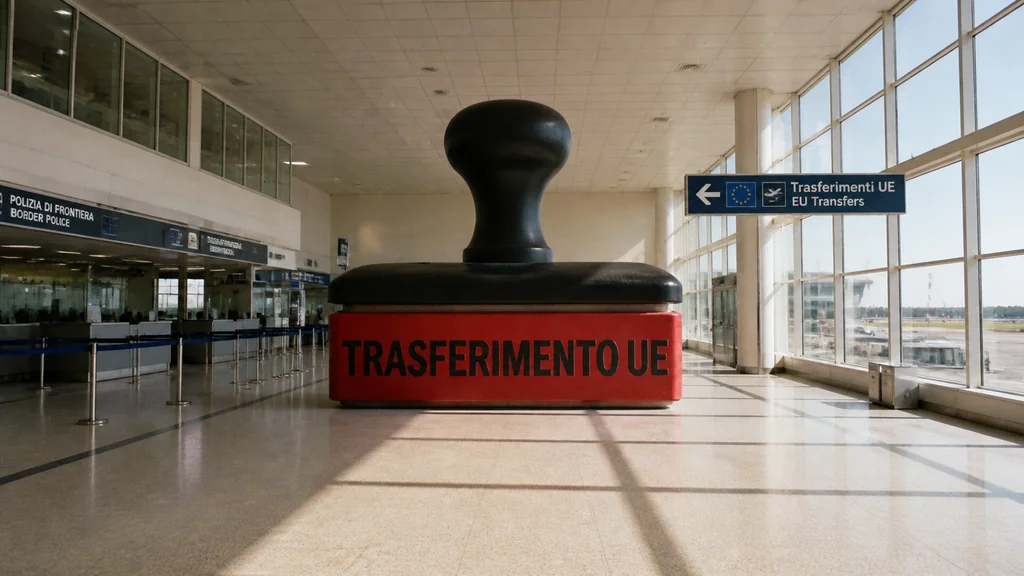
Italy turns Europe’s transfer procedure into its largest obstacle.
Cumadóireacht íomhá · tobriefThe EU's new migration pact has met its first hard test in a place that was always likely to matter: Italy's ports, and Rome's willingness to take people back.
Between 12 June and 7 July, eight EU member states asked Italy to accept asylum seekers under the new rules. Italy refused all 12 transfer requests (2eu.brussels, Visaverge). Rome has blocked incoming transfers since December 2022, with an exception for family cases involving unaccompanied minors.
The European Commission's first review of how the rules are working, published on 16 July, found no sign that the suspension had ended (Commission assessment). The early lesson is plain enough: EU law can decide which state is responsible for an asylum claim. It cannot, by itself, make a government open the door.
Rome's Defence Looks Weak on Paper
Italy's Interior Minister, Matteo Piantedosi, has offered two lines of defence. The first is that older asylum cases involving people who arrived in Italy before 12 June were "zeroed out" through arrangements with Germany and France in late 2025 (Il Sole 24 Ore). The second is that Germany should offset its transfer requests against the roughly 2,200 migrants brought to Italian ports this year by German-flagged NGO rescue ships (Il Foglio).
Neither argument sits comfortably with the law. There is no public text of any bilateral deal erasing old cases in parliamentary records, Council registers or Commission documents. The Commission's assessment deals with Italy's refusals without referring to any such waiver (Commission assessment). EU asylum regulations apply directly across the Union. Two interior ministries cannot quietly set them aside between themselves (AMMR).
The more likely explanation is less diplomatic. Under Dublin III, the old regulation that decided which country handled an asylum claim, Germany had six months to physically transfer a person after Italy accepted responsibility. If Germany missed that deadline, responsibility shifted automatically back to Germany. The EU Court of Justice confirmed that principle in the Shiri case (Dublin III, CJEU Shiri). Rome's claimed "reset" looks very like expired deadlines dressed up as a political arrangement.
The Clock Is the Only Enforcement Tool
The new Pact, formally the Asylum and Migration Management Regulation, was designed to narrow the gap between responsibility on paper and transfers in practice. Take-back procedures are more automatic. The country where a person first entered the EU remains responsible for 20 months, rather than 12 (AMMR, Verfassungsblog).
The Italian stand-off shows what the Pact did not solve: enforcement. The chain is simple. A member state such as Germany asks for a transfer. Italy must accept or propose an alternative. The Commission can assess compliance, publish findings and, eventually, open infringement proceedings, the EU's legal route for forcing a government to obey Union law. Courts can interpret the deadlines. But only Italian authorities can actually put someone on a plane.
Germany's own figures show how weak that chain already was. In 2024, Germany filed 74,583 Dublin transfer requests across the EU, received 44,431 acceptances, and completed just 5,827 transfers, according to Brussels Signal. Roughly one acceptance in eight led to an actual move.
Selective, Not Incapable
One fact makes Rome's position harder to defend. According to NZZ, Italy accepted 51 Swiss take-back requests after 12 June. Switzerland is outside the EU but participates in the Dublin system. That points to political choice rather than administrative incapacity.
Other governments have drawn the same conclusion. The Netherlands sees the stand-off as the Pact's first test of credibility (Upday NL). Austria is watching through the Brenner Pass, the Alpine corridor used by migrants who land in Italy and move north towards Austria and Germany. From Vienna, Rome's refusal looks like the export of a problem Italy was legally meant to manage (Kurier).
The Commission's next broad assessment is due in October. By then, deadlines on the first post-Pact cases will begin to expire. If Italy keeps refusing, responsibility for those asylum claims will shift back to Germany and the other requesting states, not through a negotiated compromise but by the automatic operation of the regulation itself (AMMR). The Pact gave Europe stronger legal grounds to demand Italian cooperation. It did not give anyone the practical power to carry out a transfer that Rome does not want.
Details about this article
- Model:
- claude-opus-4-6
- Generated:
- 8/15/2026, 1:53:13 AM
- Pipeline run:
- eu_pipeline_20260815_005006
- Watermark:
- SynthID (Google's invisible watermark)
- Human review:
- None before publication