Italy Blocks Germany’s Asylum Returns
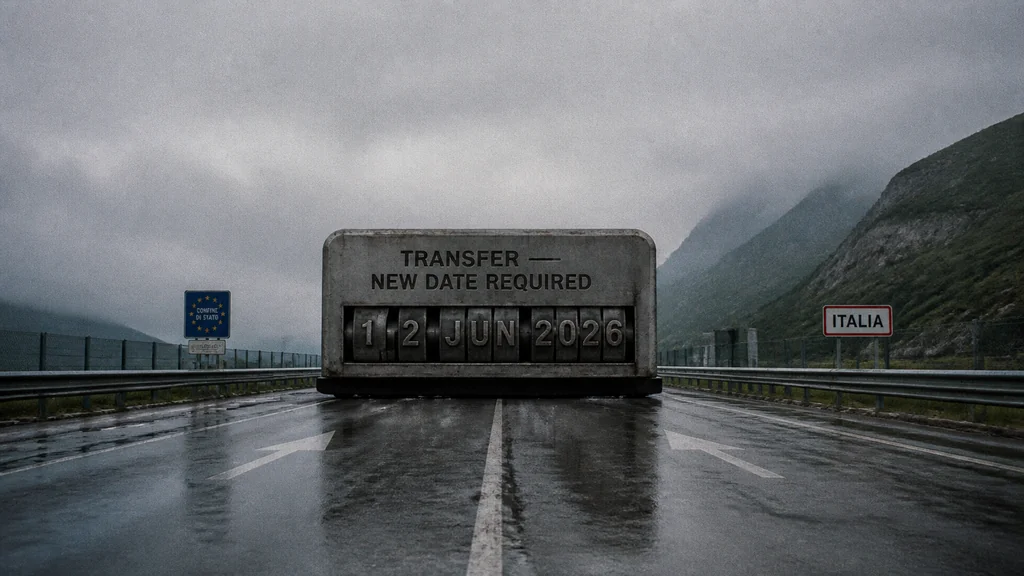
Europe assigns responsibility, but Italy controls when the road opens.
Cumadóireacht íomhá · tobriefMatteo Salvini knew exactly what he was doing when he told a League party rally on 22 August that Germany had "no right" to send back "even one irregular immigrant" while German NGO ships were landing people on Italian shores (ANSA). It was a line built for the room. But the harder work is not being done from his transport ministry. It sits with Interior Minister Matteo Piantedosi, whose department has been quietly refusing German transfer requests since mid-August (Il Messaggero). Salvini gives the dispute its noise. Piantedosi controls the gate.
That difference matters. Behind the rally language is a more serious administrative fight over the EU's new asylum system, barely two months after it came into force.
Which rulebook applies
The argument between Berlin and Rome turns on one date: 12 June 2026. That was when the EU's new Asylum and Migration Management Regulation began to apply, replacing the old Dublin system (EUR-Lex). The basic principle survived the change: the member state where an asylum seeker first arrives or is first registered is usually responsible for examining the claim.
Germany wants to return people to Italy under the new rules. Italy's Interior Ministry says those who arrived before 12 June belong to the old system and cannot simply be treated as new cases (Sky TG24). Rome formally rejected three planned German transfers in mid-August. One involved a 22-year-old Somali woman who had reached Germany in March. She entered church protection in Nuremberg before the transfer date, so the case fell away before it could properly test the new regime (EU Perspectives).
Piantedosi has tried to make the row sound smaller than it is. He told ANSA on 21 August that Italy had received about 50 requests since 12 June but that only three people had actually arrived, calling the controversy "sterile" (ANSA). The numbers are modest. The difficulty for Berlin and the European Commission is that Rome is refusing even at that scale.
Who is pushing, who is holding back
This is no longer just a German-Italian quarrel. Austria has completed four transfers to Italy since the pact began, using cooperative cases where people travelled by train or bus (ORF, Die Presse). Finland is preparing individual transfers, though none has been confirmed as completed (Helsingin Sanomat). The Netherlands says it has begun the process (Adnkronos).
France and Spain are being more careful. Madrid, which is also a first-entry country, prefers to handle pressure through the pact's solidarity instruments: the mechanism that lets member states either take relocated asylum seekers or pay into a common fund (Euronews). Spain has an obvious reason to move slowly. Any precedent that makes large-scale returns to first-entry states routine can later be used against Madrid.
The Commission's first assessment, covering 12 June to 7 July, found that eight member states had submitted requests involving 12 transfers to Italy. Italy rejected all of them. Brussels said a receiving state cannot simply refuse and must propose another date. That was meant to stop refusal by delay. It did not, by itself, move anyone across a border (European Commission, 2EU Brussels).
Rome can say no today; Brussels can punish later
Germany may have the stronger legal argument. Its problem is enforcement. The Commission can open infringement proceedings, the formal EU process used to force a member state back into line. Germany could, in theory, bring a state-to-state case before the Court of Justice, though member states have avoided doing that on migration because it can poison relations for years. Financial penalties come only after a judgment and continued defiance (Article 258 TFEU). None of that gets a transfer carried out next week.
Time is Italy's advantage. If a transfer is not completed within the legal deadline, responsibility shifts back to the sending state, as the Court of Justice ruled in its 2017 Shiri judgment (CJEU, C-201/16). Rome can reject a request, dispute the category, demand a new date and connect cooperation to the issue of NGO rescue ships. EU asylum law does not make Germany responsible for a claim because a rescue vessel flies a German flag (EUR-Lex AMMR). Salvini's argument does not have to survive a court test to work politically. It just has to buy time while northern states run down their deadlines.
Austria's four completed transfers show the system can function. They also show the scale of what is functioning: four people, by bus, in two months. The old Dublin system produced 24,152 transfer requests to Italy in 2025 alone, while Germany completed only 5,377 transfers to all destinations combined (Eurostat via Sky TG24). Dublin's old weakness was the gap between assigning responsibility on paper and moving people in practice. Italy has found the new pact's version of the same weakness: EU law can decide responsibility faster than Brussels can enforce it.
Details about this article
- Model:
- claude-opus-4-6
- Generated:
- 8/23/2026, 1:54:39 AM
- Pipeline run:
- eu_pipeline_20260823_005006
- Watermark:
- SynthID (Google's invisible watermark)
- Human review:
- None before publication