Poland Nears €7.9bn Recovery Payout
Poland clears the paperwork while Europe’s investment deadline closes in.
Cumadóireacht íomhá · tobriefPoland has cleared another gate in the EU's post-pandemic recovery fund, but the money is not in Warsaw's account yet. On 10 August, the European Commission approved Poland's €7.9 billion payment request from the Recovery and Resilience Facility, the EU investment scheme built after Covid to fund reforms and capital projects across the bloc (European Commission). Warsaw had shown it completed 16 milestones and 13 targets attached to the instalment (TVP World).
That sounds like the end of the matter. It is not. Commission approval starts the final administrative leg rather than finishing it, and the timing matters because the whole €577 billion fund is now within weeks of its implementation deadline.
How the money actually moves
The Recovery and Resilience Facility is not a conventional grant scheme. Governments do not send Brussels a bundle of invoices and wait for reimbursement. They agree, in advance, to reforms and investments. When they can prove that a law has taken effect, a service has been built, or equipment has reached its users, the Commission can release the next instalment.
Poland submitted its evidence on 19 June. The Commission assessed it on 10 August (gov.pl). The file now goes to the Economic and Financial Committee, an advisory group made up of member-state finance officials, for a four-week consultation. After that comes a formal payment decision, and only then the transfer. Polish official Jan Szyszko said the money should arrive in October (MSN/PAP).
If the full amount is paid, total EU disbursements to Poland will reach €42.05 billion, or about 76.85% of its €54.7 billion recovery plan (TVP World, gov.pl). The Commission did not flag any reduction or partial suspension. Poland's Ministry of Funds says this is the penultimate request, with the final one planned for September.
Laptops, trams and grid access
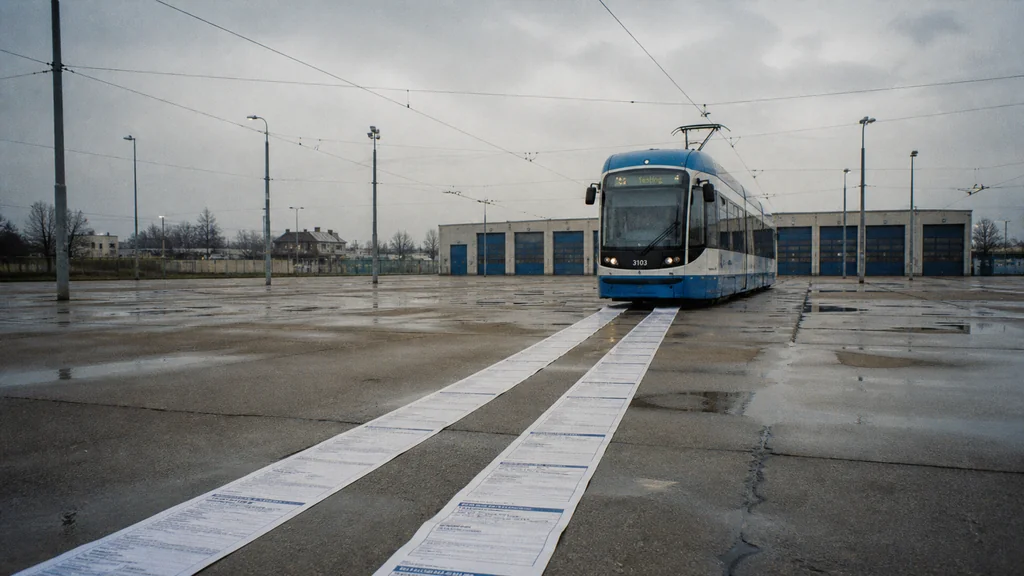
The substance behind this payment is not abstract. It includes laptop vouchers for more than 500,000 teachers, covering over 65% of the teaching workforce, 88 new trams for Kraków, Poznań and Wrocław, and changes to how electricity producers connect to the national grid (TVP World, Rzeczpospolita).
The grid reform is the kind of item that can disappear inside bureaucratic language, but it matters. Connection rules decide how quickly renewable energy and storage projects can plug into the system. For a coal-heavy economy trying to add clean power capacity, that is not paperwork; it is the machinery of transition.
This is what the fund was meant to do. It gives schools, public transport systems and grid operators investment that national budgets might otherwise postpone. The bargain is simple enough: EU money flows if governments deliver agreed work. The political risk is just as simple. The benefit only exists if the promised projects are finished, useful and capable of being checked.
Twenty days to prove the whole fund worked
The RRF was designed as a temporary instrument. Member states must complete all remaining reforms and investments by 31 August 2026, submit final payment requests by the end of September, and close all disbursements by 31 December (EUR-Lex). By late July, roughly €177 billion of the fund had still not been paid out (The Economy).
The pressure is not evenly spread. Portugal has already received 78.67% of its allocation and is ahead of schedule (European Commission Portugal). Italy has revised its plan, moving projects that could not be finished in time onto other funding tracks (ANSA). Romania has a more awkward problem: a parliamentary vote to extend coal-plant operations has put a cleared decarbonisation milestone at risk, potentially exposing billions in pending requests (EUObserver). Bulgaria recently received only a partial payment after missing one milestone (European Sting).
The Commission has a real lever here. Under the RRF regulation, it can suspend or reduce a payment when milestones or targets have not been met (EUR-Lex). That is the enforcement mechanism behind the polite language of recovery plans.
Poland has passed this checkpoint cleanly. Nothing was withheld, and the remaining steps should be routine. But approval of one instalment does not answer the larger question. Auditors will still have to judge whether earlier tranches paid for genuinely additional investment, or whether some of the money simply eased pressure on the Polish exchequer without leaving behind infrastructure that can be verified.
NextGenerationEU was the EU's largest experiment in common borrowing: the bloc raised debt together and tied the payout to results. Its credibility now rests less on the elegance of national plans than on whether final claims across all 27 member states match work that is finished and inspectable. Poland's clearance is one part of that closing test. The implementation deadline is 20 days away.
Details about this article
- Model:
- claude-opus-4-6
- Generated:
- 8/11/2026, 10:32:27 AM
- Pipeline run:
- eu_pipeline_20260811_005006
- Watermark:
- SynthID (Google's invisible watermark)
- Human review:
- None before publication