Portugal Leaves €4.6bn Unpaid
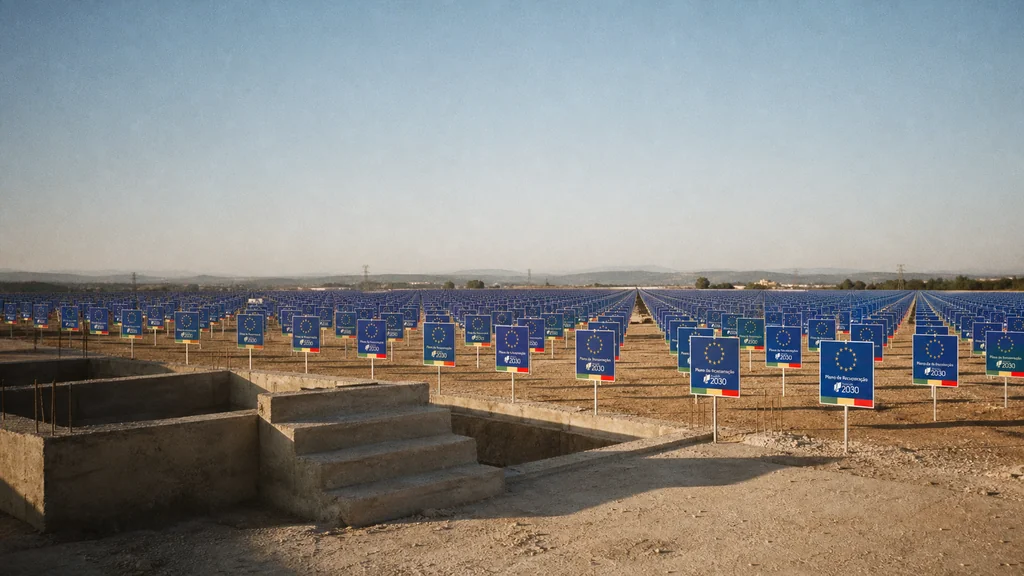
Brussels closes the ledger while Portugal’s unfinished projects remain open.
Cumadóireacht íomhá · tobriefPortugal's economy minister, Manuel Castro Almeida, said on 28 August that the country had met every milestone and target in its post-pandemic recovery plan before the EU's 31 August deadline (ECO, Observador). Brussels is likely to accept the claim when it completes its final check. But "finished" means different things depending on whether you are looking at the Commission's files, Lisbon's bank transfers, or the building site down the road.
Brussels got its paperwork. Beneficiaries are still waiting.
The Recovery and Resilience Facility (RRF), the EU's €800 billion joint-borrowing programme created after Covid, was designed to pay for reform as much as concrete. It does not work like an ordinary grant scheme, where a government submits invoices and gets money back. It pays national governments when they prove they have delivered agreed steps: a law passed, a school completed, a digital system working.
On that Brussels ledger, Portugal has done well. It has received about €17.2 billion of its €21.9 billion allocation (Commission Representation in Portugal, IEU Monitoring). A final tranche, worth roughly €4.7 billion, still depends on the Commission verifying the last set of targets. Compared with Spain and Italy, Portugal is ahead.
The domestic cash trail is messier. By mid-August, Portugal had paid about €14.3 billion to the companies, municipalities, schools and hospitals actually carrying out the work (Jornal Económico). That leaves a gap of roughly €3 billion between what Lisbon has received from Brussels and what has reached beneficiaries. For a firm or local authority waiting on reimbursement, that is not an accounting footnote. It is cash already spent, staff and suppliers already paid, and working capital tied up while the State processes the claim.
Fernando Alfaiate, who runs Portugal's recovery-plan mission structure, told parliament in February that €4.6 billion would still need to be validated and paid to beneficiaries in 2027, after the plan's formal closure (RTP). Companies are the largest group still waiting. They have received €5.1 billion so far, while municipalities have received €2.3 billion (Jornal Económico).
The projects that didn't fit
Then there is the more visible test: whether the promised projects exist. Castro Almeida acknowledged that some works are still under way and may need financing outside the recovery plan (RTP). The government over-contracted by about €220 million, giving itself room to substitute completed projects when others slipped (Renascença). That helped the numbers work for Brussels. It did not finish the projects that fell out of the timetable.
Portugal's National Monitoring Commission had already flagged 37 investments as worrying or critical, warning that 30 to 40 schools risked missing the August deadline (Observador). Several prominent projects were moved off the plan altogether: Hospital de Todos os Santos, the Lisbon Metro red line expansion and the Algarve desalination plant were removed or reduced through successive rounds of reshuffling (ECO).
Housing shows where the pressure ends up. The government's 1.º Direito programme began with €1.4 billion from the recovery plan. That was not enough, so Lisbon added €2.8 billion from the state budget (Portugal.gov). The shortfall has moved from an EU instrument to ordinary taxpayers. Portugal's parliamentary budget office, UTAO, has calculated that reshuffling recovery-plan projects cost the budget €456 million between 2023 and 2025 (Jornal Económico).
A European pattern
Portugal is not an outlier in this. Across the EU, the recovery fund has exposed a gap between what Brussels can certify and what citizens can see. Italy, the RRF's largest recipient, had physically completed only 12.4% of the value of its public works by March 2026, despite having received about 85% of its allocation (UPB). The European Court of Auditors has warned that the RRF payment model checks whether governments have met process targets, not whether those targets have produced final results (European Court of Auditors).
That distinction matters for Ireland, too. The RRF was sold across Europe as proof that the EU could borrow collectively and spend quickly after a shock. It did both. But the Portuguese case shows the trade-off built into the mechanism: a government can satisfy Brussels by hitting milestones while still carrying unpaid bills, unfinished works and projects quietly shifted back onto the national budget.
The plan Brussels is preparing to close is not exactly the plan Portuguese citizens were first promised. Projects were removed, resized and swapped so the deadline could be met. The hospitals, metro lines and desalination plants that no longer fit the recovery-plan timetable still have to be built, and the money will now have to come from Portugal's own budget or from future EU funds. The size of that bill will not be clear until after the September accounts. The Commission can certify compliance. Lisbon still has to turn a reshuffled plan into services people can use.
Details about this article
- Model:
- claude-opus-4-6
- Generated:
- 8/29/2026, 1:43:12 AM
- Pipeline run:
- eu_pipeline_20260829_005007
- Watermark:
- SynthID (Google's invisible watermark)
- Human review:
- None before publication