Putin Casts Tanker Checks As Piracy
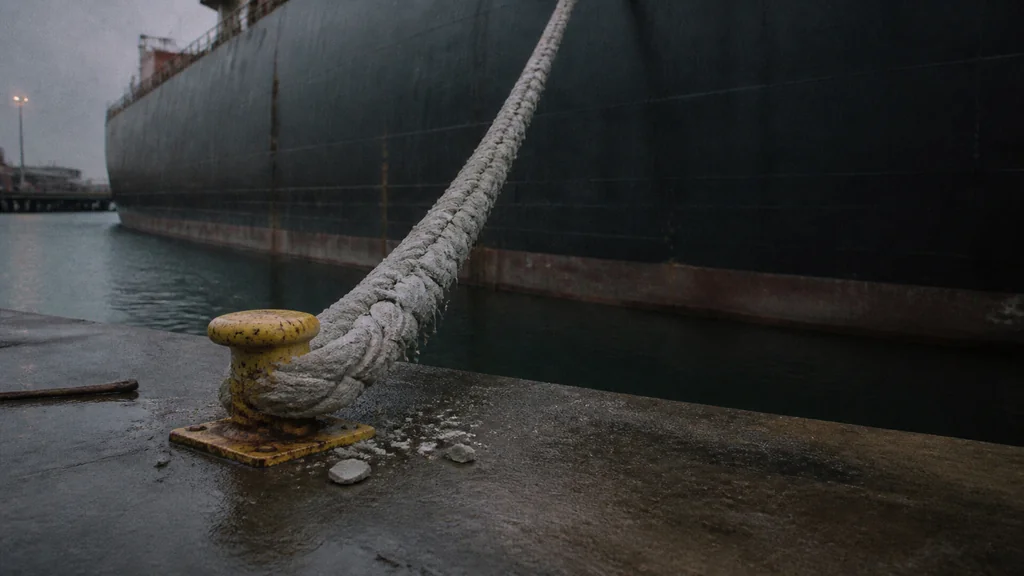
Europe’s strongest maritime pressure begins when the tanker reaches port.
Cumadóireacht íomhá · tobriefVladimir Putin's warning on Tuesday was pitched as retaliation. If European states seize Russian-linked merchant vessels, he said, Russia will respond "in kind", describing recent boardings as piracy (Reuters). Dmitry Medvedev, never knowingly under-alarmed, went further and suggested Russia had the right to attack Western merchant ships militarily (Portfolio).
The problem with Moscow's story is that the campaign it describes is not the one taking place at sea. European navies have boarded and delayed suspect tankers. They have not, on the public record, been seizing vessels and selling off Russian oil cargoes. The piracy claim works better as politics than as law, because it turns a narrow enforcement tool into a grievance big enough to test European unity.
What Europe has actually done
The most visible EU action was the boarding of the Toa Payoh on 2 August. An Italian-led force operating under Operation IRINI, the EU's Mediterranean naval mission, boarded the Cameroon-flagged tanker west of Pantelleria after its captain refused radio checks (Reuters/KFGO). IRINI's own report says the legal basis was "exercising the right of visit to verify flag state" (EEAS). In plain English, that means checking whether a ship is genuinely entitled to fly the flag it claims. It does not mean a power to seize oil.
The same pattern appears elsewhere. The UK intercepted the Smyrtos in the English Channel in June, but interception is not confiscation (BBC). France has immobilised several suspect tankers since September 2025, but released the Boracay within days. No public court record confirms cargo seizure in any case (Le Figaro, Il Foglio). Boarding and temporary detention are documented. Permanent confiscation of a ship, or of its cargo, is not.
Ports, not the open sea
The EU's 21st Russia sanctions package, adopted on 23 July, added 41 shadow-fleet vessels to its blacklist and widened the criteria to include ships servicing listed tankers (Council, Finnish government). Some coverage suggested the package gave member states the power to sell seized Russian oil. The published EU texts do not show such a power. The Commission describes its Russia sanctions as measures against named ships, companies and services, not as a general licence to stop tankers on the high seas (Commission).
Europe's strongest tools are more prosaic: port bans, insurance denial, refusal of fuel and docking services. These are administrative levers, and they work because modern shipping depends on paperwork as much as on engines. Out on the open sea, navies have far less room. UNCLOS, the UN Convention on the Law of the Sea, allows warships to board vessels only on narrow grounds, including where a ship's flag is disputed (UNCLOS). Norway's coast guard shows the limit clearly: it asks passing tankers for insurance documents voluntarily, because it lacks the legal power to force them to comply (Kystverket).
Why Moscow's framing matters more than its threat
"Piracy" has a legal meaning, and sanctions enforcement is not it. But the word has political value. EU foreign-policy sanctions require unanimity, meaning every member state has to agree. Greece has already used that leverage to secure an LNG exemption in the 21st package (Euronews). Hungary has no coastline and no direct role in maritime enforcement, but its dependence on Russian energy gives the argument about enforcement costs a domestic audience.
That is where Putin's threat lands. The higher Moscow can make the perceived price of enforcement, the more useful the argument becomes for capitals looking to slow or dilute the next sanctions package. According to Denmark's Børsen, Russia is already assembling a replacement shadow fleet, which means each enforcement round is followed by a new round of evasion rather than a clean halt (Børsen).
Both sides are stretching the picture. Europe has boarded tankers, but it has not publicly confiscated cargo. Russia has threatened retaliation, but it has not seized EU vessels. Europe's real leverage is in ports, insurance offices and service denial, where quiet refusal can hurt more than a boarding party. Moscow's real target is not a European warship. It is the unanimity vote behind the next sanctions package.
Details about this article
- Model:
- claude-opus-4-6
- Generated:
- 8/13/2026, 1:54:21 AM
- Pipeline run:
- eu_pipeline_20260813_005005
- Watermark:
- SynthID (Google's invisible watermark)
- Human review:
- None before publication