Rhine Freight Costs Treble at Kaub
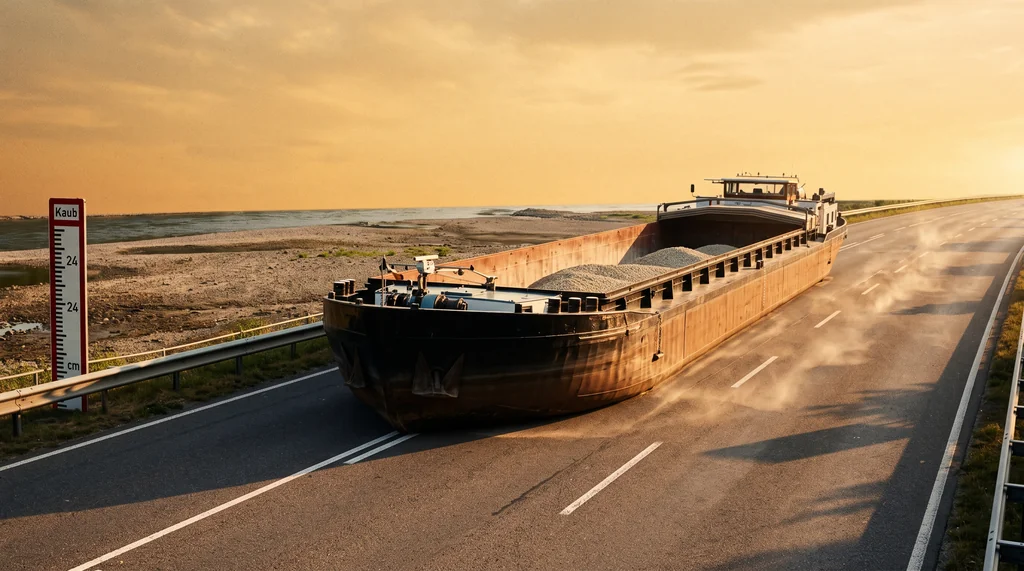
The Rhine’s missing capacity cannot simply move onto Europe’s roads.
Cumadóireacht íomhá · tobriefA barge passing Kaub on the Middle Rhine this week looks, at first glance, like business as usual. It is still moving. The river has not been closed. But the cargo tells the story: the same vessel is carrying roughly a third of what it could take a month ago.
That is where the cost comes in. Along the corridor from Rotterdam into the industrial belt of western Germany, eastern France and Luxembourg, freight rates have tripled. The Rhine is still navigable, but at these water levels it has lost much of the thing that makes it valuable: cheap, heavy capacity.
The same ship sails, but it delivers far less
Kaub is the pinch point that matters. The gauge there, on the commercial route between the North Sea ports and Germany's industrial heartland, stood at around 23–24 cm in early August and fell to a record 19 cm on 5 August (Pegelonline). The gauge does not show the depth of the whole channel. It measures the water level against a fixed reference point. But when Kaub drops, barges have to lighten their loads so they sit higher in the water and avoid scraping the riverbed.
The loss is brutal. Koninklijke Binnenvaart Nederland, the Dutch inland-shipping association, says every 10 cm of lost depth can take about 100 tonnes of cargo off some vessels (Trouw). At Rotterdam, barge loading has fallen from about 70% to 30–35% of capacity. The port recorded roughly 100 extra ship calls a week, but total Rhine volume was still more than 10% below normal (Transport Online, WNL).
That is the mechanism behind the price shock: more ships, less cargo, higher cost per tonne. Tanker freight on the Rotterdam–Karlsruhe route is reported to have risen from about €45 per tonne in late June to around €150 (RFI, Le Marin).
The cargo loss shows up in other countries too
The Rhine is Germany's river, commercially speaking, but its problems do not stop at the border. BASF chief executive Markus Kamieth warned in late July that low water could force product shortages at the company's Ludwigshafen complex, which sits directly on the river and depends on continuous supply by barge. The company declared force majeure on several product lines, a legal notice telling customers it cannot meet contracts because conditions are outside its control (Breakbulk).
German states including Baden-Württemberg and Bavaria have lifted Sunday truck bans to let road freight plug some of the gaps (Onvista). That helps for urgent cargo, but it does not restore the lost tonnage.
The same thinning-out is visible downstream and across the region. In Luxembourg, barges arriving at the Moselle port of Mertert were carrying just 450–500 tonnes on vessels built for 2,000, about a quarter of capacity, because the Rhine had already forced cargo to be shed upstream (RTL Infos, Luxtoday). In Alsace, French terminals face the same constraint set by water levels at Kaub, hundreds of kilometres away.
The obvious alternative is not much of an alternative either. Freight forwarder Kuehne+Nagel has warned that rail between Troisdorf and Wiesbaden is shut for maintenance at the same time (Kuehne+Nagel).
Who pays when the river shrinks
Sending more trucks on Sundays or pushing freight towards rail is a sensible emergency response. It protects the flows that cannot wait: fuel depots running close to minimum stock, chemical plants trying to keep production lines moving, factories with little room for delay.
But these are rationing tools, not replacements. If a barge loses 1,000 tonnes of cargo, it takes about 40 heavy trucks to move the same load. Repeat that across the Rhine corridor and the sums stop working.
The pain falls first on sectors built around cheap bulk transport: chemicals, petroleum products, steel, ores, construction materials, fertilisers and grain (Destatis, Eurostat). These are heavy, low-margin goods where transport costs matter. Households feel it later, through dearer inputs, delayed deliveries and the slow spread of producer costs through supply chains.
For Ireland, the immediate effect is indirect. But the lesson is familiar for a country whose economy depends on open European logistics: a single physical bottleneck can quietly reprice a whole supply chain. The Rhine has not stopped flowing. It has simply stopped carrying enough.
Details about this article
- Model:
- claude-opus-4-6
- Generated:
- 8/11/2026, 10:40:40 AM
- Pipeline run:
- eu_pipeline_20260811_005006
- Watermark:
- SynthID (Google's invisible watermark)
- Human review:
- None before publication