Rhine low water triples freight costs
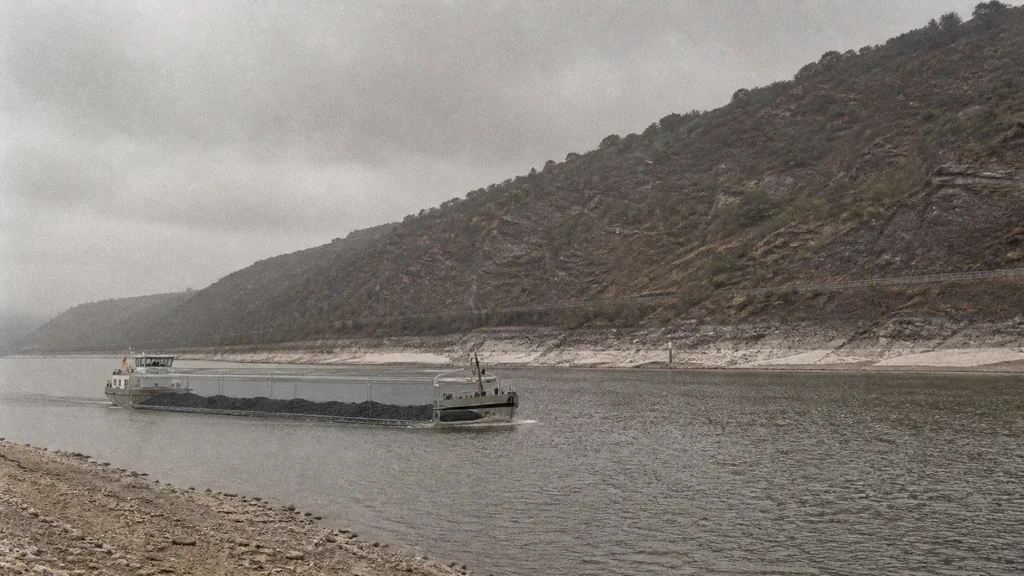
Europe’s busiest river carries more emptiness with every passing vessel.
Cumadóireacht íomhá · tobriefA barge passing Kaub on the Middle Rhine this week is carrying barely a third of the load it was built for. At this narrow stretch between Koblenz and Mainz, the gauge is reading around 16-17 cm, below the previous record low of 25 cm set in 2018 (ELWIS, Tagesschau). The figure is not the full depth of the river. It is the height above a fixed reference point, and it determines how low a loaded vessel can sit in the water. For Europe’s busiest inland freight route, that distinction now matters in euro.
Rotterdam is seeing around 100 extra vessel calls per week, but total Rhine traffic is still more than 10% below normal (nieuws.nl). More boats are moving. Less freight is getting through.
How depth becomes cost
The mechanism is brutally simple. Every 10 cm of lost water can take roughly 100 tonnes off some vessels, Dutch operators told Trouw (Trouw). At Mertert in Luxembourg, barges built for 2,000 tonnes were loading just 450-500 tonnes (RTL Infos). Vessels linked to Rotterdam that would normally run at about 70% capacity are down to 30-35% (Schuttevaer, Transport Online).
The price has followed the waterline. Moving a tonne from Rotterdam to Karlsruhe now costs roughly €150-160, compared with about €45 in late June (RFI, Breakbulk).
Why trucks and trains cannot fill the gap
A single 3,000-tonne barge does the work of roughly 150 trucks (ingenieur.de). Germany’s federal transport minister, Steffen Bilger, has pushed five states to relax Sunday truck bans for replacement freight (Zeit). That helps at the margin, but it does not create a second road haulage system overnight.
Dirk Engelhardt of the BGL road transport association put his finger on the constraint: drivers who work Sundays still have to comply with EU rest-time rules. A Sunday shift means compensating rest elsewhere, so the total pool of driving hours does not expand in any meaningful way (ingenieur.de).
Rail is no easy release valve either. A key Rhine corridor is already closed for scheduled maintenance, Kuehne+Nagel warned clients (Kuehne+Nagel). A Czech logistics expert told iROZHLAS that full substitution is, in practice, unavailable (iROZHLAS).
Who pays
The Rhine is one of the quiet pieces of infrastructure behind German industry. It links Rotterdam and Antwerp to chemical plants in Ludwigshafen, steelworks in the Ruhr and factories stretching into Switzerland. The goods on these waterways are not optional extras: petroleum products, ores, chemicals and construction materials, the heavy inputs that manufacturing runs on (Eurostat, Destatis). BASF’s Ludwigshafen complex, Europe’s largest integrated chemical site, is especially exposed to Rhine logistics (C&EN).
The pressure is not stopping at Germany’s border. At Lobith, where the Rhine enters the Netherlands, inflow has fallen to around 614-615 m³/s, roughly a third of the normal 1,800-1,900 m³/s (NRC). In Belgium, Flemish construction firms say a barge that would usually carry 3,500 tonnes of Rhine sand is now loading about 900 tonnes. Low-water surcharges have reached €8 per tonne for sand and €17 for gravel (GVA).
For Ireland, this is not a direct port story. It is a supply chain story. German chemicals, industrial inputs and construction materials sit inside wider European production networks, including the ones that feed Irish pharma, medtech and manufacturing. When the Rhine slows, the cost does not remain neatly on the riverbank.
Stefan Kooths of the Kiel Institute estimates the episode could take 0.1-0.2 percentage points off German GDP in the third quarter, or roughly €1-2 billion in lost output (Tagesschau). The estimate is provisional, but the order of magnitude is credible given how much industrial throughput depends on the river.
The winners, to the extent there are any, are the operators sitting on scarce capacity: hauliers with suitable trucks and barge owners with low-draft vessels. That is scarcity rent, not a gain for the wider economy. Consumer prices have not yet shifted visibly; for now, the squeeze is sitting with industrial logistics and factory inventories. Whether it stays there depends on the river. Dutch water authorities have kept formal drought status in place since 16 July (Rijkswaterstaat). The corridor now needs more ships, more trucks and more hours to move fewer tonnes. This is not a delay. It is a loss of capacity.
Details about this article
- Model:
- claude-opus-4-6
- Generated:
- 8/12/2026, 1:58:20 AM
- Pipeline run:
- eu_pipeline_20260812_005006
- Watermark:
- SynthID (Google's invisible watermark)
- Human review:
- None before publication