Romania Risks €100 Million On Coal
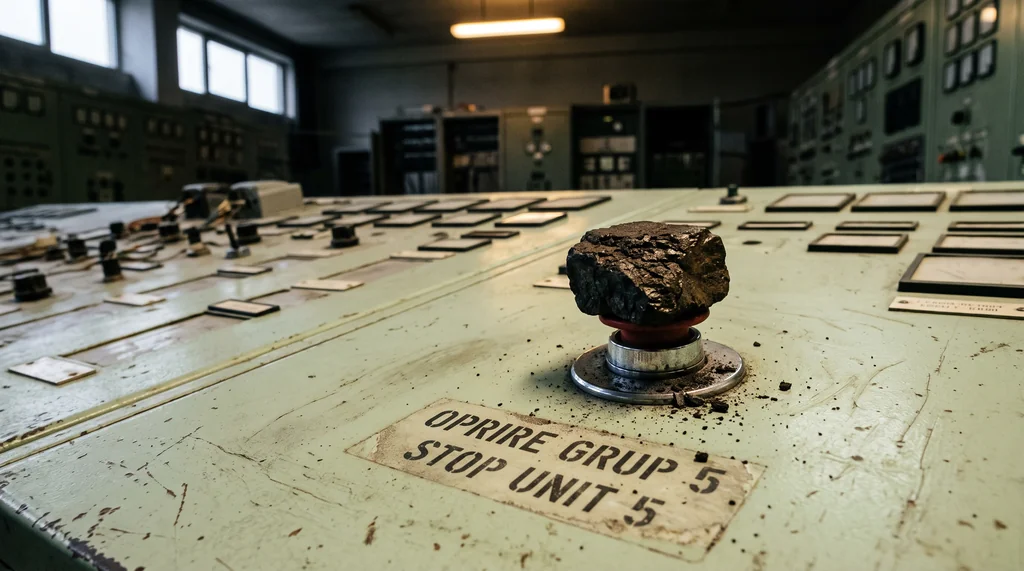
Romania keeps Unit 5 running as Europe’s payment window closes.
Cumadóireacht íomhá · tobriefRomania has chosen to keep three lignite power units open beyond the deadline it gave Brussels when it signed up for EU recovery money. On 28 August, the government approved a memorandum keeping Craiova 1 and 2 running until mid-2027, and Turceni 5 until early 2028 (Libertatea, Spotmedia). The closure date promised to the Commission was 31 August 2026.
On the same day, Portugal's minister Castro Almeida said his country's recovery plan was "totally concluded" (Observador, RTP). Two countries, the same EU programme, the same deadline: Lisbon is closing the file, while Bucharest is asking how much it will cost to keep coal on the grid.
How the RRF pays, and why timing matters now
The RRF, the Recovery and Resilience Facility, is the EU's post-pandemic spending programme worth hundreds of billions across member states. It does not work like an ordinary reimbursement scheme. Governments do not simply spend money and send receipts to Brussels. They agree reforms and investments in advance, prove they have delivered them, and only then receive payment (EUR-Lex, Council of the EU).
Romania's bargain included a law fixing the coal phase-out and the physical withdrawal of coal and lignite capacity by 31 August 2026 (Agerpres). It has now broken both parts of that bargain.
Parliament adopted amendments in August saying coal units can close only after replacement low-carbon capacity is built and operating (Agerpres). That rewrites the coal-closure law the Commission had already assessed and paid for. Separately, the government's decision to keep Turceni and Craiova producing electricity breaches the physical shutdown commitment. Earlier this year, Brussels had already refused a Romanian workaround that reduced licensed capacity on paper without actually closing plants (Economica.net).
The enforcement mechanism is not a fine in the usual sense. Under Article 24 of the RRF regulation, the Commission can suspend all or part of a payment, give the government time to fix the breach, and permanently reduce the allocation if the problem remains (EUR-Lex). Prime Minister Ilie Bolojan has put the possible cost of the coal delay at up to €100 million (Economica.net), though the Commission's calculation has not been fully explained.
The timing makes the difference. Earlier in the programme, Romania could have corrected the breach and submitted again. At the end, there is little road left. Commission closing guidance requires all measures to be completed by 31 August, final payment requests to be filed by September, and the programme to be legally settled by December (European Commission). A suspension now is much more likely to become money lost for good.
Portugal did not deliver perfectly. It kept Brussels inside the process.
Portugal is presenting its €21.9 billion recovery plan as complete and is preparing its tenth and final payment request. It has already received about 79% of its allocation (ECO, Portuguese government).
That does not mean Lisbon delivered the plan exactly as first written. It reprogrammed about €516 million between investments and removed 85 milestones, mostly through administrative mergers approved by Brussels before the deadline (Portuguese government, Sol). Health and housing targets were scaled back. The distinction is simple enough: Portugal changed its plan with permission. Romania changed the terms on its own.
Who pays for keeping the coal running
In Romania, the immediate beneficiaries are visible. The lignite plants stay open, workers keep their jobs for now, and politicians in Oltenia's coal basin avoid a hard shutdown before replacement gas and solar capacity is in place (Libertatea).
The costs are less visible, but they do not disappear. If Brussels cuts the payment, projects funded through the recovery plan lose money. Romanian taxpayers then make up the gap, either through higher borrowing or cuts elsewhere (ZF).
The case will be watched well beyond Romania. Other coal-dependent states, including Poland and Bulgaria, still have RRF energy commitments of their own (Euronews Poland, Investor.bg). If the Commission lets a unilateral delay pass at the finish line, the RRF becomes easier to treat as negotiable even after payments have been made.
If it cuts Romania's allocation, the message is different: a political choice to keep coal running has to be paid for at home. The exact Commission calculation is still unclear, but the precedent is not. Either agreed milestones cost money when broken, or they don't.
Details about this article
- Model:
- claude-opus-4-6
- Generated:
- 8/29/2026, 1:46:00 AM
- Pipeline run:
- eu_pipeline_20260829_005007
- Watermark:
- SynthID (Google's invisible watermark)
- Human review:
- None before publication