Romania’s Coal Shift Risks EU Funds
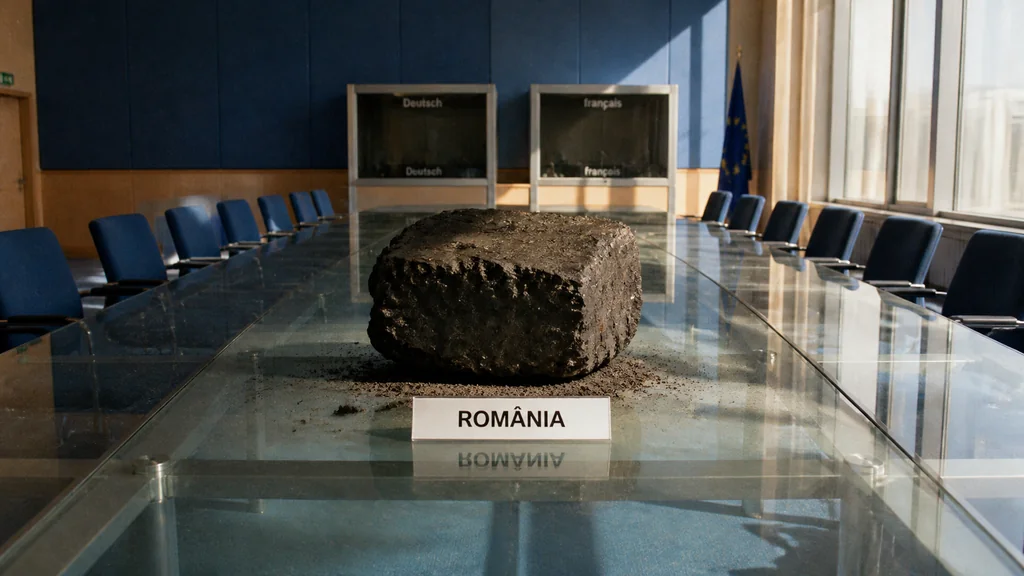
Coal takes Romania’s seat as its European bargain reaches judgment.
Cumadóireacht íomhá · tobriefRomania’s lower house has turned a coal phase-out into a test of how hard the EU is willing to police its post-pandemic recovery fund.
On 5 August, the Chamber of Deputies voted 180 to 9 to rewrite the country’s coal-closure law. The old law required coal and lignite plants to close by fixed dates. The new text says no plant closes until replacement low-carbon capacity has been built, connected to the grid and is running commercially (Agerpres, Europa FM).
That matters because the original law was not just domestic energy policy. It was the legal basis for a reform the European Commission had already approved and paid for. Within a day, the Commission warned that the amendment could mean the reform "is no longer considered fulfilled" (HotNews, Ziare).
The bill is now on the desk of President Nicusor Dan. He can sign it, send it back to parliament, or ask the constitutional court to review it (Bursa). His choice will decide whether this remains a row inside Romania’s governing system or becomes a formal enforcement case in Brussels.
A closure date replaced by a promise with no deadline
The amendment was backed by PSD, Romania’s Social Democrats and the largest governing party, and by the nationalist AUR. It replaces a clear phase-out with a condition that has no hard date: coal plants stay open until replacement sources are installed, grid-connected and commercially operational (Agerpres).
PNL, the centre-right coalition partner, and European projects minister Dragos Pislaru warned that the move could put recovery-fund payments at risk (Stiripesurse).
Pislaru put the exposure at about €5 billion in future grants. He also pointed to roughly €600 million linked to a milestone that has already been paid (Digi24). Those are the minister’s figures, not a published Commission calculation.
The Commission’s confirmed position is narrower, but still serious. It will assess whether the new law reverses milestone 114, which was already cleared in an earlier payment, and whether it prevents Romania from meeting milestone 119A, the remaining coal-capacity closure that requires the country to decommission 710 MW before receiving its final instalment (Agerpres, Libertatea).
The clock does the Commission's work
The Recovery and Resilience Facility, the EU’s post-pandemic fund that pays member states when they complete agreed reforms and investments, does not punish countries instantly.
Under Article 24 of the RRF Regulation, the process is staged. Romania requests a payment. The Commission checks whether the milestones have been met. If they have not, it can suspend all or part of the payment. Romania then gets a month to respond. Permanent cuts follow only if the problem is not corrected within six months.
That mechanism matters. The Commission usually withholds money linked to the failed reform rather than blocking everything. Bulgaria’s recent experience shows the pattern: Brussels released close to €900 million under Sofia’s fourth request while holding back money attached to unfulfilled milestones (Economic.bg, European Sting).
Romania’s problem is the calendar. All recovery-fund reforms must be completed by 31 August 2026, with final payment requests filed by 30 September (Brussels Times). If the amended law stands, Romania cannot show that it has met milestone 119A. There is little time left to find a workaround.
An energy argument the Commission already rejected
The energy concern behind the amendment is not invented. Across South-East Europe, coal plants still provide winter heat and dispatchable electricity, the power that can be switched on when wind, solar or imports are not enough. Pislaru has acknowledged that the government told Brussels coal plants needed to remain online through winter while new capacity comes on stream (Digi24).
The Commission has already rejected that argument for the purposes of the milestone. Its view is that Romania’s electricity supply is stable, the market is functioning, and no emergency justifies rewriting the legal basis of a reform Brussels had already cleared (Euronews Romania, Agerpres).
There is a difference between keeping coal plants available through winter and changing the law that secured EU money. The first is an operational decision. The second alters the bargain Romania made with the Commission.
If Dan signs the bill, Brussels will have to choose between suspending payments, negotiating a revised timeline, or tolerating a softened reform after the money has been banked. The last option would be noticed well beyond Bucharest. Any member state could then take recovery funding and later dilute the measure that unlocked it.
If Dan sends the bill back, Romania’s parliament will have to weigh coal-region politics against billions in EU funding. The argument Bucharest is making about power security is already familiar in Sofia and Warsaw. That is why the Commission’s response will be read not just as a Romanian decision, but as a signal to every capital tempted to reopen its recovery-fund bargain.
Details about this article
- Model:
- claude-opus-4-6
- Generated:
- 8/7/2026, 2:20:24 AM
- Pipeline run:
- eu_pipeline_20260807_005006
- Watermark:
- SynthID (Google's invisible watermark)
- Human review:
- None before publication