Romania Loses Its Nuclear Power
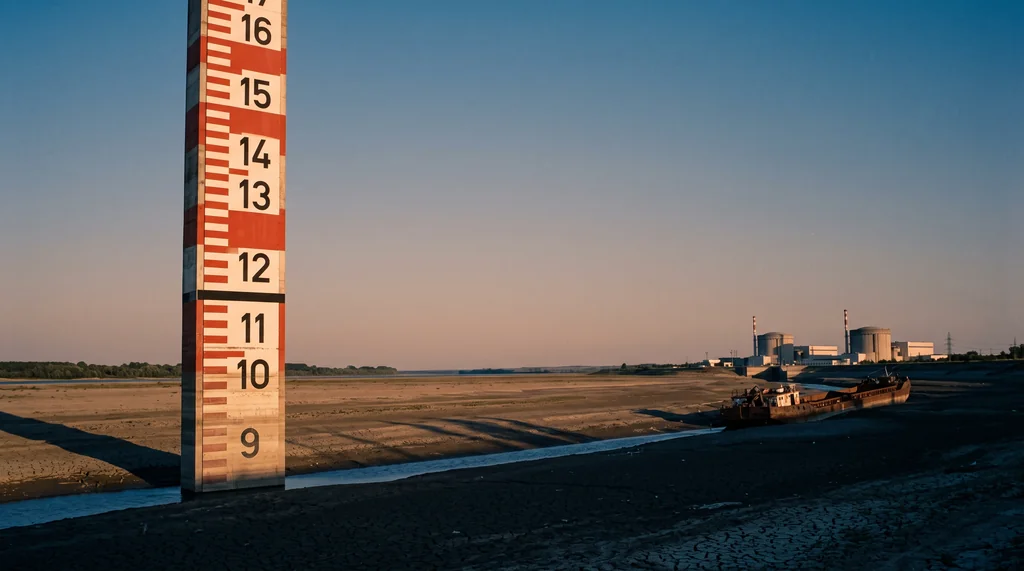
A falling river now sets the limits of Romania’s power system.
Cumadóireacht íomhá · tobriefRomania woke on 13 August with a problem that had been moving slowly down the Danube for weeks. By that morning, Cernavodă Unit 2, the last reactor still producing electricity at the country's only nuclear plant, had been taken off the grid because the river had fallen below the level needed to cool it safely (ABC News/AP, Digi24). Unit 1 had already stopped on 28 July for the same reason. Between them, the two reactors normally provide about 1.4 GW of steady electricity, roughly a fifth of Romania's power (Agerpres, Reuters via Global Banking & Finance). That contribution is now gone.
The physics are plain enough. A nuclear plant makes heat to produce steam, and it needs large volumes of water to carry heat away safely. If the river falls too far, the operator cannot guarantee enough cooling water at the intake. The reactors have not been damaged; they simply cannot operate under those conditions. Bucharest spent more than €2 million on emergency works on the river, including dredging and sinking barges to push more water towards the plant's intake (Al Jazeera, Firstpost). It bought time, but not enough. At Baziaș, the Danube's flow was forecast at about 1,400 cubic metres per second through 17 August, roughly a third of the August average (Agerpres).
After sunset, the squeeze
The difficult hours come after dark. During the day, solar power can cover part of the gap left by Cernavodă. In the evening, household demand and air conditioning remain high, while solar generation falls away. That is when Romania has to lean on imports. The Energy Ministry said evening import needs could reach 2,300 MW, with cross-border transmission capacity of about 4,000 MW (Digi24). The distinction matters: transmission capacity is the size of the pipe. It does not mean neighbouring countries have spare electricity to send through it at 9 p.m.
The pressure was showing before the full shutdown. On 5 August, Romanian evening demand reached 7,675 MW, while domestic generation supplied 5,321 MW. Imports met close to 31% of consumption, and wholesale prices for next-day power had risen 48% to about €178 per megawatt-hour (Brussels Signal). If the shortage worsens, Romania's contingency plan allows Transelectrica, the grid operator, to cut large industrial consumers by 10–30% and suspend exports (Balkan Green Energy News).
Same river, same problem, shared bill
Hungary is caught by the same river. Its Paks nuclear plant also depends on the Danube, and on 7 August it was producing about 230 MW from a total capacity of 2,000 MW (HVG, kormany.hu). That left nearly 1,770 MW of reliable Hungarian generation missing just as Romania was losing its own.
The bill arrived quickly. Hungary's daily net import cost rose from about 0.6 billion forints in late July to almost 4 billion forints by early August, as the country bought much of its electricity during the costly evening period, when prices were above €200/MWh (Telex/G7, Portfolio). These are wholesale prices, paid by utilities and big buyers in power markets. They do not show up on household bills immediately, but they raise the costs that suppliers eventually try to recover.
Romania and Hungary are therefore chasing the same scarce evening electricity from a region with less spare power than usual.
Who gains, who pays
Bulgaria is the obvious short-term beneficiary. Its Kozloduy nuclear plant uses spray ponds and backup wells for cooling, in effect a stored-water buffer that gives it more room when the Danube drops. Energy Minister Iva Petrova reported exports of 32,000–33,000 MWh per day, with about 1,355 MW flowing towards Romania on 7 August (Club Z, economic.bg). Bulgarian wholesale prices rose to €150–170/MWh, from €100–120/MWh a week earlier (Mediapool). Sofia is selling into a tight market at a premium. That advantage may not last: Bulgarian officials said Kozloduy could keep running for roughly another week and a half at current water levels (BTA).
The losers are easier to find: Romanian and Hungarian industrial users facing possible cuts, electricity buyers paying two or three times normal summer wholesale rates, and taxpayers who paid for emergency river works that delayed the shutdowns without preventing them. Romania's grid is not on the edge of collapse. But its stability now depends on several things going right at once: enough wind, enough hydro within tightening water limits, enough surplus power across the borders, and evening demand that stays under control. That is Bucharest's wager while the Danube keeps falling.
Details about this article
- Model:
- claude-opus-4-6
- Generated:
- 8/14/2026, 2:03:31 AM
- Pipeline run:
- eu_pipeline_20260814_005006
- Watermark:
- SynthID (Google's invisible watermark)
- Human review:
- None before publication