Romanian Pay Reform Puts €770m at Risk
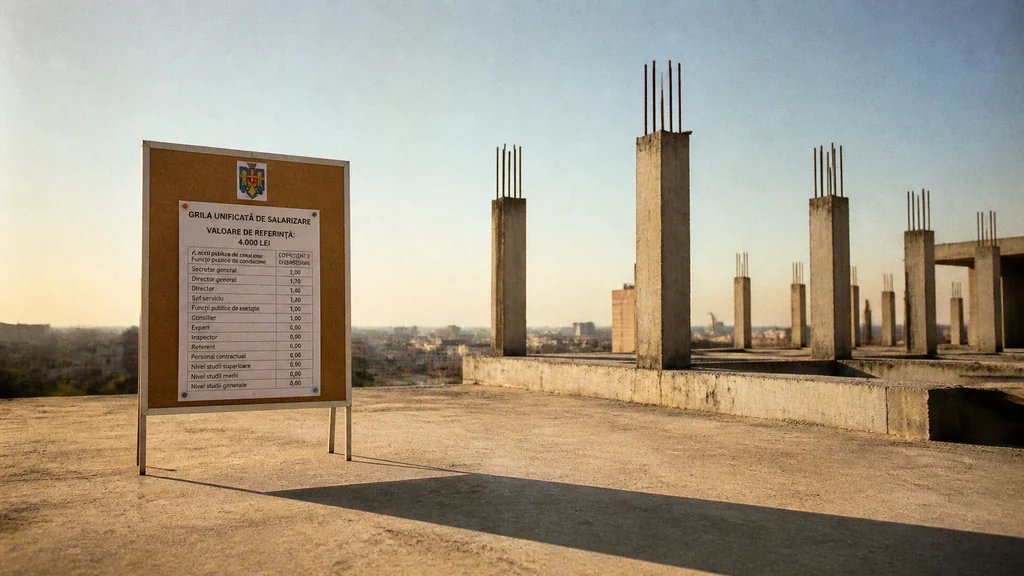
Romania posts its pay promise before the budget is built.
Cumadóireacht íomhá · tobriefRomania has nine days to turn a difficult political bargain into law. By 31 August, it must enact the unified public-sector wage reform it promised Brussels in return for EU recovery-fund payments. If it misses the deadline, about €770 million could be suspended (RRI, Romania Insider).
The problem is that passing the law is only half the test. If the final version costs too much, Romania risks further pressure on its credit rating. At BBB- with a negative outlook, it is already sitting on the lowest rung of investment grade. A downgrade would mean higher borrowing costs each time Bucharest goes back to the bond markets (SeeNews). As things stand, the governing parties have no deal.
The reference value keeps falling
The latest draft, sent to party leaders on 20 August, puts the base reference value at 4,000 lei. That figure is the spine of the whole wage grid: a public employee’s base salary is calculated by multiplying the reference value by a coefficient attached to the job. Raise the value and everyone’s pay rises with it.
That is why the number matters politically. It has already been cut from 4,320 lei in earlier versions to 4,100 lei in July and now 4,000 lei (Adevărul, Gândul). The draft also caps most bonuses at 20% of base-salary funds (Spotmedia).
Each reduction makes the proposal easier to defend in Brussels and harder to sell to public workers at home. The reform is meant to close gaps across the state, but pension-house unions say it would leave one of the most obvious ones in place: a senior adviser at the central pension authority would earn 11,200 lei, while someone doing comparable work in a territorial office would get 8,600 lei (Agerpres).
Court clerks have gone further. They say they will close courts and prosecutors’ offices from 1 September if the draft survives in its current form (Digi24). That is the day after the EU deadline expires.
Brussels doesn't set wages — it asks who covers the bill
The European Commission has not formally rejected the Romanian draft. Prime Minister Ilie Bolojan said Brussels had sent "questions and clarification requests", while Labour Minister Dragoș Pîslaru said the text was still a working draft, with nothing formal yet to reject (Agerpres, Realitatea).
The Commission’s question is the familiar one in EU fiscal politics: who pays? According to Romania Insider, the wage bill reportedly rose from about 8 billion lei to roughly 12 billion lei, and Brussels wants to know how Romania intends to cover the difference.
A higher wage bill is not like a capital project that can be funded once and finished. It rolls into every future budget. Romania’s space to absorb that kind of recurring cost is narrowing.
Public debt reached 60.1% of GDP at the end of the first quarter of 2026 (Eurostat). That crosses a domestic legal threshold: once debt is above 60%, the government cannot increase total payroll or social spending unless it cuts elsewhere or finds new revenue (Bursa). The Finance Ministry expects debt to rise to 61.8% this year and 63.9% by 2028 (Economica).
Who pays
For workers already earning more than the new grid allows, the promise is that nominal wages will not fall. The catch is that they may be frozen for years until the grid catches up (G4Media). If inflation keeps moving, a frozen salary becomes a real pay cut.
Pre-university teachers may be among the few groups to gain, after their coefficients were increased in the latest draft (Digi24).
Missing the 31 August deadline would not make €770 million disappear overnight. Under Article 24 of the RRF Regulation, the EU rulebook for recovery-fund payments, the Commission can suspend a payment and then restore it once the member state fixes the problem.
Timing is the danger. Romania is close to the end of the recovery facility’s life. A correction that might have been manageable in 2024 is much riskier in late 2026, when there may not be enough time to pass the law, show it works and have compliance verified before the facility closes (Curs de Guvernare).
Romania promised Brussels an affordable pay reform. The politics now come down to which group carries the cost. Workers pay through lower expectations or frozen real wages. The state pays through a recurring bill it cannot easily fund. Brussels will accept the result only if the arithmetic holds.
Details about this article
- Model:
- claude-opus-4-6
- Generated:
- 8/22/2026, 2:01:29 AM
- Pipeline run:
- eu_pipeline_20260822_005006
- Watermark:
- SynthID (Google's invisible watermark)
- Human review:
- None before publication