Six States Build €2tn Budget Block
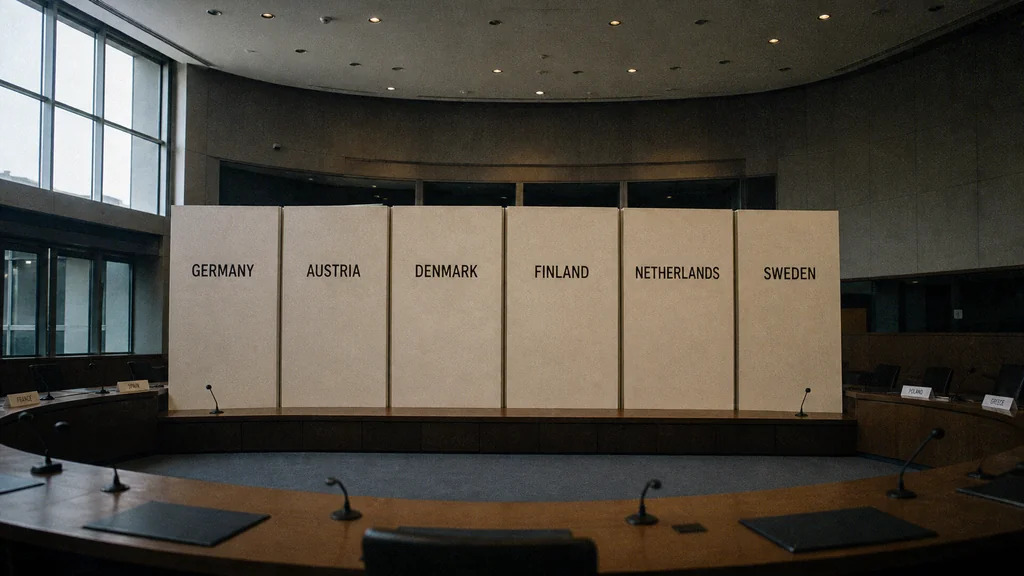
Six governments turn a minority position into Europe’s budget barricade.
Cumadóireacht íomhá · tobriefGermany, Austria, Denmark, Finland, the Netherlands and Sweden have chosen their moment carefully. On 27 August, they told the European Commission to take "several hundred billion euros" out of its proposed €2 trillion seven-year budget (Bundeskanzleramt). Six governments out of twenty-seven would usually look like a manageable minority. In EU budget politics, they are something else entirely.
The reason is the rulebook. The EU's long-term budget needs unanimity in the Council, where national governments sit. A bloc of six is not simply outvoted if it refuses to move. It can stop the deal (EUR-Lex).
The Commission wants the 2028-2034 spending ceiling, formally the Multiannual Financial Framework, or MFF, set at 1.26% of EU gross national income (European Commission). The MFF is the EU's binding seven-year budget cap: once agreed, it decides how much room there is for farm payments, regional funds, research, migration, defence and everything else Brussels is allowed to finance.
This time, the bill is carrying more weight than usual. The Commission says the ceiling has to cover a five-fold increase in defence spending, repayment of pandemic-era borrowing, a new competitiveness fund, farm support and cohesion money, the EU funding stream used for poorer regions and infrastructure (ECFR). The six net contributors say the price is too high. As To Brief reported last month, this fight will decide not only accounting lines in Brussels, but regional development, farm incomes and the balance of power between countries that pay more into the EU and those that depend on its spending.
Why the timing matters
European Council president António Costa began visiting EU capitals on 25 August to test each government's red lines before drafting a negotiating framework in October. That framework is the document that starts turning political positions into numbers (Euronews). The six-country statement landed before Costa could build momentum around the Commission's proposal. It shifted the opening position.
Costa warned in Vilnius that leaders need agreement by year-end if they want to avoid funding gaps for farmers, businesses and students when the current budget runs out (Yeni Şafak). Missing that deadline would not create a cliff edge. Existing spending ceilings would roll over automatically. But it would also mean no new defence or competitiveness money (European Parliament).
That distinction matters. A rollover keeps the lights on. It does not answer the question European leaders keep asking in speeches: how to pay for a more dangerous security environment while preserving the older bargains on farms and poorer regions.
Everyone's "cut" exempts something different
The six agree on a smaller total. After that, the unity becomes thinner. Austria's chancellor Christian Stocker says net contributors are "not the EU's ATM", but wants Austria's annual rebate and farm support protected from cuts (Bundeskanzleramt Österreich). Sweden wants regular spending kept at around 1% of GNI and is defending rebates worth SEK 8-11 billion a year (Riksdagen). Finland wants a lower ceiling, but accepts higher defence spending and supports some new EU-level taxes (Valtioneuvosto). The Netherlands wants harder choices on spending, but Dutch coalition politics make open cuts to the farm budget risky (NOS).
"Cut several hundred billion" is the easy line. The harder one is naming the programmes that lose money. Nobody in the coalition has done that yet.
What the cuts would hit
The bargain is blunt. The six want a lower bill. Countries that rely heavily on EU funds want defence, cohesion and farm spending protected. Romania, for example, has €31.5 billion in approved cohesion support for transport, the green transition and social inclusion (European Commission). In practice, that means motorways, water systems and regional jobs. Romania and Spain have aligned with a "Friends of Cohesion" bloc to defend those flows (G4Media, El País).
The Commission's attempted escape route is new EU-level revenue. It has proposed taxes and contributions, from carbon border levies to corporate payments, that it says would raise €58.5 billion per year and pay for new priorities without increasing national contributions (European Commission).
But this is not money the Commission can simply collect because it has put a figure in a paper. Each new revenue source needs its own unanimous vote in the Council and ratification by every national parliament. That gives capitals and legislators a second place to block the deal (European Parliament). Several of the six are already wary: the Netherlands opposes the corporate levy, while Austria will accept new revenues only if they do not increase its burden (Officiele Bekendmakingen, Parlament Österreich).
Unanimity gives the six leverage. It also forces them to live with their own contradictions. By October, Costa's framework will require them to show that "several hundred billion" means an actual list of cuts, not just a cheaper headline.
Details about this article
- Model:
- claude-opus-4-6
- Generated:
- 8/28/2026, 1:59:03 AM
- Pipeline run:
- eu_pipeline_20260828_005006
- Watermark:
- SynthID (Google's invisible watermark)
- Human review:
- None before publication