Spain Gets Funds, €537m Frozen
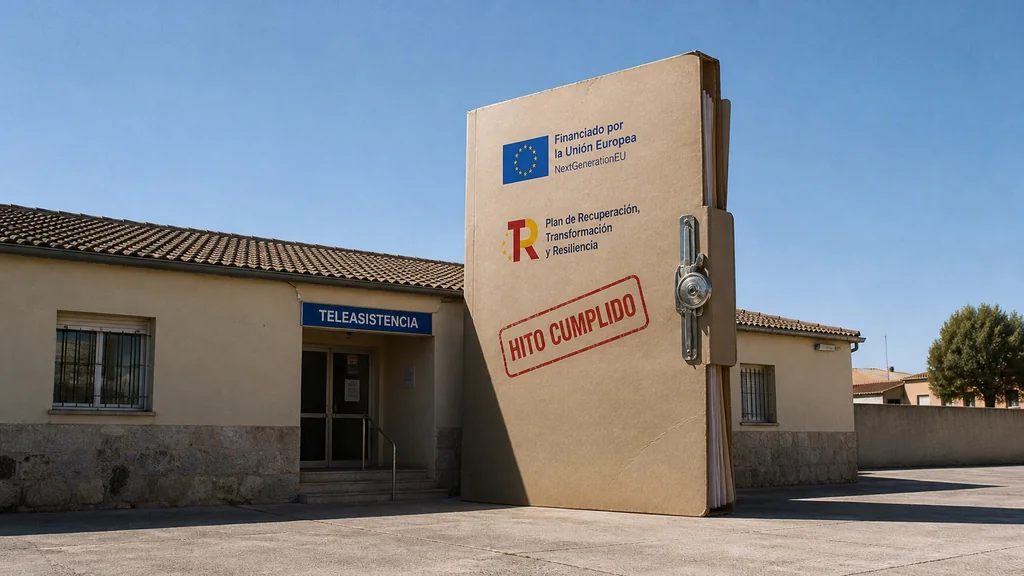
Europe verifies the file while Spain’s promised services wait outside.
Cumadóireacht íomhá · tobriefSpain got most of what it wanted from Brussels this week, but not all of it. The European Commission approved €7.021 billion under Madrid's sixth recovery-fund payment, then transferred only €6.234 billion to the Spanish treasury on 11 August (Hacienda, Infobae/EFE). The missing money is the useful part of the story. It shows how the EU's post-pandemic fund has grown a set of enforcement tools, while still struggling with the harder question of whether completed files mean changed lives.
Three numbers, three different stories
The €7.021 billion is the gross approval: the amount the Commission signed off after deciding Spain had met 73 reform milestones and spending targets. Of these, 64 were linked to grants and 9 to loans (Hacienda, Mineco).
The €6.234 billion that actually arrived in Madrid is lower because Brussels deducts pre-financing from each later transfer. That is the advance cash countries received at the start of the programme, and the rule applies across the board (Commission, El Economista).
The third figure is the one Madrid will feel more sharply: €537 million frozen by Brussels. The Commission could not certify three targets covering bilingual vocational training, telecare services, and projects for vulnerable groups and micro-enterprises (ABC, El Español). Spain did move on all three. Its problem was proof. Madrid now has six months to produce evidence Brussels will accept. If it cannot, the suspension becomes a permanent loss under the fund's rules (EUR-Lex).
The fund proves compliance, not results
Among the 73 approved items were CASA 47, a new state housing agency; more than 50 centres for victims of sexual violence; and €2.242 billion in industrial investment through PERTE, Spain's scheme for large strategic projects (Hacienda). A Sustainable Mobility Law also counted as a completed milestone (Mineco).
These are not paper fictions. They are real administrative and political steps. But the RRF, the Recovery and Resilience Facility behind the EU's roughly €800 billion post-pandemic investment programme, is built to ask whether governments have completed what they promised. It is much less able to ask whether the promise worked.
CASA 47 can be counted once it exists as a legal entity. The harder test is how many affordable homes are occupied. Spain can hire healthcare staff, but the public test is whether hospital waiting lists shorten. The telecare target failed for exactly this reason: Madrid could not show convincingly that users had received a better service. The payment machine rewards verifiable completion, not necessarily useful delivery.
Spain's response shows how the machinery adjusts when deadlines get close. This month, the Commission approved Madrid's closing revision, rewriting the wording of 121 milestones and targets to clarify the evidence Spain must present before the final deadline (Mineco, El Constitucional). Madrid says the substance has not changed. In practice, the route to protecting the money still runs through better files as much as better services.
Who gains, who waits
Spain has now received about €78 billion, roughly 76.5% of its total RRF allocation, and cleared 338 milestones (Infobae/EFE, Hacienda). One request remains: a final tranche of about €25.9 billion, tied to 148 milestones, with all reforms due by August 2026 and payments closed by December (La Voz de Galicia, European Commission).
The winners are visible enough. Spain's treasury gets cash. Ministries and regional agencies get time to complete commitments. The Commission gets evidence for its preferred argument: that the recovery fund is not a blank cheque. The frozen €537 million is the part Brussels will point to when national capitals ask whether the controls have any bite.
The losers are harder to count because the system is not designed around them. Telecare users may still be waiting for better services. Vulnerable groups may still be relying on projects Spain could not verify. Would-be buyers need affordable homes built, not merely a housing agency created. The programme is financed through joint EU borrowing, to be repaid by 2058 (European Commission). For Irish readers, familiar with both the value of EU money and the politics attached to it, the question is a practical one: can Brussels make withheld money improve delivery, or will it mostly improve the paperwork?
Details about this article
- Model:
- claude-opus-4-6
- Generated:
- 8/12/2026, 1:52:23 AM
- Pipeline run:
- eu_pipeline_20260812_005006
- Watermark:
- SynthID (Google's invisible watermark)
- Human review:
- None before publication