Traders Reserve Ukraine Gas Route
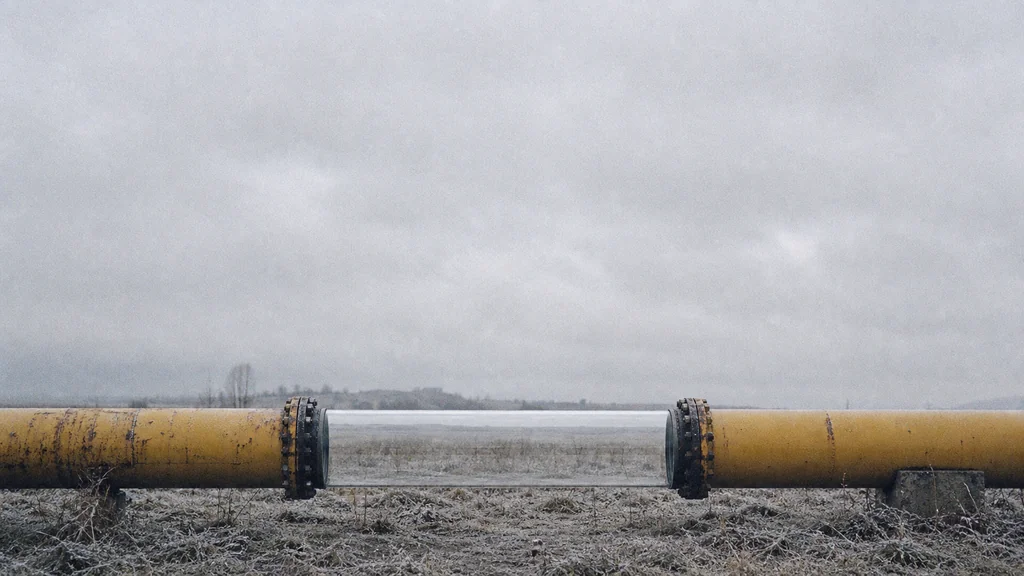
The infrastructure is in place, but the flow of energy remains a phantom.
Cumadóireacht íomhá · tobriefGreece, Bulgaria, Romania and Moldova have put together a northbound gas route that could move liquefied natural gas from the Aegean to Ukraine. Traders are now paying to reserve space on it. That tells us the pipes can work. It does not yet tell us that Ukrainian storage sites will be filled through this corridor before winter.
Booked pipes, missing contracts
The route begins with LNG arriving at Greek terminals. From there it enters the network run by DESFA, Greece's gas grid operator, crosses into Bulgaria, moves through Romania and reaches Ukraine via Moldova (European Commission). Each stretch is controlled by a different national grid, tariff system and regulator. The European Commission's CESEC platform, a regional energy forum for central and south-eastern Europe, has helped coordinate the project, but it does not buy the gas, set border charges or force anyone to ship it.
The most concrete sign that this is more than a diplomatic diagram comes at Sidirokastro, on the Greek-Bulgarian border. Traders have booked 46% of available export capacity for the gas years 2026/27 through 2029/30, with some reservations running as far as 2040/41 (Logos Press, Euro2day). Companies do not usually reserve multi-year cross-border pipeline rights for appearances. On the supply side, DESFA handled 18.61 TWh of LNG in the first half of 2026, while the Alexandroupolis terminal more than tripled its volumes year on year (Powergame).
The hard evidence, though, stops before Ukraine. Capacity bookings show that traders want the option to move gas north. According to Model Diplomat, there is no public record showing who has signed Ukraine-bound supply contracts, at what price, or for which delivery days. Romania's Transgaz reports 1.5 bcm/year of bidirectional capacity with Bulgaria, but there is no comparable public figure for the Moldovan or Ukrainian exit (BVB/Transgaz).
Winter economics still favour the Russian-linked route
The calendar matters. Bulgaria's own upgrades at its Greek and Romanian borders are scheduled for late 2026, which means this winter will depend on existing infrastructure rather than the promised expansion (Economic.bg). The wider corridor upgrade, from about 5 bcm/year to 9.4 bcm/year, is still a financing commitment rather than usable capacity (Jurnalul).
The quieter issue is price. The route became commercially plausible only after operators packaged separate border crossings into single booking products with discounted tariffs. That allowed a trader to reserve Greek-to-Romanian capacity in one transaction instead of dealing with three separate border charges (Economica). If those discounts disappear at any point, traders may hold on to the reservations and leave the pipes underused.
Bulgaria has already seen how that can play out. Bulgargaz used only about 23% of its contracted Turkish-route capacity in 2025, while carrying heavy costs for the unused remainder (Novinite). Paying for pipeline space is not the same as filling it.
The LNG moving through the Vertical Corridor also has to compete with TurkStream, which brings Russian gas through Turkey into south-eastern Europe and avoids the liquefaction and regasification costs built into the new route. The corridor wins only when buyers are willing to pay extra for diversification. Greece, Bulgaria and Romania each have reasons to want that: hub status, transit revenue and future leverage once Romania's Neptun Deep gas field starts producing around 2027 (Economica). Hungary and Slovakia, although outside the physical route, are still using winter energy anxiety to press for concessions on sanctions and supply, a reminder that cheaper Russian-linked options continue to shape the politics (Topky).
For Ukraine, this is an option rather than a guarantee. The route exists, traders have reserved capacity and governments have put their names behind it. What is still missing is delivery evidence: named contracts, daily flow nominations and delivered prices. Until shippers and buyers speak as clearly as governments, the Vertical Gas Corridor can carry gas to Ukraine, but it has not yet shown that it will.
Details about this article
- Model:
- claude-opus-4-6
- Generated:
- 7/15/2026, 2:37:18 AM
- Pipeline run:
- eu_pipeline_20260715_005006
- Watermark:
- SynthID (Google's invisible watermark)
- Human review:
- None before publication