Trump’s Ukraine Plan Needs Europe
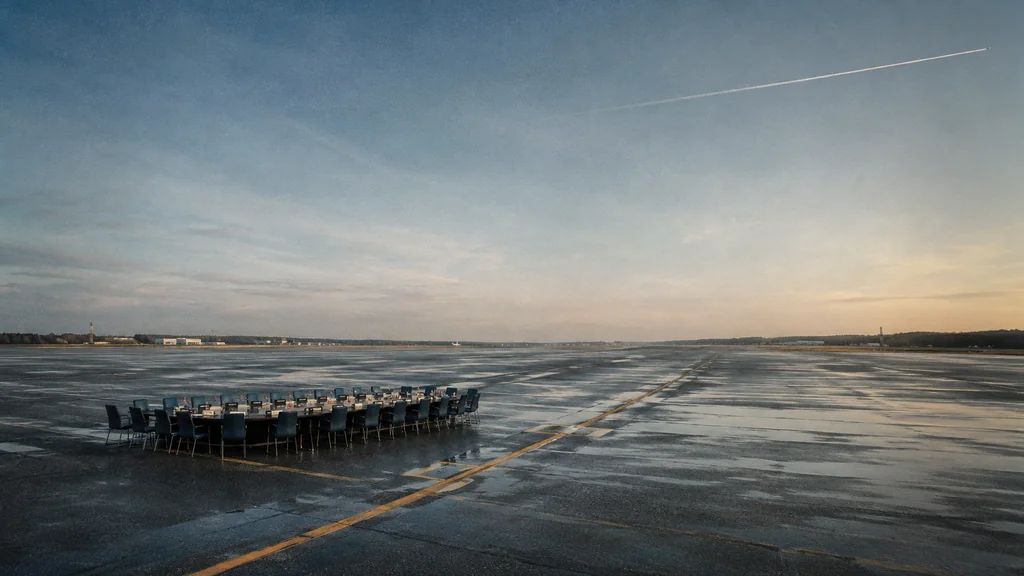
Europe holds the levers but remains outside the negotiating room.
Cumadóireacht íomhá · tobriefSteve Witkoff and Jared Kushner are being sent into the war’s hardest political space this weekend: first to Moscow on Saturday to meet Vladimir Putin, then to Kyiv on Sunday for talks with Volodymyr Zelenskyy (Axios). The Kyiv leg matters. Trump’s two lead negotiators on Ukraine have sat down with Putin several times, but they have not visited Ukraine until now, despite months of invitations from Kyiv (Kyiv Independent).
Trump says they are carrying "a proposal to end the war" (RFE/RL). That is as much as anyone outside the process has been told. No text has been published. An earlier one-page ceasefire framework, agreed between Zelenskyy and US officials, was dismissed by the Kremlin within days (RBC-Ukraine, Kyiv Independent). This weekend’s paper could be a revision of that idea, a looser negotiating brief, or something else entirely.
Russia treats the shuttle as opportunity, not concession
Moscow is not presenting this visit as a moment for compromise. Kremlin spokesman Dmitry Peskov said Putin’s demand that Ukraine cede all four regions claimed by Russia and abandon NATO ambitions remains "unshakeable" (Internazionale/Reuters). A Kremlin-linked source told Reuters there was "no chance" of an agreement on the front line until Russia finishes securing the rest of Donetsk. The Russian view is that the battlefield may look better for Moscow by year’s end (Internazionale/Reuters).
That judgement is shared elsewhere. Bloomberg-sourced intelligence, reported in Lithuania, put expectations of a breakthrough at "extremely low" (Delfi). The Russian calculation is plain enough: keep talking to Washington, avoid giving ground to Kyiv, and let the military pressure do its work.
Moscow reportedly tried to stop the Kyiv visit altogether (RBC-Ukraine). That fits the pattern. Russia would prefer a US-Russia channel in which Ukraine’s view arrives late, narrowed or mediated by someone else. Putin has spoken publicly of a "chance" for peace while also threatening large-scale strikes on Ukrainian energy infrastructure (BBC, Agerpres).
Kyiv keeps the exit open
Zelenskyy has not endorsed a proposal he has not seen. His wording was careful: Ukraine would "see what proposals Steve and Jared have and what Moscow will say to them" (Liga.net). That leaves Kyiv room to reject, revise or attach conditions after hearing Russia’s response.
Ukraine also has a legal brake. Its constitution requires a nationwide referendum for any territorial change. A legal analysis by OPORA, a Ukrainian civic organisation, found that no official has clear authority to sign away territory without one (OPORA). International law scholars at EJIL:Talk have separately argued that a treaty imposed through force could be challenged as unlawful under the Vienna Convention on the Law of Treaties (EJIL:Talk).
Even the travel arrangements show the enforcement problem. Zelenskyy offered to pause Ukrainian strikes while the envoys were in Moscow and asked Russia to do the same during the Kyiv meeting (Censor.NET). Washington had to seek separate safety commitments from each side because there is no direct Russia-Ukraine communication channel (Delfi). If a pause for a two-day diplomatic journey needs assurances brokered through a third party, a durable ceasefire will need something far stronger.
Europe controls levers Washington cannot bypass
The public itinerary gives no European government a role in either meeting (Axios). That is the weakness in the exercise. The powers needed to make any settlement real are not held by the White House alone. Many of them sit in Europe, divided between EU institutions, national capitals and, in some cases, individual member states with a direct veto.
Sanctions are the first lever. EU restrictive measures against Russia can be changed only by the EU Council, where all member-state governments must agree unanimously (Consilium). A US-Russia understanding cannot lift EU sanctions by itself. Any formula offering Moscow sanctions relief needs Dublin, Paris, Berlin, Warsaw, Budapest and every other capital to say yes.
Frozen assets are the second. Roughly €210bn in immobilised Russian central-bank funds are held mostly at Euroclear, the Brussels-based clearinghouse regulated under Belgian law. Belgian Foreign Minister Maxime Prévot has publicly refused to treat those funds as available for confiscation-like use (Euronews, Le Soir). If a peace deal quietly assumes Russian money will pay for reconstruction, Belgium can slow that assumption to a crawl.
Security guarantees are the third. The EU has approved a €6.1bn tranche for Ukraine’s air defence (EEAS). A multinational Coalition of the Willing is preparing troops for a post-ceasefire deployment, with joint exercises planned this autumn (UK government). Those commitments depend on decisions by individual governments, not on a signature in Washington.
Trump’s team may be able to draft a text. It cannot deliver EU sanctions relief, decide the fate of Russian assets in Brussels, or commit European forces and air defence systems without Europe. The awkward fact is that the people who would have to fund, police and defend any settlement have not been invited to shape it.
Details about this article
- Model:
- claude-opus-4-6
- Generated:
- 9/5/2026, 1:42:34 AM
- Pipeline run:
- eu_pipeline_20260905_005005
- Watermark:
- SynthID (Google's invisible watermark)
- Human review:
- None before publication