Kyiv Left Out of Vienna Channel
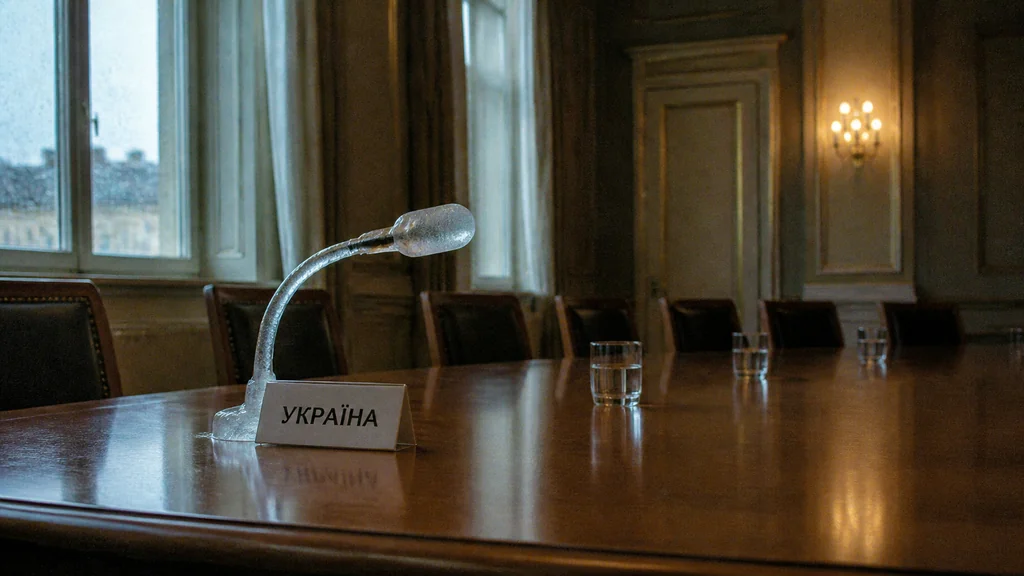
Europe tests a path to peace beyond Ukraine’s hearing.
Cumadóireacht íomhá · tobriefIn July, while Ukraine was still fighting the war being discussed, former senior officials from Britain, France and Germany sat down in Vienna with an unidentified Russian counterpart to explore the conditions for possible peace talks. The meeting was reported by Bloomberg. No government has claimed ownership of it. The Russian participant has not been named.
That is the uncomfortable part. Backchannels have their place in war diplomacy. They allow people to test language, incentives and red lines before governments are ready to speak openly. But this was a conversation about how a war might end, held without the country fighting it.
Former officials, no formal mandate
Bloomberg identified three Western participants. Tim Barrow, a former UK national security adviser. Markus Ederer, a former German state secretary who also served as the EU's ambassador to Russia. Pierre Vimont, a veteran French diplomat and former secretary-general of the European External Action Service, the EU's foreign-policy arm. These are not random retired officials. Each would be recognisable to Moscow, and potentially useful, as someone who understands how decisions are made in European capitals.
The meeting was reportedly organised by the Centre for Humanitarian Dialogue, a Swiss conflict-mediation NGO (Bloomberg). Ederer and Vimont sit on its board (Gândul). That matters because it muddies the status of the encounter. Were they private citizens sounding out possibilities, or informal diplomatic assets attached to an established mediation body?
The Russian side remains a blank space. N-tv correspondent Rainer Munz suggested the participant could have been Alexander Voloshin, a former Kremlin chief of staff, but presented that as a possibility rather than a confirmed identity (n-tv). Kremlin spokesman Dmitry Peskov did not respond to Bloomberg's request for comment.
Governments step back but don't shut it down
The governments involved all stepped away from the meeting. Germany's Foreign Ministry said it had "keine Kenntnis", or no knowledge, and that the discussions were neither conducted on its behalf nor coordinated with it (Berliner Zeitung). France declined to comment (Challenges). Britain offered a general line about supporting a "just and lasting peace" without addressing the role of the former officials (The Moscow Times).
That leaves the meeting in a useful grey area. Governments do not own the conversation, but they have not condemned it either. As Telegrafi noted, such meetings do not bind governments and can allow former officials to examine possible solutions that may later be passed to those still in office.
The mechanism is simple enough. London, Paris and Berlin get deniability. Moscow gets a channel.
The east reads a warning
French and German coverage largely treated Vienna as exploratory diplomacy. Polish coverage heard something more ominous.
Former Polish ambassador Jerzy Marek Nowakowski called the meeting "not a good signal", arguing that a channel with Moscow was not in Poland's interest and that Poland's absence "does not serve us" (Fakt). Onet linked Vienna to a separate backchannel meeting in Baku earlier in July, where different former German and Russian officials also met.
Two informal meetings in one month would be enough to make eastern Europe pay attention. Both involved former German officials. Both excluded Ukraine and eastern-flank states. That repetition is what turns the episode from a curiosity into a pattern.
Vienna also came shortly after the UK and France, as co-chairs of the Coalition of the Willing, the military-support alliance for Ukraine, reaffirmed that any peace must involve Ukraine's "full and continuous participation." The July Kyiv Declaration put the principle plainly: no decisions concerning Ukraine can be taken without Ukraine.
The Vienna meeting did not take a decision. But it tested the principle all the same. If Europe's three largest powers keep saying nothing happens without Kyiv, they cannot leave unexplained whether their former senior officials are sounding out Moscow beyond Kyiv's view. Ukraine, and the eastern flank, are owed an answer on what these channels are producing, and who, if anyone, authorised them.
Details about this article
- Model:
- claude-opus-4-6
- Generated:
- 8/8/2026, 1:51:28 AM
- Pipeline run:
- eu_pipeline_20260808_005006
- Watermark:
- SynthID (Google's invisible watermark)
- Human review:
- None before publication