VW Plan Hits Four German Plants
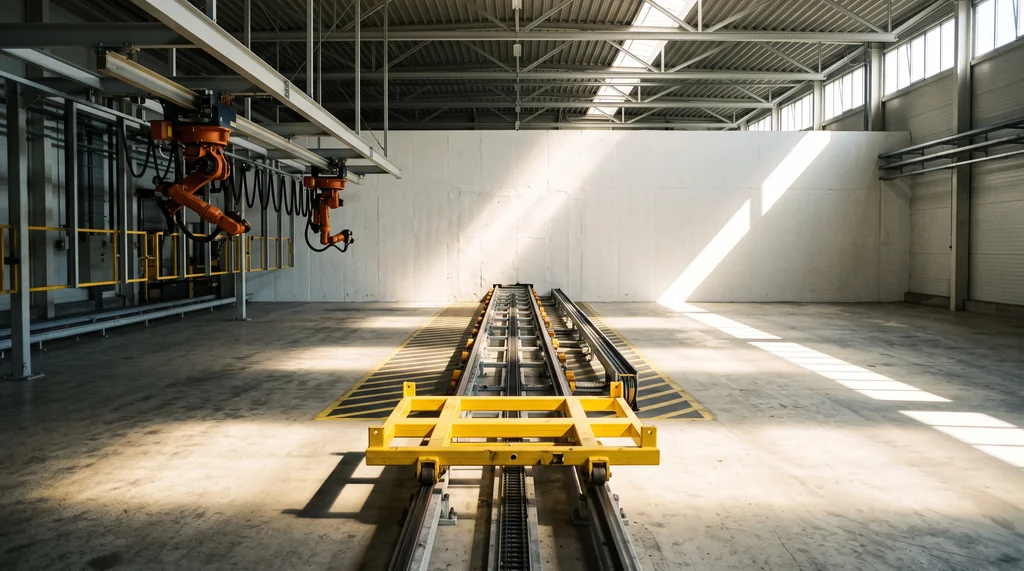
The factories remain open while their next models leave Germany.
Cumadóireacht íomhá · tobriefVolkswagen has not announced the closure of four German factories. That is the careful part. What its management board has backed, according to leaked documents, is a plan that would end vehicle production at Emden and Zwickau by 2031, Hannover by 2032, and Audi Neckarsulm by 2034 (Handelsblatt, Focus). The supervisory board meets on September 3–4 to discuss the proposal. VW has declined to confirm the papers, saying internal documents are dealt with by "the responsible bodies" (SWR, Krone).
In a company like Volkswagen, the distinction between stopping production and closing a factory is not legal pedantry. It is the terrain on which the fight will be fought.
The model-allocation loophole
Car plants live by model cycles. A factory builds a vehicle for several years and, when that model reaches the end of its life, it needs the next one to keep the line alive. The leaked VW plan works by denying that next assignment. The ID.4 replacement would go to Škoda's Czech plant at Mladá Boleslav, the Q4 e-tron replacement to Bratislava, a commercial van programme to Poznań, and the A8 successor to Leipzig (Handelsblatt). The gate is not locked. The order book simply runs out.
That gives management room before the usual German checks bite. Under VW's special governance law, the supervisory board must approve the "setting up or relocating production facilities" by a two-thirds majority (VW-Gesetz §4). The opening for management is model allocation: it can argue that deciding where to build the next car is not the same thing as shutting the old factory (NWZ). Whether the supervisory board, or ultimately the courts, accept that line is still unresolved.
Why the numbers force the question
VW's problem is not invented for negotiating leverage. Revenue was broadly flat at €321.9bn in 2025, but operating profit fell 53% to €8.9bn (Volkswagen Group, CNBC). That left an operating margin, the share of revenue left after costs, of 2.8%. VW's own target is 6.5%, and Toyota earns roughly three times as much.
The unused-factory problem sharpens the squeeze. VW's German plants ran at about 81% of capacity in 2026 and are projected to fall to 73% by the end of the decade (Moto RP/Reuters). A plant that is one-quarter empty still has to carry wages, energy bills and machinery costs. Fewer cars means each vehicle carries more of the fixed burden. Across Europe, VW has spare capacity of roughly 500,000 vehicles a year, and the leaked documents say existing structures "no longer secure long-term competitiveness" (Handelsblatt).
Who gains, who loses
Lower Saxony owns 20% of VW's voting rights, enough to block major resolutions (Volkswagen Annual Report 2025, NZZ). Workers hold half the supervisory board seats under Germany's co-determination system, and works councils can force negotiations on social plans for displaced staff (BetrVG §111). That is why run-downs in German industry tend to unfold over years rather than months.
Across VW's European network, the early pattern is already visible. Škoda says VW's restructuring has "no direct impact" on its Czech plants, which are running at full capacity (Newstream). Czech suppliers, however, are already reporting order falls of "tens of percent" (Novinky). Poland has the clearest confirmed investment: PLN 1.5bn for electric Crafter production at Wrzesnia (PAP Biznes). The opportunity is real, but uneven. Suppliers are absorbing the downturn before any formal plant decision is made.
For Ireland, this is not a remote German labour dispute. VW is part of the European industrial base that underpins the single market Ireland depends on, from vehicle imports to parts, logistics and finance. When a company of this scale starts moving work around Europe, the argument is never only about efficiency. It is about which regions keep skilled jobs, which supplier chains survive the transition to electric vehicles, and how much political power workers still have over decisions made in boardrooms.
The leaked plan shows how VW can begin shrinking German production before anyone votes to close a factory: move the next models somewhere else. The documents remain unconfirmed, and the supervisory board has not approved the proposal. But the mechanism is already in motion. Suppliers are losing orders. The real question is whether Lower Saxony and labour can force a broader bargain over jobs and transition costs, or whether the spreadsheet settles the matter before the politics catches up.
Details about this article
- Model:
- claude-opus-4-6
- Generated:
- 9/2/2026, 2:03:17 AM
- Pipeline run:
- eu_pipeline_20260902_005006
- Watermark:
- SynthID (Google's invisible watermark)
- Human review:
- None before publication