VW’s 500,000-Car Factory Gap
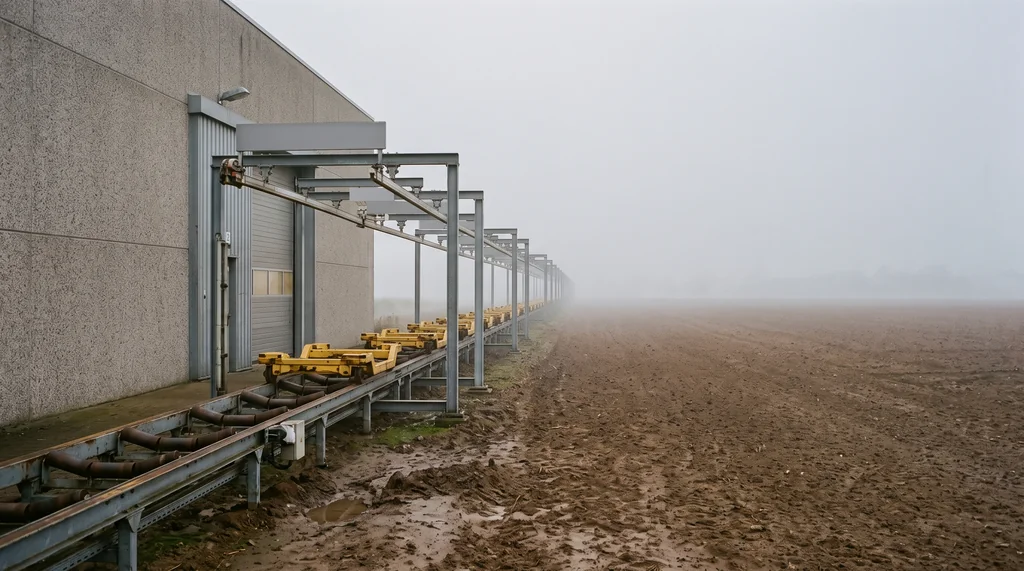
Europe’s car factories wait to learn where the next models go.
Cumadóireacht íomhá · tobriefVolkswagen has more factory than market. Its European plants can build over 500,000 vehicles more than customers are likely to buy (Volkswagen Group). On 3 September, the supervisory board signed off unanimously on Future Plan 2030, the group's attempt to close that gap. It means roughly 50,000 additional jobs going, the model range being cut in half, and about 75% of product complexity stripped out (Volkswagen Group, Reuters).
That is the arithmetic of retreat. The political question is sharper: which parts of Europe's car industry get the next generation of work, and which are left managing decline?
Factories lose work before they close
The decisive mechanism is model allocation. That is the internal process by which Volkswagen decides which plant gets the next vehicle when the current model reaches the end of its life. A factory does not have to close on paper to be finished in practice. If no successor model arrives, shifts are cut, suppliers lose orders, and the town around the plant starts to feel it.
Four German sites are now in that position. Volkswagen says competitive future production "cannot currently be secured" for Emden, Zwickau, Hannover and Neckarsulm, in stages from 2031 to 2034 (Volkswagen Group, Handelsblatt). Each now has to win the case for another model or watch its line run down.
The pressure behind the decision is not hard to see. VW's operating margin, meaning profit as a share of revenue, fell to 2.8% in 2025 on sales of €321.9 billion (Volkswagen annual results 2025). China, once the group's great profit machine, took 8% fewer cars in 2025, while battery-electric deliveries there fell 44.3% as domestic rivals gained ground (Volkswagen 2025 deliveries, Caixin). US tariffs are expected to add about €5 billion a year in costs (Volkswagen Group). The board wants a 9% operating margin by 2030, about three times the present level.
A quiet country-by-country competition
The pain will not be shared evenly. Across Europe, governments, unions and plant managers are already fighting for the models that survive.
Spain is the most sensitive case politically. Madrid has linked more than €4 billion in public money to VW's electric transition at SEAT's plants (La Moncloa, La Vanguardia). Yet leaked reports suggest the Seat brand itself could disappear by 2029, folded into the higher-margin Cupra label (El Confidencial). Unions argue that even plants with commitments need a second electric platform to keep lines busy (Público). Public money may have bought a runway, not a guarantee.
Portugal and Poland look steadier for the moment. Portugal's Autoeuropa plant in Palmela built 240,400 vehicles in 2025, worth 4.5% of Portuguese exports, and is expected to make the forthcoming ID.EVERY1 (AFIA, ECO). Poland's Września plant has a confirmed 1.5 billion złoty investment for the electric eCrafter (Volkswagen Poznań).
But final assembly is only the visible part of the car industry. Suppliers usually feel volume cuts earlier and more brutally. CLEPA, the European parts-industry association, counted 104,000 supplier job losses across 2024 and 2025, against just 7,000 new positions (CLEPA). If VW halves its model range and cuts variant complexity, there are fewer parts contracts, fewer tooling orders and less work for the small and mid-sized firms feeding the assembly lines. Portuguese and Polish component makers have already warned about this risk, even where the headline plant looks secure (ECO). A factory can stay open while the industrial web around it weakens.
Contraction first, transformation later
VW shares rose after the vote, with investors reading the plan as a route back to stronger margins (NZZ, WSJ). What is visible for now, though, is the contraction. The battery plants, software platforms and new value chains that would make this a genuine industrial renewal are less concrete than the cuts. Eurofound found that automotive restructuring announcements across Europe already covered about 106,000 jobs in 2024 and early 2025 alone (Eurofound).
Volkswagen's problem is real: too many factories for a weaker market, a China business losing ground, and an electric transition in which it is no longer setting the pace. So far, it has described the shrinkage more clearly than the rebuild. The production map due in June 2027, when VW finalises model assignments across its network, will show whether new work follows the old work out the door.
Details about this article
- Model:
- claude-opus-4-6
- Generated:
- 9/4/2026, 6:36:24 AM
- Pipeline run:
- eu_pipeline_20260904_005006
- Watermark:
- SynthID (Google's invisible watermark)
- Human review:
- None before publication