Ukraine’s drones hit a 161 km/h cap
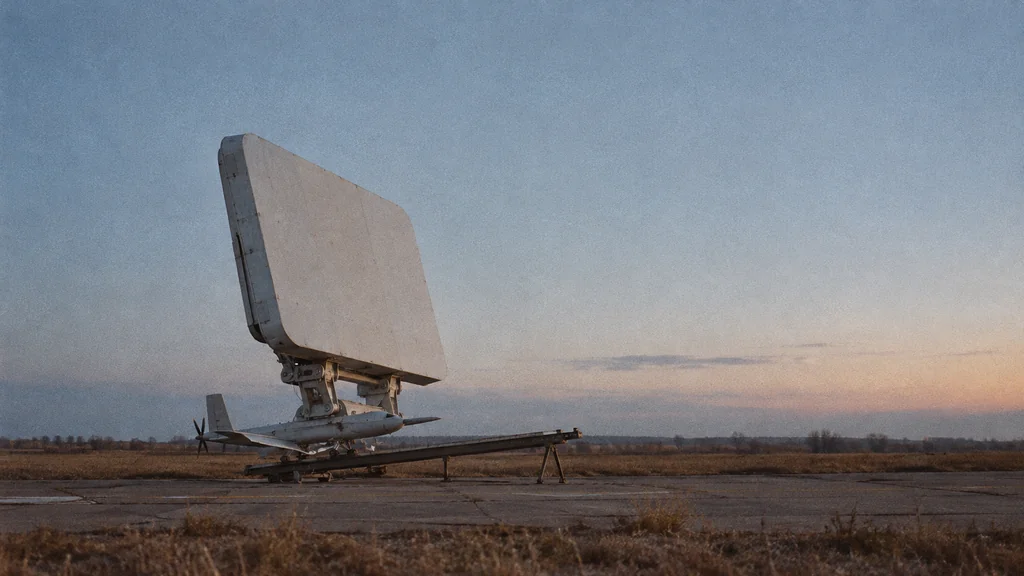
Ukraine’s drones can fly again, but the limit on their link remains.
Image composition · tobriefOvernight on 13–14 October, Ukrainian attack and interceptor drones began losing their satellite links mid-mission. Ukrainian officials traced the drops to a speed limit that appeared without warning on terminals used under Starshield, SpaceX's military satellite service (AP, Reuters). Service partly recovered, but the cap stayed, nobody has said who set it, and the EU leaders meeting on 15–16 October have nothing ready to switch on in its place (Council).
Ukraine's 7th Air Assault Corps said drone-control connections could vanish for 10 to 20 seconds even at 110–120 km/h, and some missions were cancelled (ArmyInform). An operator steering a strike drone, or chasing an incoming Russian one, can lose the target in that time.
By Wednesday evening, Defence Minister Mykhailo Fedorov said links up to 160 km/h were recovering, enough to fly attack and interceptor drones again, and demanded the limit be scrapped (Ukrainska Pravda). His ministry said the formal cap of around 161 km/h still stands (Ukrinform). These remain Ukrainian accounts. No independent telemetry or count of failed missions has been published.
A setting nobody will claim
Elon Musk said Starshield, unlike commercial Starlink, is owned and controlled by the US government, with the military and ultimately the president deciding its speed and usage limits (Musk on X). That describes who holds the controls in general. A senior US official told Axios something narrower: the administration had nothing to do with this particular restriction and would ask SpaceX what happened (Axios).
Both statements can stand together, and neither answers the question that matters. Someone changed a setting that decides whether Ukrainian drones can fly, and the US military has not said who.
Kyiv's suspicion has a recent source. At talks in Miami, Trump envoys Steve Witkoff and Jared Kushner pressed Ukraine to stop striking Russian refineries. According to the Financial Times, the 9 October meeting also brought a warning that intelligence sharing could end, though a US official denied any threat. Nothing ties Miami to the speed cap, but it explains why a technical fault reads as leverage in Kyiv.
European money has not bought European control. Germany paid for 10,000 Starlink ground stations for Ukraine in 2023 (German Foreign Office), yet by Musk's own account the limits are set in Washington.
Warnings that came late
Missile alerts show the same dependence through a different system. Zelenskyy said five ballistic missiles struck Kyiv on 12 October with no advance warning from partners (Ukrainian presidency). The next night, Air Force spokesperson Yurii Ihnat said partners missed the first wave but warned of the three that followed (Ukrinform).
Commission chief spokesperson Paula Pinho said Brussels had no indication that US intelligence sharing had stopped (European Commission). So specific alerts failed, and why is still unknown. The wider gap is older: in January 2026, the IISS judged that Europe could not yet replace the US infrared satellites that spot a missile's exhaust at launch (IISS).
What Europe can actually offer
The closest EU tool is Govsatcom, a shared pool of satellite links that member governments contribute from their own national systems. Commission spokesperson Thomas Regnier said wider Ukrainian access was under discussion and that existing capacity could provide basic connectivity, but declined to compare it with Starshield (European Commission). That suits command posts and supply hubs, not drones in flight, and the capacity belongs to the governments that own the satellites.
Hardware is the harder gap. Reuters found that allies have no ready-made terminal to fit the affected drones (Reuters). The nearest European kit, a OneWeb manpack, is built to be carried by soldiers or mounted on vehicles (Intellian). Europe's own constellation, IRIS², is not due to be fully operational until 2029 (European Commission).
Leaders can still do useful things this week. Governments with their own satellite capacity can assign it to Ukrainian command posts, others can fund compatible terminals, and some can share national imagery. None of that restores the two links that failed. The drone speed cap remained after service improved, its author is unnamed, and nothing Europe described this week replaces either the connection to drones in motion or the first warning of a ballistic launch. Both still run through American systems.
Details about this article
- Model:
- claude-opus-5-5
- Generated:
- 10/15/2026, 1:35:57 AM
- Pipeline run:
- eu_pipeline_20261015_005006
- Watermark:
- SynthID (Google's invisible watermark)
- Human review:
- None before publication