Kaub Gauge Drops to 11 Centimetres
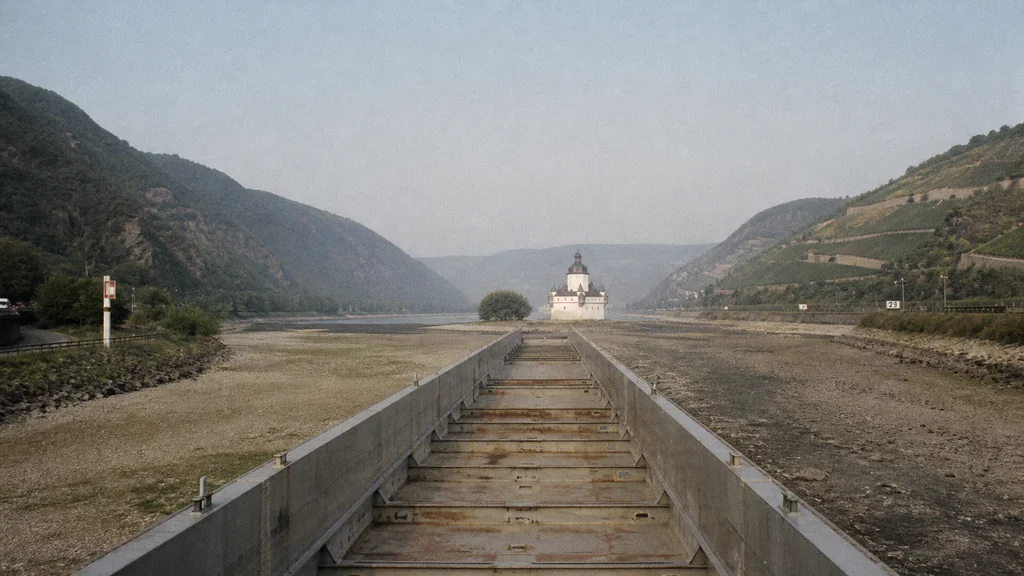
The Rhine still marks a route, but no longer carries one.
Cumadóireacht íomhá · tobriefThe Rhine’s weak point is a small measuring station at Kaub, on the Middle Rhine, where the river narrows into a commercial choke point. On Wednesday, the gauge there read 11 centimetres (ELWIS, Reuters). The previous record low, set in 2018, was 25 cm.
Kaub matters because it decides whether freight can move between the North Sea ports and Germany’s industrial heartland. Barges carrying inputs for chemical plants, steelworks and refineries all have to pass this stretch. This week, most through traffic has stopped.
As we reported earlier (To Brief), the disruption was already feeding into production costs. It has now moved into a harsher phase: for much cargo, the route is no longer commercially usable.
Barges can float but cannot carry
The gauge at Kaub does not show the river’s actual depth. It measures water against a fixed reference point. When the gauge showed 16 cm last week, the navigable channel still had about 129 cm of water (Tagesschau, Zevener Zeitung).
The problem is weight. Below 40 cm on the gauge, operators say journeys stop making commercial sense because vessels have to sail almost empty. There is no formal sailing ban; captains decide whether to go on (RTL/AFP). Most are deciding against it.
One shipowner told Argus Media that a 1,200-tonne vessel was loaded with just 180 tonnes and took five days, rather than two, to travel from the Rotterdam area to Karlsruhe (Argus). Contargo, Germany’s largest inland container operator, has suspended regular services to the southern Rhine and Rhine-Main region entirely (Arab News/Reuters).
Freight rates from Rotterdam to Karlsruhe have jumped from about €45 per tonne in June to €155–160, with petroleum loads reaching €200 (France24, Mercopress). That is no longer a nuisance charge. For low-margin cargo such as construction aggregate or animal feed, it can decide whether the shipment moves at all.
300 million tonnes with no easy substitute
The Rhine carries roughly 300 million tonnes a year: petroleum products, chemicals, iron ore, coal, grain and construction materials (S&P Global, CCNR). One 1,500-tonne barge replaces about 60 trucks (C&EN).
That scale is why the problem is not easily moved onto roads. BASF sends 75% of its European raw materials by water to Ludwigshafen, a vast integrated complex where one missing input can stop production further down the chain. The company told customers it could not guarantee delivery of some surfactants after low water cut off raw-material supply (Insurance Journal).
Transport Minister Steffen Bilger has convened a crisis summit and announced Sunday truck-ban exemptions, faster road permits and postponed lock maintenance (Zeit). At least eight German states have eased weekend trucking rules (DW).
The mismatch is stark. Industry estimates put the missing capacity at 50–75%, with up to 6 million tonnes a month stranded, equal to about 250,000 truckloads (trans.info). EU driving-time rules still apply, so drivers who work on Sunday have to rest later in the week. The exemptions shift operating hours around. They do not produce extra drivers, trucks or road space.
The same drought is hitting neighbouring parts of the corridor. Strasbourg port now receives about three barges a day instead of 20. A grain silo there reported that 70% of its cereals normally leave by water; the grain is now sitting in storage (TF1).
Germany and the Netherlands together handle more than 70% of EU inland waterway freight (Eurostat). When that corridor fails, the cost travels well beyond the riverbank. It reaches any manufacturer whose supply chain depends on German chemicals, Dutch ports or bulk materials moving cheaply through continental Europe.
The winners are few and temporary: operators with scarce shallow-draft vessels, and hauliers picking up spot work. The losers are spread across chemical plants, fuel distributors and grain handlers whose business models assume barge transport will be available and predictable.
Kiel Institute economist Stefan Kooths estimated that low water could shave 0.1–0.2 percentage points off German economic output in the third quarter (Tagesschau, DW). Nationally, that sounds manageable. Inside the affected supply chains, it is anything but. Sunday trucks, lighter barges, emergency rail slots and altered permits all ration scarce capacity. None of them creates water.
Details about this article
- Model:
- claude-opus-4-6
- Generated:
- 8/13/2026, 1:54:10 AM
- Pipeline run:
- eu_pipeline_20260813_005005
- Watermark:
- SynthID (Google's invisible watermark)
- Human review:
- None before publication