Romania Lets €770 Million Slip
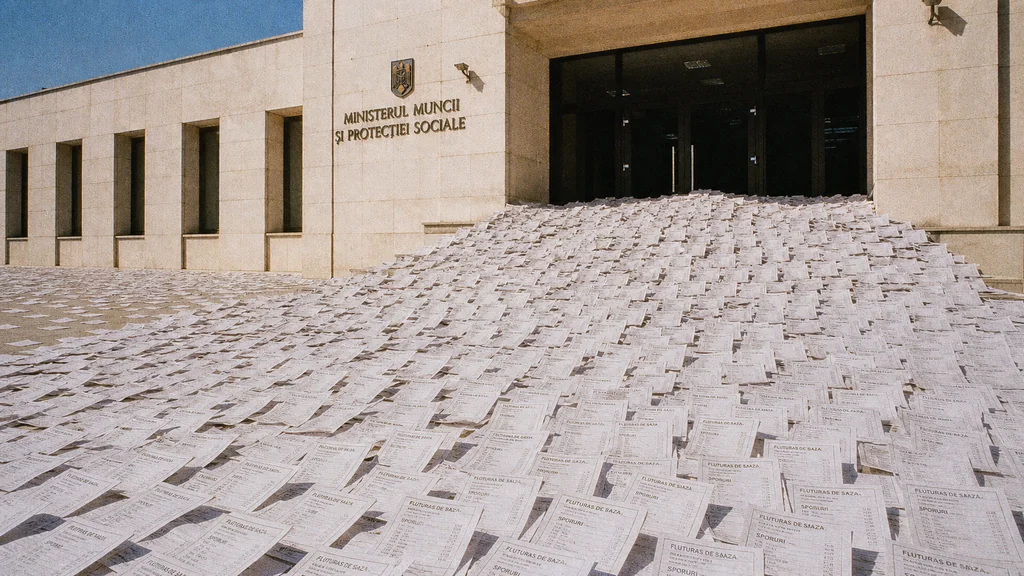
Romania’s unresolved wage patchwork piles up as the EU deadline passes.
Cumadóireacht íomhá · tobriefRomania has run out of road on one of the more politically awkward promises in its EU recovery plan. President Nicușor Dan said on 26 August that the governing parties had failed to agree a reform of public-sector pay before the EU's 31 August deadline, and had jointly accepted the loss of roughly €770 million in recovery grants (Digi24, Spotmedia).
Brussels has not yet made the cut formally. The EU's Recovery and Resilience Facility, the post-pandemic fund that pays member states for completing agreed reforms, works through a set process: Romania submits a payment request, the Commission checks whether the promised reform has actually been delivered, and only then is money reduced for a missed milestone (EUR-Lex). A Commission spokesperson said in late August that Romanian laws would be assessed through that payment request, rather than by judging draft legislation in advance (European Commission audiovisual, Euronews).
The money is therefore politically conceded but not yet legally gone, as we reported when the talks collapsed (To Brief). The practical problem for Bucharest is that the legal sequence no longer gives it much room to change the result.
The deadline kills the escape route
Romania has rescued money from the process before. On its third payment request, €350.7 million was recovered after corrections, while €458.7 million was permanently lost on milestones that remained unresolved (Agerpres, Radio Romania International). That earlier fight had one advantage: time.
This one does not. Reforms had to be completed by 31 August. Final payment claims follow in September. The EU must finish all payments by December (Commission closure guidelines, European Parliament EPRS). A law that is not passed by the deadline cannot be assessed in time. The correction window that saved part of the third request has effectively closed.
A real problem dressed up as a milestone
The wage reform was never just a Brussels checkbox. Romania's public-sector pay system is a patchwork of base salaries, sector-specific allowances known as sporuri, and institutional exceptions that can leave people in comparable jobs on very different pay (Economedia, Factual.ro). Uncapped allowances allow ministries to lift pay outside the official salary grid, which makes the total public wage bill difficult to predict.
The proposed reform would have created a single national pay scale, with a bonus cap reported at around 20% of base salary. Brussels wanted that because a unified system would make public wages as a share of the economy, the payroll-to-GDP ratio, easier to control. Romania had committed to cutting that ratio by at least 1.5 percentage points by 2031, according to Romania Insider and Nexa News.
The argument in Bucharest came down to who would carry the cost. Successive drafts pushed the price from an initial RON 8 billion towards RON 12 billion. The Commission told the government to identify permanent savings for any spending above the agreed envelope (Digi24). Unions rejected the lower reference value. Dan said the law was technically almost finished, but the unresolved question was political: how to divide the wage envelope between professional categories (Gandul).
The loss is manageable. The timing is bad.
Daniel Dăianu, head of Romania's Fiscal Council, an independent body that monitors the public finances, said the €770 million had already been factored into budget planning. Losing it would not, by itself, derail 2026 budget execution. His larger point was that the wage law still needs to pass for 2027, because its purpose is to make pay costs predictable rather than to tick off a one-off EU target (Stiripesurse).
The loss lands badly because Romania is already under fiscal pressure. Public debt reached 60.1% of GDP at the end of the first quarter of 2026, triggering domestic rules that freeze increases in personnel and social spending (Agerpres). Fitch rates the country BBB- with a negative outlook, one notch above junk, citing high deficits and poor fiscal visibility (Fitch Ratings, Romania Insider).
Romania's investment budget also leans heavily on EU money. According to Friendship Bridge's reading of finance ministry data, more than 70% of public investment in the first half of 2026 was financed through EU grants and the PNRR loan component (Friendship Bridge). When grants disappear, the state either borrows more at home and abroad or delays projects. When fiscal credibility weakens, investors charge more to lend. Romania now faces both pressures at once.
This is a harder problem than many late-stage recovery fund scrambles. Bulgaria interrupted its parliamentary recess to pass civil-service changes before the same deadline (24 Chasa). Italy has kept its plan moving through six revisions and project reshuffling (Openpolis). A delayed motorway can be moved out of a plan. A permanent wage reform either passes or it does not.
The parties in Bucharest avoided a painful vote. Public employees keep the bonus patchwork for now. If the missing grant money is replaced, taxpayers carry the cost through borrowing. If it is not, some investment will have to wait.
Details about this article
- Model:
- claude-opus-4-6
- Generated:
- 8/28/2026, 2:02:03 AM
- Pipeline run:
- eu_pipeline_20260828_005006
- Watermark:
- SynthID (Google's invisible watermark)
- Human review:
- None before publication