Volkswagen’s EV Choice Puts Jobs on Line
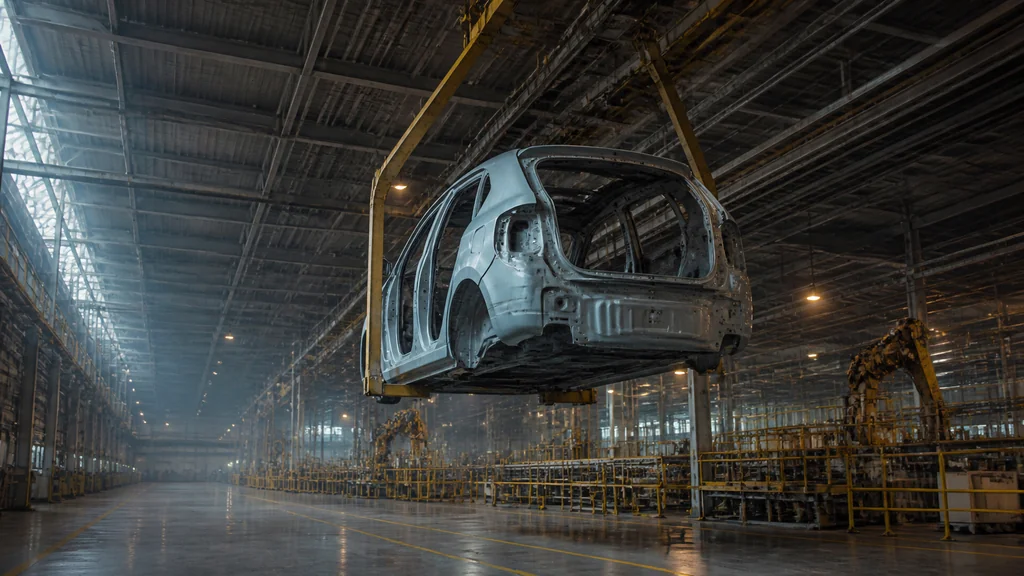
One future model now carries the weight of Europe’s factories.
Cumadóireacht íomhá · tobriefVolkswagen’s supervisory board meets on Friday with a question that sounds, at first, like an internal German corporate matter: does Oliver Blume, the chief executive, get authority to push through the deepest restructuring in the company’s history?
The answer matters well beyond Wolfsburg. In the electric-car era, the real decision is not simply whether a plant stays open. It is whether that plant gets the next model, the next platform, and the next production ramp. Across at least four EU member states, that is what will decide which factory towns keep work.
Why Blume Has Leverage
Blume is arriving at the meeting with numbers that strengthen his hand. Volkswagen’s operating profit fell to €8.9 billion in 2025 from €19.1 billion a year earlier, while revenue was broadly flat (Volkswagen 2025 results, CNBC). He has told managers that overhead costs are still more than 30% above comparable companies (Yahoo Finance).
The China story has turned against Volkswagen as well. BEV deliveries there fell 44.3% in 2025 and another 63.8% in the first quarter of 2026 (VW deliveries 2025, VW Q1 2026). China once gave European carmakers volume and margin. It is now sending competition back into Europe.
Before the full board meets, an executive committee including the works-council chief, Lower Saxony’s premier Olaf Lies, and members of the Porsche-Piëch shareholder families meets on Thursday to see whether a deal is possible (Investing.com/Reuters). That line-up tells you why this cannot be handled like an ordinary cost-cutting exercise.
Volkswagen’s power structure is deliberately hard to move. The Porsche-Piëch families control 53.3% of voting shares. Lower Saxony, the state that includes Wolfsburg, holds 20% (VW Annual Report 2025). Workers hold half the 20 seats on the supervisory board through co-determination, the German system that gives employee representatives a formal role in overseeing management. A special 1960 law also means that moving or establishing production sites needs a two-thirds board majority, so labour and Lower Saxony together can block plant decisions (Gesetze im Internet, NWZ).
A December 2024 agreement already rules out compulsory redundancies at German plants and keeps factories open until 2030 (Correctiv). Blume wants room to go further, keeping closures on the table and carving out weaker divisions. The board can give him that mandate on Friday. It cannot close a factory that day.
The Next EV Decides the Jobs
The most important restructuring may happen without a dramatic closure vote. It will come through model allocation: deciding which factory gets the next car, the next battery-electric platform, and the investment that follows. Once that choice is made, it fixes years of jobs, supplier orders and local tax receipts.
Czechia looks well placed. Škoda says its Czech factories are running at full capacity, and analysts see the brand as Volkswagen’s cost champion, able to take work from more expensive German plants (Newstream, Aktuálně). Yet Czech suppliers are already reporting order declines of tens of percent (Novinky).
Spain has bought itself time. Martorell has begun producing the Cupra Raval and VW ID.Polo after a €3 billion conversion to electric (Cinco Días). But the works committee says the factory cannot survive beyond 2030 without a second electric platform (El Nacional). That is the whole logic in one plant: one car keeps the line moving for five years; the next assignment decides what happens after that.
Hungary’s Audi plant in Győr sits in the middle of the drivetrain question. Volkswagen’s EV shift is tied directly to Hungarian industrial output, where vehicle manufacturing accounts for 26.3% of all manufacturing (KSH). Győr secured a €350 million investment last year for a new EV drivetrain programme (Audi MediaCenter).
The closure of Audi Brussels showed what happens when a site loses the allocation battle. Unions and governments can negotiate exit terms, but they cannot force Volkswagen to send a new model (Trends-Tendances). As we reported, Volkswagen already faces possible multibillion-euro EU CO₂ fines because of weak electric-car sales, which adds pressure to concentrate EV production in fewer, more efficient plants.
Where the Capacity Goes
German workers have the strongest legal protections and the weakest utilisation, meaning the share of each factory’s capacity that is actually being used. Reuters-cited projections show German passenger-car plants falling from 81% utilisation in 2026 to 73% by 2030, with Zwickau dropping from 88% to 42% (MarketScreener/Reuters). Central European plants are cheaper and fuller, but their suppliers are already taking the hit. Eurofound finds that since 2022, auto suppliers have announced more job losses than the manufacturers themselves (Eurofound).
Friday’s board meeting can give Blume the political authority to restructure. The harder judgement will come later, factory by factory, when Volkswagen decides where its future electric models will be built. Those decisions are still open, and Volkswagen’s governance ensures each one will be contested before it is settled.
Details about this article
- Model:
- claude-opus-4-6
- Generated:
- 8/30/2026, 1:49:41 AM
- Pipeline run:
- eu_pipeline_20260830_005006
- Watermark:
- SynthID (Google's invisible watermark)
- Human review:
- None before publication