€70 Million Shell Deal Ousts Pevkur
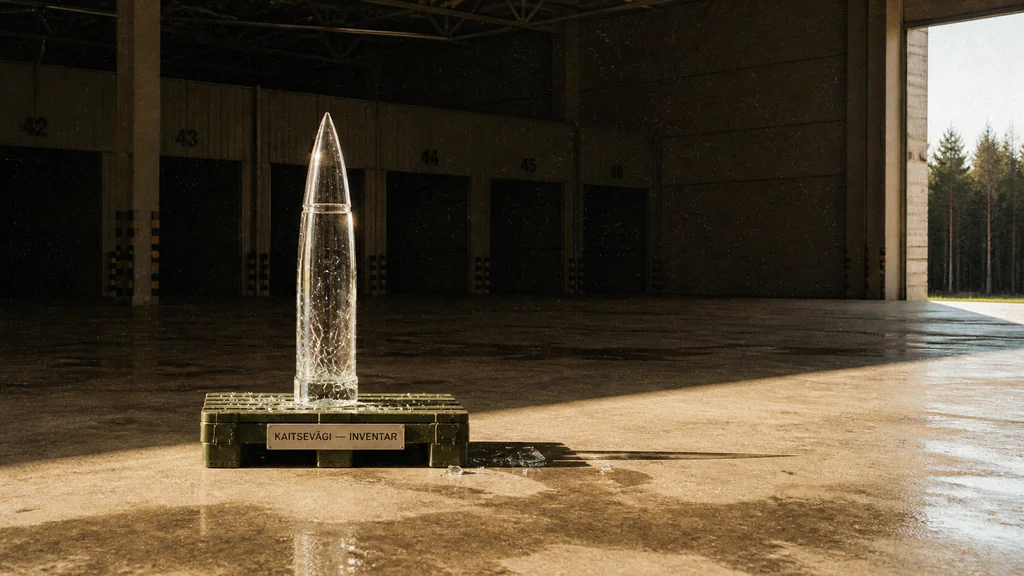
Estonia’s defence stocks look solid until the light passes through.
Image composition · tobriefEstonia's Defence Minister Hanno Pevkur resigned on 2 September after two failures that point to a familiar European problem: governments are now spending serious money on defence, but the machinery that tracks stock, checks suppliers and protects public funds has not always caught up.
For Malta, this is not a distant Baltic story. It is a warning about what happens when a small state moves quickly, relies on trusted administrative channels, and assumes that formal procedures are enough. Estonia is larger than Malta but still small by EU standards. When its defence systems fail, the margin for institutional error is thin.
The first failure was in the books. Estonia's National Audit Office, Riigikontroll, said it could not verify €1.2 billion in defence inventory balances (Riigikontroll, ERR News). The money has not disappeared, and the equipment may exist. The problem is that the Defence Ministry's records were so weak that auditors could not confirm what was sitting in state warehouses.
The second failure was a procurement case. Estonia's procurement agency signed contracts worth roughly €70 million with Datasel S.R.L., an Italian-registered company, for artillery shells intended for Ukraine. The first delivery was due by November 2024. Nothing usable arrived, and Estonia has now gone to court (ERR News, Liga.net).
Records That Couldn't Keep Pace
The audit findings, published on 28 August, describe a ministry that created its own rules for recording stock and then fell behind in entering deliveries into its accounts. The Defence Forces still did not have a modern inventory-management system. Auditors had raised similar concerns the previous year (ERR, Riigikontroll).
The mechanism is simple enough. Estonia increased defence spending quickly, as Russia's war in Ukraine forced EU states to rearm. The administrative systems behind that spending did not move at the same pace (ERR). In Maltese terms, it is the same risk that appears whenever a ministry suddenly handles larger funds than its controls were built for: the decision may be urgent, but the audit trail still has to exist.
The shell contract is harder to justify. Datasel, linked to India's Neco Defence Munitions, signed four contracts with Estonia from August 2024 onwards (Euractiv). Advance payments continued even after the first delivery failed. Riigikontroll examined €72.1 million in prepayments and found problems with €71.6 million of that amount. The largest problematic supplier had received €59.8 million (Riigikontroll).
Auditors warned that any losses could end up on the state budget, squeezing other planned spending (Äripäev). That is where procurement stops being an internal ministry issue. If the state pays advances without sufficient protection, the loser is not an abstract treasury line. It is every other programme competing for the same public money.
At a Riigikogu committee hearing on 2 September, the institutions shifted responsibility between themselves. The Defence Ministry pointed to the procurement agency. The agency pointed to its former director. Auditors said they had repeatedly asked for the disputed contract text and had not received it. Confidentiality clauses prevented public discussion of the terms (ERR News, Riigikogu).
Without that contract, the public can see the payment, the missed delivery and the court case. It cannot see whether Estonia has a realistic path to recover the money.
Datasel's corporate trail raises the obvious due-diligence question. The company's only traceable Romanian presence is a branch registered near Bucharest in June 2025 with zero employees, created after the Estonian contracts had already been signed (MetricBiz). Public materials showed no prior record of shell production and no financial scale matching tens of millions in ammunition advances (Euractiv).
If normal checks missed that, the issue is not only one failed supplier. It is the screening process that allowed the state to treat that supplier as credible.
Money Moves Faster Than Controls
The scandal comes at an awkward moment for Tallinn. Estonia received its first €351.6 million payment in August under SAFE, the EU's new defence-loan instrument, which can provide up to €2.34 billion in EU-backed financing (European Commission). SAFE is meant to help member states borrow for defence purchases at scale, backed by the EU's balance sheet.
No public SAFE document links Datasel to that loan line, and the 2024 contracts came before Estonia's SAFE agreement. Still, Estonia had presented itself as an early test case for EU defence financing. That credibility suffers when its own auditors cannot verify defence stocks or explain how €70 million in advances reached a supplier with no visible production history.
Czechia's ammunition initiative offers a different model. Prague makes monthly payments against confirmed deliveries and uses an oversight commission to monitor implementation (Czech Defence Ministry, iROZHLAS). That system has transparency gaps of its own (Seznam Zprávy). But payments tied to deliveries would have limited Estonia's exposure after the first missed shipment, rather than allowing the risk to build through a fourth contract.
Europe is building defence-finance tools faster than some member states are proving they can police the contracts those tools will support. Pevkur's resignation is the political price paid in Tallinn. The deeper question is for every EU government now turning urgent defence money into procurement: who checks the supplier before the advance leaves the account?
Estonia's parliament, courts and auditors must answer that first. Brussels, as it prepares SAFE's next disbursements, should be paying attention.
How was this article?
Help us get better
Help us get better
Details about this article
- Model:
- claude-opus-4-6
- Generated:
- 9/3/2026, 2:09:23 AM
- Pipeline run:
- eu_pipeline_20260903_005007
- Watermark:
- SynthID (Google's invisible watermark)
- Human review:
- None before publication