Jellyfish Stop Gravelines Reactors
Summer’s multiplying seas press against the machinery of cheap power.
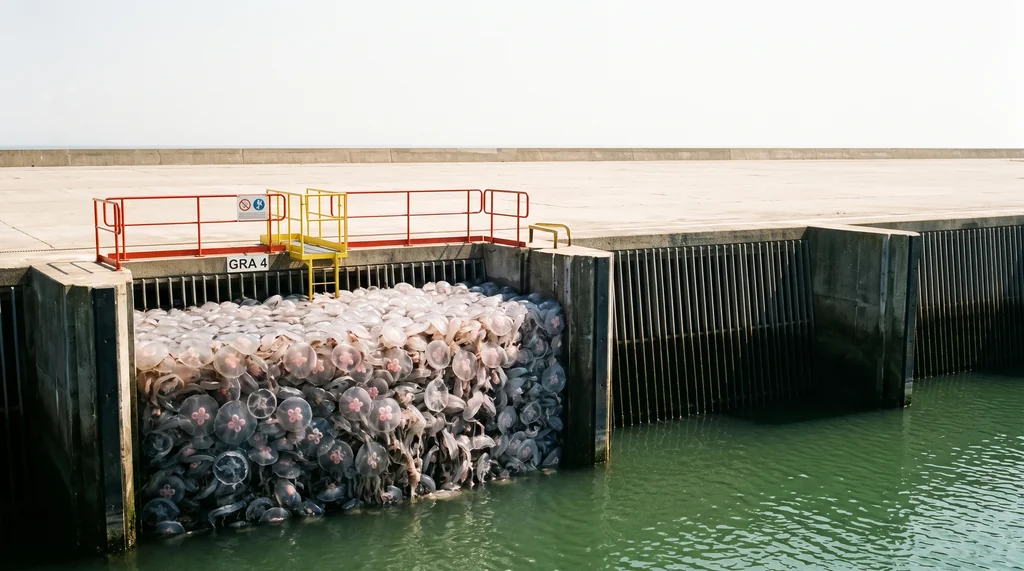
Kompożizzjoni tal-immaġni · tobriefTonnes of jellyfish blocked the seawater filters at Gravelines. Pumps lost flow, the cooling circuit on the turbine side could not work properly, and the six reactors at France's largest nuclear plant dropped out of normal operation one after another (EDF, France 24). By 27 August, two units were running at reduced power, two had stopped because of jellyfish, one was down with a technical fault, and one was already in maintenance. Not one reactor at the plant near Dunkirk was operating normally.
Gravelines has six 900 MW reactors, around 5.4 GW of capacity, enough to cover the demand of a mid-sized European country on a quiet day (EDF, El Debate). This was the third jellyfish episode there in twelve months. No radioactive system was affected. EDF said there was no consequence for safety or the environment (Le Figaro). The practical result was still serious: several gigawatts of cheap, steady electricity disappeared from a grid connected to Belgium, the UK and the wider European market.
A filter problem with a market price tag
Gravelines uses seawater to cool the non-radioactive turbine side of the plant, where steam is condensed after producing electricity. Jellyfish accumulated on the pre-screens and rotating drum filters at the pumping station, restricting the water flow needed to remove heat (France 3 Hauts-de-France). When that flow falls, operators either cut output or shut a unit down. The reactor core remains protected. The electricity does not reach the grid.
After a jellyfish episode in August 2025 shut Gravelines for nearly 48 hours, EDF installed cameras along the intake canals and worked with fishing boats to detect swarms offshore (EDF, France 3 Hauts-de-France). The new warning system did not stop the next swarm from overwhelming the intake.
The cost is not confined to EDF. In Europe's coupled electricity market, producers and buyers trade hourly blocks for delivery the next day through day-ahead auctions. When low-cost nuclear power is removed, the system has to call on more expensive gas plants or imports. That pushes up the clearing price in countries linked by interconnectors, whether undersea cables or overland lines. The impact travels until those cables are full; after that, the shock is contained.
This episode did not leave an obvious spot-price spike. France's day-ahead average on 27 August was €157/MWh, while Belgium's was €162/MWh, only slightly above the previous day (Selectra). But Bloomberg reported that the disruption helped lift French month-ahead contracts, electricity bought now for delivery next month, to their highest level since January 2025 (Bloomberg). Traders were pricing the pattern, not only the day’s outage.
The broader August picture is worse
On 12 August, 20.4% of EDF's nuclear fleet was offline for environmental reasons: heat, low river levels and jellyfish. Thirteen of France's 57 reactors were affected (France 24). That wider squeeze did move prices. Day-ahead power rose 21.8% in France and 22.8% in Germany, as heatwave-hit French nuclear output coincided with weak German wind generation (Euronext/Reuters). The European Commission said the electricity system remained stable (European Commission). Stability does not mean affordability.
The losses move through the system in stages. EDF loses production revenue first. Suppliers that sold fixed-price contracts must buy replacement electricity at the market price. Industrial users on variable tariffs feel the rise immediately. Governments take part of the hit where regulated tariffs or subsidies limit retail prices. Gas generators and other flexible producers benefit, because they sell into the higher clearing price created by missing nuclear supply.
The same type of risk appeared on the Danube this summer, where drought forced Hungary's Paks nuclear plant to cut output. The Hungarian government cited replacement-power costs, meaning electricity bought from more expensive sources to make up the shortfall, of at least 50 billion forints per month if Paks lost cooling water (Hungarian Government, MVM Paks). The trigger was different, but the mechanism was the same: round-the-clock power disappears, and the cost is shared by consumers and treasuries inside an interconnected grid.
For Malta, which buys into the same European energy market logic even from the edge of the map, this is not a French curiosity. Interconnection, imported fuels and administered prices mean wholesale shocks eventually become domestic questions, whether through Enemalta's purchasing costs, government support, or bills faced by industry. Gravelines shows that Europe's nuclear risk is no longer only about reactor safety. It is also about whether cooling systems can keep cheap electricity moving during hotter summers and more volatile marine conditions. EDF, grid operators and energy ministries have not published the thresholds or contingency rules that would help markets and neighbouring countries prepare for the next episode. This one did not produce a clean price spike. The forward market has already noticed the pattern.
Details about this article
- Model:
- claude-opus-4-6
- Generated:
- 8/28/2026, 2:05:05 AM
- Pipeline run:
- eu_pipeline_20260828_005006
- Watermark:
- SynthID (Google's invisible watermark)
- Human review:
- None before publication