Brenner tunnel hits German delay
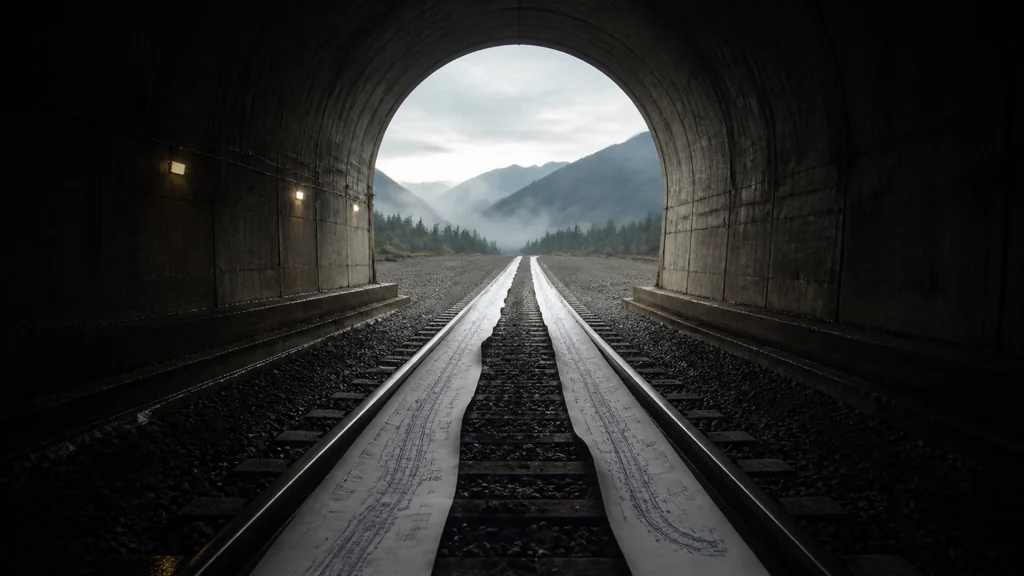
Europe completes the crossing before completing the railway that feeds it.
Kompożizzjoni tal-immaġni · tobriefThe first continuous tube of the Brenner Base Tunnel now runs 55 kilometres from Innsbruck in Austria to Fortezza in Italy, after a boring machine completed the final stretch on 25 August (South Tyrol, ANSA). When trains begin using it, around 2032, it will be the world’s longest underground railway link. The bill is €10.5 billion, of which the EU is paying €2.3 billion (CINEA).
For Malta, this is the EU at its most tangible: Brussels money, national planning systems, environmental politics and freight costs all tied into one project. The question is not whether Europe can drill through a mountain. It has done that. The test is whether it can finish the rail corridor around the tunnel before the tunnel opens.
A flat track under a steep pass
The old Brenner railway climbs gradients of 24–27 per mille, steep enough for freight trains to need extra locomotives and carry less weight (BBT SE). The new tunnel is almost flat, at 4–7 per mille. That allows longer, heavier trains and cuts the Innsbruck-to-Fortezza journey from 80 minutes to about 25 (CINEA, Webuild).
In freight economics, that matters more than the engineering spectacle. A flatter track lowers the cost per tonne and makes rail a serious competitor to trucks. For an island that imports almost everything and pays for every delay in the price of goods on the shelf, the mechanics of European logistics are not distant infrastructure policy.
The demand is already there. More than 2.5 million trucks cross the Brenner Pass each year, while rail carries only about 27% of cross-border freight on the corridor (CINEA, Bezirksjournal). Three quarters of goods still move by road. A tunnel that makes rail faster and cheaper has a market, provided the tracks on either side can feed it.
At the moment, they cannot. Germany’s northern access route from Munich through Bavaria has not entered construction. Berlin’s transport ministry sent planning documents to the Bundestag in July 2026, leaving parliament to decide whether to proceed (BMV). Bavarian reporting puts construction starting in 2034 and trains running in 2043 (rosenheim24, BR24).
If the tunnel opens in 2032, Europe could have an eight-to-eleven-year gap in which its most expensive Alpine crossing operates below full capacity because Bavaria’s tracks are not ready. Germany’s access route alone carries an estimated price tag of around €16.2 billion (n-tv, Spiegel).
Italy’s southern side is further ahead. RFI, Italy’s rail network manager, has started work on the first Fortezza–Ponte Gardena lot, worth more than €1.5 billion (RFI). But the full Fortezza–Verona upgrade remains unfinished. The Rovereto bypass is still at design stage (Daily Alpine). Italy has begun the job; it has not completed the corridor.
Switzerland already tried this
Europe has a useful comparison. Switzerland opened the Gotthard and Ceneri base tunnels and backed them with firm policy incentives to move freight from road to rail. By the end of 2024, rail’s share of Swiss transalpine freight had reached about 70%. That is high, but it had slipped 2.6 percentage points since 2022.
Around 960,000 trucks still crossed the Swiss Alps, well above the legal target of 650,000 (admin.ch, SRF). Swiss authorities blame construction works on access routes and a lack of diversion capacity. Even with a flat tunnel and a government committed to rail, the shift stalls if the connecting lines cannot cope.
Who gains, who waits
Northern Italian exporters and logistics firms are the obvious winners from faster, more reliable rail. The Italy–Germany lane alone carries more than 220,000 full truckloads a year (Contship Italia). Tyrolean communities living with lorry pollution gain only if governments also use the new rail capacity to push traffic off the road.
The losers are harder to sell politically. Long-haul road hauliers whose margins rely on cheap Alpine transit face pressure. Taxpayers on both sides carry the risk of overruns, delays and half-finished access routes. Anyone who has watched EU-funded infrastructure in a small member state knows the pattern: the ribbon-cutting is the easy part; the system around it decides whether the money was well spent.
The EU is caught in its own contradiction. Brussels co-funded the tunnel to shift freight to rail. Yet in case C-524/24, the Commission intervened on Italy’s side against Austria’s truck restrictions on the same corridor (Curia, Trasporto Europa). Austria wants to restrict trucks now. The Commission argues that such restrictions obstruct EU trade while rail capacity is not ready.
An Advocate General recommended in July 2026 that Austria’s bans violate EU free-movement law (Logifie). In plain terms, Europe is building the rail alternative while protecting the road model until that alternative works. The contradiction disappears only if the corridor is completed.
The tunnel cannot deliver the shift on its own. Whether five countries can coordinate two decades of access-route construction into one functioning freight corridor will decide whether €10.5 billion buys a transport change Europe can feel, or a remarkable piece of engineering waiting for the railway around it to catch up.
Details about this article
- Model:
- claude-opus-4-6
- Generated:
- 8/26/2026, 1:48:01 AM
- Pipeline run:
- eu_pipeline_20260826_005007
- Watermark:
- SynthID (Google's invisible watermark)
- Human review:
- None before publication