Cernavodă Shutdown Squeezes Balkan Power
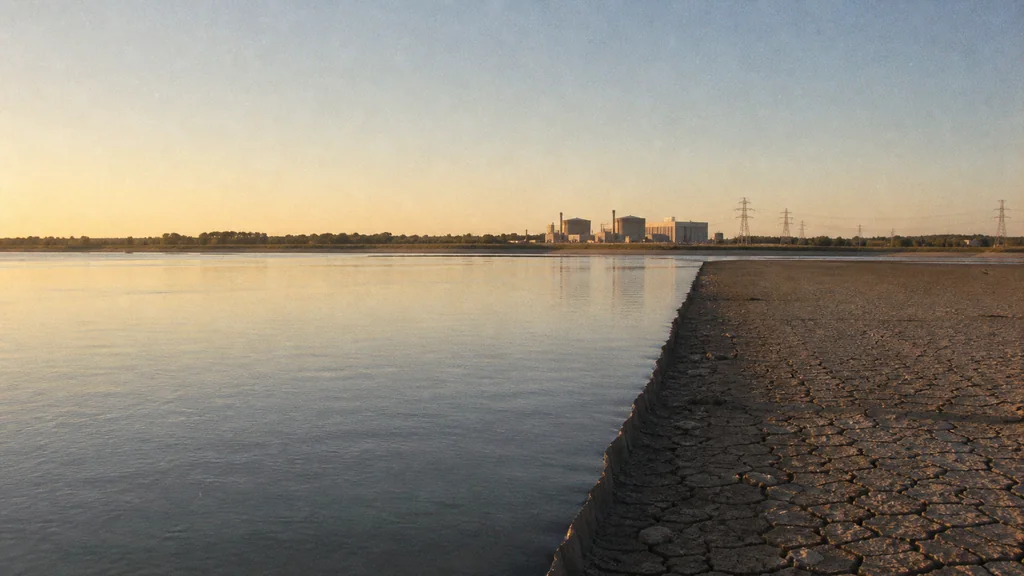
The shrinking Danube leaves five countries competing for evening power.
Kompożizzjoni tal-immaġni · tobriefAt 19:25 on Tuesday, Romania was using more than 8,000 MW of electricity. Its own plants were producing 5,873 MW. The missing 2,150 MW came through imports (Agerpres, Adevărul). That hole is now set to grow. Romania has begun preparing to shut Cernavodă Unit 2, its only nuclear reactor still operating, which supplies around 700 MW, because Danube water levels are too low to cool it safely (Argus, Economica). The immediate question is whether Romania and four neighbouring systems can share limited evening electricity without forcing one of them into painful prices or cuts.
Why 19:00 matters
The pressure comes from the hour, not only from the shutdown. In the middle of the day, solar generation pushes cheap power into the grid. By early evening, the panels fade, but air conditioning is still running. Between 19:00 and 23:00, Romania, Hungary, Bulgaria and nearby countries are all looking for the same thing: firm electricity from plants that can run on demand, or imports from someone else.
Romania has formally told Brussels and its neighbours that it is in an electricity crisis. The procedure sits under EU Regulation 2019/941, which obliges governments to alert the Commission and surrounding countries when power supply is at risk (HotNews, Ziare). The Commission called an Electricity Coordination Group meeting on 11 August and judged the system strained but stable (European Commission, Digi24). That makes blackouts less likely. It does not make power cheaper.
This is where the EU electricity market matters in very practical terms, including for small states such as Malta that import almost every major energy assumption from the wider European system. Market coupling, the automatic mechanism that sends electricity from cheaper zones towards more expensive ones until the cables are full, can move power efficiently across borders. It cannot manufacture spare megawatts at 20:00.
Who sells, who buys
For the moment, Bulgaria is on the profitable side of the trade. Romanian and Hungarian traders have requested 3,500–4,000 MW of Bulgarian cross-border capacity, according to ESO dispatch director Dimitar Zarchev (Mediapool). But Bulgaria’s Kozloduy nuclear plant depends on the same river system. Energy minister Iva Petrova said it could continue running for about another week and a half if Danube levels remain where they are (DBR). Day-ahead prices have moved towards 150–170 €/MWh, up from 100–120 €/MWh a week earlier, giving Bulgaria a windfall that may not last (Mediapool).
Hungary is the exposed buyer. Paks, its main nuclear plant, ran at half capacity for 11 days before returning to full output. That left Hungary buying evening imports at an average of 218 €/MWh on 4 August. In one hour, the price reached 439 €/MWh for 3,522 MW of imported power (VG, Portfolio). Slovakia’s energy regulator, ÚRSO, has warned of an "unusually tense" electricity situation across the region (STVR).
Inside Romania, households are protected for now. The government’s emergency plan would first target large industrial users, with staged curtailment between 19:00 and 23:00 as a last resort (Agerpres). But suppliers cannot absorb peak-hour costs indefinitely. If they keep paying more to secure electricity in the evening, the bill eventually reaches household contracts. Expert scenarios put possible day-ahead averages between 850 and 1,800 lei/MWh, with isolated evening peaks above 5,000 lei/MWh (Economica, Adevărul).
Coal, recovery money and the real trade-off
Bucharest has tied the crisis notification to a request Brussels knows well: keep coal units Rovinari 4 and Turceni 5 running beyond their scheduled closure dates (HotNews). Coal helps during evening peaks because it does not depend on sun or wind. The problem is that Romania had promised to close these units under its national recovery and resilience plan, the reform contract attached to EU recovery money. If those milestones are reversed, the Commission can suspend payments (Ziare). The Commission’s finding that there is no immediate supply risk makes Romania’s emergency argument harder to sell.
The grid is still holding. But it is holding through expensive imports, plans to curb industrial demand and a political fight over coal commitments tied to EU money. That is stability, but it is not comfort.
Details about this article
- Model:
- claude-opus-4-6
- Generated:
- 8/12/2026, 1:48:18 AM
- Pipeline run:
- eu_pipeline_20260812_005006
- Watermark:
- SynthID (Google's invisible watermark)
- Human review:
- None before publication