Danube drought cuts Bulgaria’s nuclear cushion
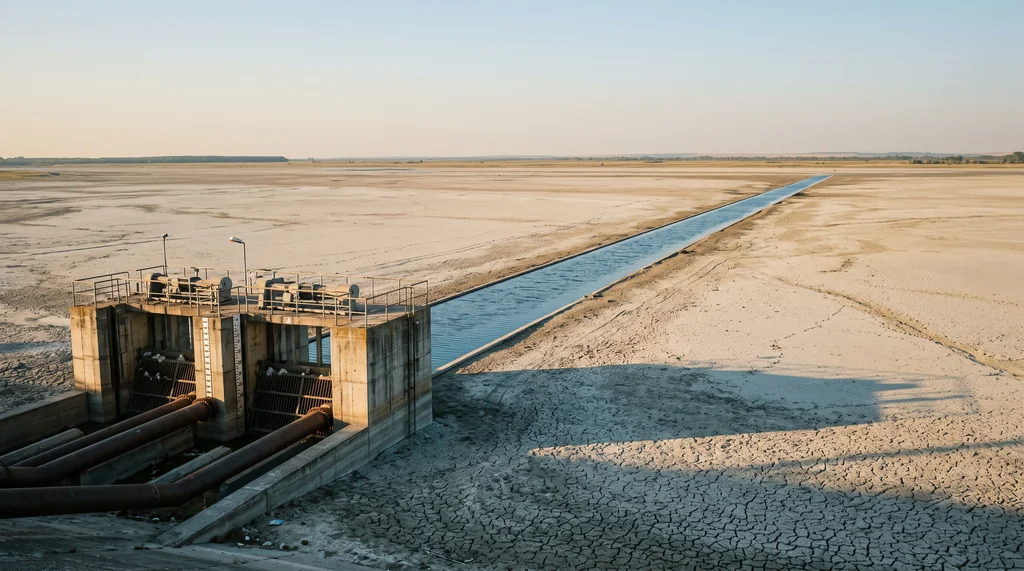
The Danube recedes, taking south-east Europe’s electricity buffer with it.
Kompożizzjoni tal-immaġni · tobriefBulgaria’s Kozloduy nuclear plant has cut electricity generation for the first time in its 52-year history because the Danube fell too low to cool its turbines properly. The reduction is modest. The timing is not. It took away south-east Europe’s biggest spare electricity cushion just as Romania and Hungary were already scrambling to keep their own Danube-cooled reactors running.
Why low water means less electricity, not reactor danger
Bulgaria’s Energy Ministry said on 20 August that Unit 5 would reduce output by about 120 MW, calling it a preventive response to "continuing unprecedented and critical" Danube levels (Bulgarian Energy Ministry, 20 Aug). By 26 August, plant data showed Unit 5 had fallen from around 1,010 MW to 850 MW, a drop of roughly 15% (SEGA, Fakti). Energy Minister Iva Petrova said there was no crisis (Bulgarian Energy Ministry, 21 Aug).
That is true, but only in the narrow nuclear-safety sense. Danube water is not cooling the reactor core. It cools steam in the condensers on the turbine side, the machinery that turns heat into electricity. When the river is too low, intake pumps have less water to work with, the cooling loop becomes less efficient, and the plant produces less power even though the reactor’s safety systems remain separate and intact (Actualno, Fakti EN). This is an electricity shortage problem, not a nuclear-accident problem.
For Maltese readers used to thinking of energy security through interconnectors, generation margins and imported fuel, the lesson is familiar: the weak point is often not the headline technology but the supporting system around it. Here, the same river created three different engineering problems in three countries. As we reported last week, Romania ordered emergency dredging and reservoir releases to keep water reaching Cernavodă, which normally supplies about a fifth of Romanian electricity (Agerpres, World Nuclear Association). Hungary spent HUF 6.1 billion on stone barriers and sunken barges to raise the water level at Paks (kormany.hu).
The buffer that shrank
When Kozloduy cut output, Bulgaria was exporting roughly 30,000 MWh a day against domestic consumption of about 90,000 MWh (Bulgarian Energy Ministry, 21 Aug). That surplus was already helping neighbours cover gaps. On 6 August, Romania imported a net 2,240 MW during the evening peak, with Bulgaria supplying most of the physical flow (Newscenter). Kozloduy’s reduction did not create Romania’s dependence on imports. It reduced the supply Romania was already using.
The price signal shows up across the region. On 26 August, day-ahead wholesale prices, the prices paid by generators and large buyers for electricity delivered the next day, were tightly grouped: Bulgaria at 172 EUR/MWh, Romania 175, Hungary 172, and Greece 173 (euenergy.live). Germany-Luxembourg, further from the stress, was at 126 EUR/MWh (euenergy.live). That gap is the cost of replacing steady nuclear output, the kind of power that normally runs day and night, when water conditions force plants to scale back.
Who gains, who pays
Slovakia is the obvious winner. Its nuclear plants at Bohunice and Mochovce use cooling towers rather than drawing directly from the river, so low Danube levels barely affect them (Denník E). During the stress, Slovak power flows to Hungary exceeded 2.5 GW in some hours (SITA).
The losers are on both sides of the meter. Nuclear operators tied into regulated or pre-agreed prices lose margin when they must buy expensive replacement power to cover shortfalls. Industrial users carry the first interruption risk: Hungary’s emergency rules allow grid operator MAVIR to cut power to factories drawing more than 0.5 MW before households are touched (HVG). Romania’s Nuclearelectrica has warned customers that it may not be able to honour contracts because of events outside its control (ZF).
The European Commission said on 11 August that Europe’s electricity system remained stable despite extreme weather (European Commission). At continental level, that statement holds. At regional level, stability depended on dredging, barges, stone barriers, emergency reservoir releases and costly evening imports. The system held, but the useful disclosure now is not another reassurance. It is the water level at which each operator must cut output, published before the next drought forces another improvised response.
Details about this article
- Model:
- claude-opus-4-6
- Generated:
- 8/27/2026, 1:54:44 AM
- Pipeline run:
- eu_pipeline_20260827_005006
- Watermark:
- SynthID (Google's invisible watermark)
- Human review:
- None before publication