Estonia’s bunker order lands in court
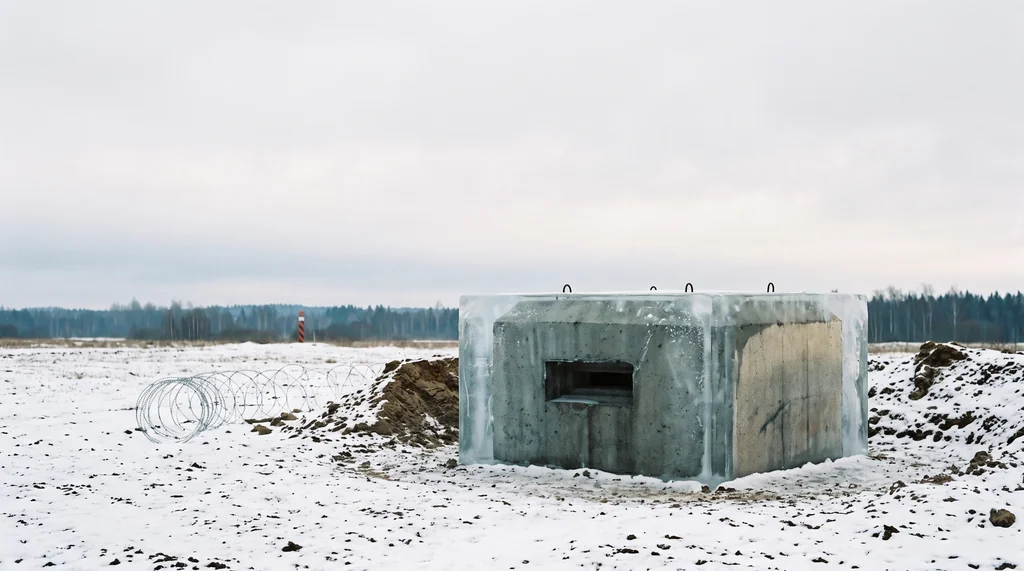
Estonia’s defensive timetable hardens around a dispute over standards.
Kompożizzjoni tal-immaġni · tobriefEstonia’s defence procurement agency, RKIK, cannot place the next order for concrete bunkers on the country’s eastern border. One bidder has challenged the certification rules in the latest tender, and the case has now moved to court. Until that is settled, the large order meant to turn a limited pilot into a defensive line capable of slowing an attack remains frozen.
The aim is to have roughly 600 concrete bunkers by the end of 2027, as part of a wider system of strongpoints, anti-tank obstacles, wire and ditches along Estonia’s border with Russia (Estonian Defence Ministry). RKIK has completed a first tranche of 28 units, nine of which had been reported as installed by early 2026. The tender now blocked is the one meant to move the project beyond that trial phase.
The standards that blocked the order
According to Postimees, the bidder challenged the procurement over its ISO 9001 and ISO 14001 requirements. These are international standards for quality management and environmental management, often used by contracting authorities as a quick way of testing whether a supplier can deliver reliably. The court question is whether those demands were proportionate, or whether Estonia should have accepted other evidence that the bidder was capable of doing the job.
That challenge is possible because EU procurement law still reaches into defence contracts. Directive 2009/81/EC, the EU’s specific regime for military procurement, allows tender conditions to be reviewed. Article 346 of the EU treaty gives member states room to protect essential security interests, but it is not a free pass to ignore competition rules. A losing bidder can still ask a court whether a tender was written too narrowly. That is what has happened here.
Three countries, one political promise
The Baltic Defence Line is not one EU-style project run from a single centre. It is three national builds tied to one political commitment. Estonia, Latvia and Lithuania agreed the concept in January 2024, linking it to NATO’s post-Vilnius pledge that allied territory should be defended from the first metre.
Each country pays for, designs and builds its own section through its own institutions. A field report from Delfi Latvia found the Latvian stretch focused on anti-tank obstacles and ditches, with uneven progress. An independent military analysis described the line as coordinated in concept, but different in execution from country to country.
Estonia’s court case does not legally stop Latvia or Lithuania from continuing their own work. But Estonia had set the clearest concrete target and built the most advanced pilot. If it cannot move from pilot to scale on time, the most visible part of the regional promise stalls. In a small frontline state, that kind of delay carries a political message well beyond the tender file.
The deadline now runs through court
The 2027 target is not dead yet. If the litigation is resolved quickly and RKIK can award the contract without restarting the tender, the timetable may still hold. But there is no public document showing a contingency plan, an alternative supplier route, or revised milestones that factor in the lost months.
NATO can set the strategic promise. Estonia still has to buy the concrete. The bunker delay does not show that the Baltic Defence Line is failing, but it does show how the alliance’s forward-defence commitment can be slowed by ordinary national procurement law. Estonia’s deadline now depends on a court calendar and on a procurement fallback the public has not seen.
Details about this article
- Model:
- claude-opus-4-6
- Generated:
- 8/7/2026, 2:01:57 AM
- Pipeline run:
- eu_pipeline_20260807_005006
- Watermark:
- SynthID (Google's invisible watermark)
- Human review:
- None before publication