E3 Pushes Into Ukraine Talks
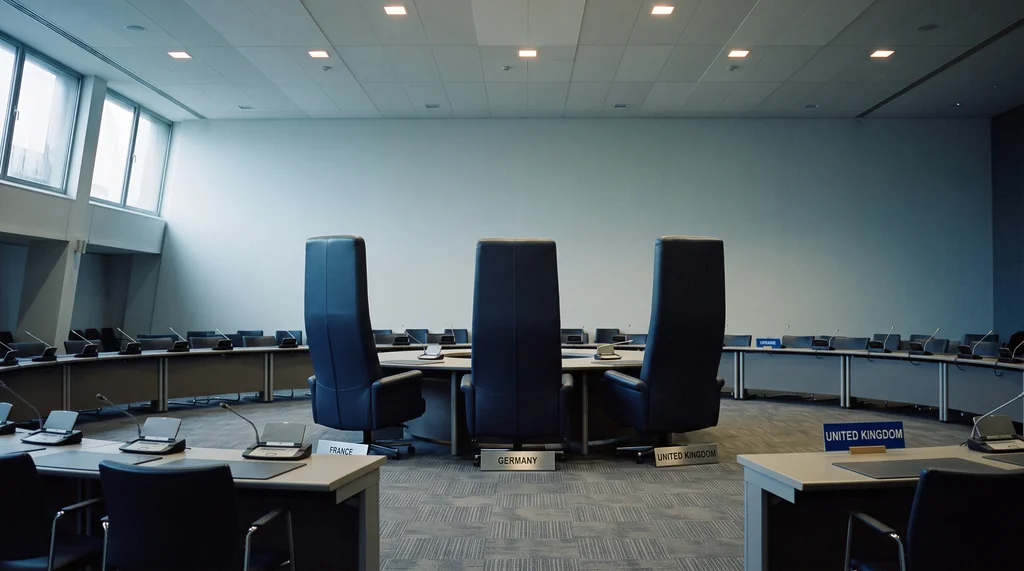
Europe seeks a seat while deciding who may speak for it.
Kompożizzjoni tal-immaġni · tobriefFrance, Germany and the United Kingdom are working on a joint format to make sure Europe is in the room if negotiations begin to end Russia’s war against Ukraine, according to European officials cited by the New York Times. This is not yet a peace plan. It is a piece of diplomatic plumbing: Paris, Berlin and London are trying to convert Europe’s sanctions, money and military support into influence before Washington sets the process without them.
The immediate reason is Sergei Lavrov’s statement on 14 August that Moscow would not refuse another meeting with Trump envoys Steve Witkoff and Jared Kushner (Bloomberg). A US-Russia shuttle now looks more plausible than at any point since the full-scale invasion. If talks start on Washington’s terms, Europeans risk being presented with outcomes they helped pay for but did not shape.
What the E3 actually controls
The three governments do have leverage, though much of it matters after any deal rather than inside the negotiating room itself. EU sanctions against Russia require unanimity in the Council, meaning every member state has a veto, including Malta (Council of the EU). Washington and Moscow can talk about sanctions relief, but they cannot switch off European measures by themselves.
Ukraine’s EU membership path is another lock held by the member states. Under Article 49 of the EU treaty, accession needs unanimous approval (EUR-Lex). Frozen Russian assets also sit largely in European banks and clearing systems. On 5 August, the Commission said revenues from those assets had funded another €1.4 billion for Ukraine (European Commission).
Europe may not control the first conversation. But it controls several of the doors that any settlement would need to pass through.
The bypass inside the bypass
The E3’s problem is that a format meant to stop a US-Russia bypass of Europe could end up creating a Paris-Berlin-London bypass of the rest of Europe. Reports describe a three-tier structure: the E3 as the operational core, Poland, Italy and Nordic countries consulted in a second ring, and EU institutions brought in later (the New York Times, European Pravda). Consultation is not the same as a mandate.
That question was already live before this format emerged. In July, former senior officials from Britain, France, Germany and Russia met secretly in Vienna, as Bloomberg reported. No government claimed the meeting as official; the German Foreign Office reportedly said any alleged contacts were not conducted on its behalf (Berliner Zeitung). But Vienna revived the core wartime rule: nothing about Ukraine without Ukraine. The E3 now has to respect that principle if its coordination effort is to look legitimate rather than exclusive.
The countries facing the most direct risk are in the second ring or outside the format altogether. Poland, under Russian hybrid pressure and central to NATO logistics, has not endorsed an E3 mandate; Warsaw’s public line remains focused on rearmament and the US alliance (KPRM). Romania, where drones from the war zone have triggered F-16 scrambles near Tulcea (Agerpres), needs any peace terms to reduce real military exposure along its Black Sea border. Finland’s president said on 14 August that Europe should prepare for Russia as a long-term threat even after any ceasefire (Finnish government).
Italy makes the legitimacy issue sharper. As a G7 member and a vote in every EU sanctions decision, Rome may accept the E3 as a coordination channel, but not as a replacement for the forums where Italy actually co-decides (Adnkronos, RBC Ukraine). Even within the E3, Britain is reportedly more cautious than France, wary of damaging its relationship with Trump (European Pravda).
There is no published E3 text. Neither Washington nor Moscow has accepted a European seat. The three capitals are positioning, not negotiating. The E3 can make a serious case for a European voice in talks that could reshape the continent’s security order. It cannot credibly claim to be that voice unless the countries carrying the direct risk are part of the mandate.
Details about this article
- Model:
- claude-opus-4-6
- Generated:
- 8/16/2026, 1:57:39 AM
- Pipeline run:
- eu_pipeline_20260816_005006
- Watermark:
- SynthID (Google's invisible watermark)
- Human review:
- None before publication