Germany’s €500 Billion Fund Falls Short
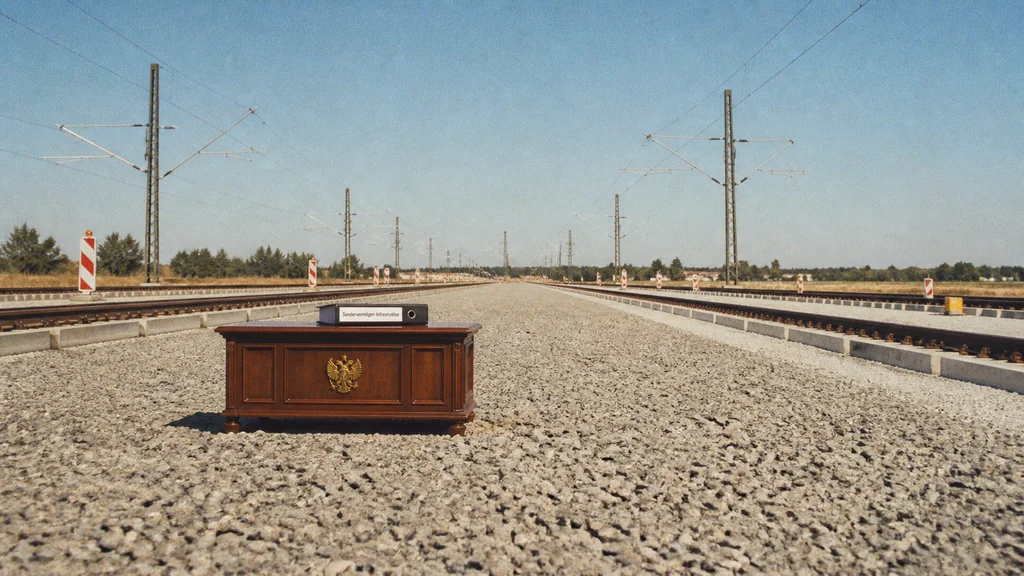
Germany’s borrowing apparatus arrives before the infrastructure it promised.
Kompożizzjoni tal-immaġni · tobriefGermany’s €500 billion infrastructure fund sounds like money ready to be spent. It is not. It is a constitutional borrowing limit, approved in March 2025, that lets Berlin raise debt for roads, railways, hospitals and climate projects over twelve years. The debt is kept outside Germany’s normal borrowing rule, the debt brake, which limits the federal structural deficit to 0.35% of GDP (Bundestag WD 4-032-26). The federal budget pays the interest. Repayment begins no earlier than 2044.
The split is clear: €300 billion for federal investment, €100 billion for state and local governments, and €100 billion for the Climate and Transformation Fund (BMF FAQ, Bundesregierung). The number is huge. The early evidence is much smaller.
Borrowed Money That Replaced Old Spending
In 2025, the German government borrowed €24.3 billion through the fund. Federal investment, however, rose by only €1.3 billion compared with the previous year (ifo). The ifo Institute’s conclusion was blunt: 95% of the new debt did not finance additional infrastructure. It replaced spending that had already been sitting in the ordinary budget. The IW economic institute, using another method, put the substitution rate at 86%, with around €12 billion covering items the regular budget used to pay for (Tagesschau).
The trick lies in the rulebook. Before money from the fund can be used, the ordinary federal budget must keep investment above 10% of total spending. For 2026, the government reports 10.5%, just above the threshold (BMF Sollbericht 2026). But the Bundesbank noted the obvious weakness: the ratio was already above 10% before the fund was created (Bundesbank). Berlin can therefore satisfy the legal condition while shifting old investment into the new vehicle, leaving more space in the ordinary budget for other priorities.
The Finance Ministry rejects that interpretation. In its April 2026 analysis, it says €168.3 billion in planned fund investment between 2025 and 2028 is genuinely additional, around 95% of the total (BMF April 2026). But the ministry is measuring planned allocations. The critics are measuring what changed in actual spending. Germany’s federal auditor, the Bundesrechnungshof, backed the sceptics, pointing to around €16 billion in rail construction grants for 2026 as a clear example of relabelling: spending that was already under way, now booked under the fund (Handelsblatt).
By late July 2026, €51.1 billion had been disbursed, roughly a tenth of the full envelope (Zeit).
Why the Rest of Europe Is Watching
If the fund eventually turns into real construction orders, Germany’s neighbours will feel it. Around 28% of Polish exports go to Germany, mostly industrial components, so a genuine building programme would feed directly into Polish suppliers (Rzeczpospolita). The Bundesbank estimates that infrastructure and defence spending together could add around 1.3 percentage points to German GDP between 2025 and 2028 (Bundesbank).
For Malta, the issue is less about supplying German construction sites and more about the politics of fiscal space. Small eurozone states live with rules largely shaped by the big economies, and the German debt brake has long been treated as a model of discipline. Berlin has now created a constitutional route around its own rule while still resisting broader loosening of EU fiscal rules. That matters in a eurozone where borrowing costs, deficit procedures and Commission judgments are not academic questions but constraints on what governments can actually do.
France cannot copy Germany’s move so easily. It is already under the EU’s excessive-deficit procedure, the mechanism used when a member state breaches the bloc’s deficit or debt limits. It is paying 4.10% on ten-year bonds, compared with Germany’s 3.25%, and its public-debt gap with Germany exceeds 50 percentage points of GDP (Le Monde, Sénat). Italy’s finance minister Giancarlo Giorgetti put the imbalance plainly: if the EU allows borrowing flexibility for defence, the same logic should apply to energy security (ANSA).
Germany can borrow cheaply for priorities it defines as strategic. Higher-debt countries trying the same approach pay more because markets charge them higher interest. That is the real European argument behind the German fund: not whether infrastructure is needed, but who gets to bend fiscal rules without paying a political or financial premium.
The fund has legal force and constitutional cover. What it has not yet shown is investment on the scale implied by the borrowing. In 2025, €24 billion in debt produced only around €1–2 billion in extra spending. If 2026 follows the same pattern, Germany will have built an elaborate mechanism for large-scale borrowing while its roads, bridges and railways improve at only a fraction of the pace suggested by the headline figure.
Details about this article
- Model:
- claude-opus-4-6
- Generated:
- 8/24/2026, 1:50:46 AM
- Pipeline run:
- eu_pipeline_20260824_005006
- Watermark:
- SynthID (Google's invisible watermark)
- Human review:
- None before publication