Greece’s €3.1bn Shield Needs Code
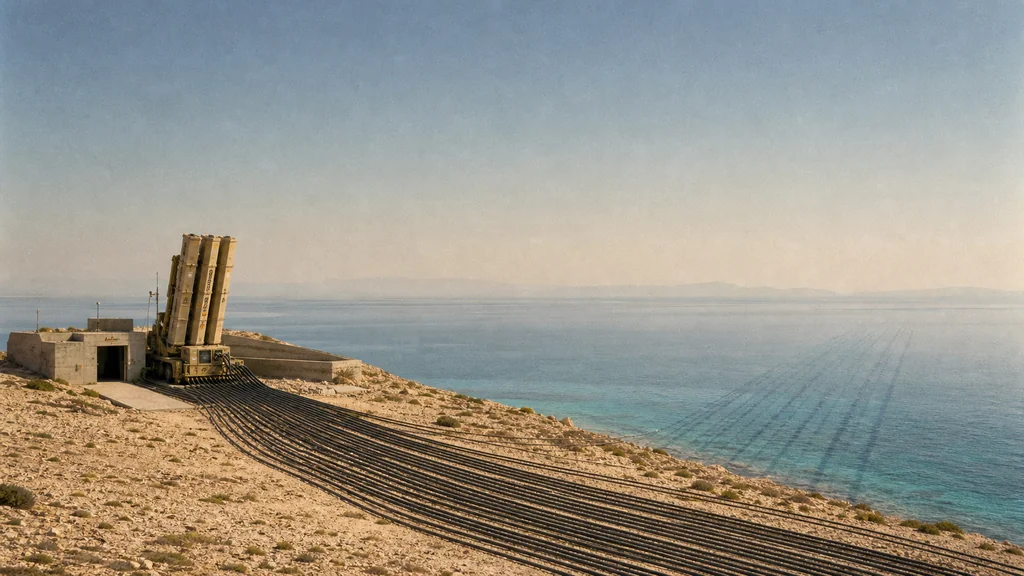
Greece buys a shield while control remains beyond the horizon.
Kompożizzjoni tal-immaġni · tobriefGreece and Israel are expected to sign agreements worth around €3.1 billion on 31 August for the Achilles Shield, a layered air and missile defence network (Cyprus Mail, Breaking Defense). For Malta, this is not a distant Aegean procurement story. It is a reminder that Mediterranean security is increasingly being written in software, supply chains and foreign-owned upgrade cycles.
The package would give Greece three Israeli interceptor families covering drones, cruise missiles and ballistic threats. Israeli reporting says it would be the largest defence export in Israel’s history (Calcalist Tech). But the value of the deal depends on something that will not be visible at the signing ceremony: who controls the source code, who supplies the missiles, and who decides what the system can do five years from now.
What Greece is buying
The programme brings together three systems: Rafael’s SPYDER for short- and medium-range threats such as drones, Israel Aerospace Industries’ Barak MX as a modular middle layer, and David’s Sling (Rafael/Raytheon) for cruise and ballistic missiles (Jerusalem Post, Hurriyet Daily News). These are not three stand-alone purchases.
They are meant to feed into a unified command centre, modelled on Israel’s own integrated system and running AI-enabled software. That centre would connect sensors, launchers, Greece’s existing Patriot batteries and the new Israeli interceptors, allowing commanders to match each incoming threat with the appropriate weapon (AeroTime, i24NEWS).
Defence Minister Nikos Dendias has said full operational capability should come within 35 months, with staged deliveries rather than one final handover. Greece’s top national-security cabinet approved the programme on 23 July (Breaking Defense).
The signatories in Tel Aviv are Greece’s defence procurement directorate and Israel’s defence-export cooperation arm, with Israeli contractors at the table. These are procurement offices, not diplomatic ones. That points to an implementation package rather than a symbolic memorandum (Calcalist Tech).
The source-code question
Athens reportedly secured two concessions intended to avoid the familiar trap of buying foreign defence systems: industrial dependence and software lock-in. Greek press reports say at least 25% of the programme value, more than €700 million, will go to roughly 12 Greek subcontractors (SKAI). Several outlets also report that Greece demanded source-code access for the critical command-and-control software (Strategist Cyprus, Naftemporiki).
Both claims matter, but both remain vague. No reporting has clarified whether "source-code access" means full source code, escrow rights, sovereign configuration authority or something narrower. The contract text, payment milestones, interceptor replenishment terms and lifecycle costs have not been published.
This is the part Maltese policymakers should recognise. Small states often buy capability from larger partners because they need speed and scale they cannot build at home. The real question is whether the contract leaves them with operational control, or with an expensive dependency dressed up as sovereignty.
Whether NATO systems can talk to it
Greece is buying this system because of its geography. Achilles Shield is designed around the Aegean, Thrace, the Greek islands and the eastern Mediterranean, with Turkey as the principal named regional factor (DefenseRomania). The threat map is concrete, the timetable is tight, and Israel has recent operational experience in layered interception. Speed and tested equipment carried more weight than waiting for collective European alternatives.
The deal’s NATO value depends on whether Achilles can plug into the alliance’s Integrated Air and Missile Defence System, the framework that links national sensors and weapons into a shared air picture (NATO). Greece’s Patriot batteries already have NATO data-link interfaces, although specialists note they still need a full capability modernisation.
Bulgaria shows why this matters in practice. Sofia still relies on old Soviet-era systems with limited anti-drone capacity and has depended on Greek Patriot support and F-16s under NATO coordination (BTA, Mediapool). A stronger Greek air-defence layer could widen that umbrella. A bespoke Israeli architecture with weak alliance connectivity would leave Greece better protected, but less useful to the wider NATO picture.
Europe is already building several shields at once, each tied to different contractors, software and ammunition. Germany’s Sky Shield Initiative combines German IRIS-T, US Patriot and Israeli-US Arrow (BR). France has criticised that initiative, and deals such as Achilles, for sidelining the Franco-Italian SAMP/T NG system and weakening European industrial sovereignty (Opex360).
The EU’s own defence-industrial instruments are designed to steer procurement toward European suppliers (European Commission, Council). Achilles moves in the other direction. It gives Greece speed, but it also gives Israeli industry a central role in a NATO member’s future air-defence architecture.
Athens can answer the dependency question only by publishing enough of the contract architecture to show who controls upgrades, data links, replenishment and source-code rights. Until then, Greece has bought speed. Whether it has also bought independence remains buried in annexes that nobody outside the procurement directorate has seen.
Details about this article
- Model:
- claude-opus-4-6
- Generated:
- 8/31/2026, 1:51:36 AM
- Pipeline run:
- eu_pipeline_20260831_005006
- Watermark:
- SynthID (Google's invisible watermark)
- Human review:
- None before publication