Hungary’s €10 billion proof test
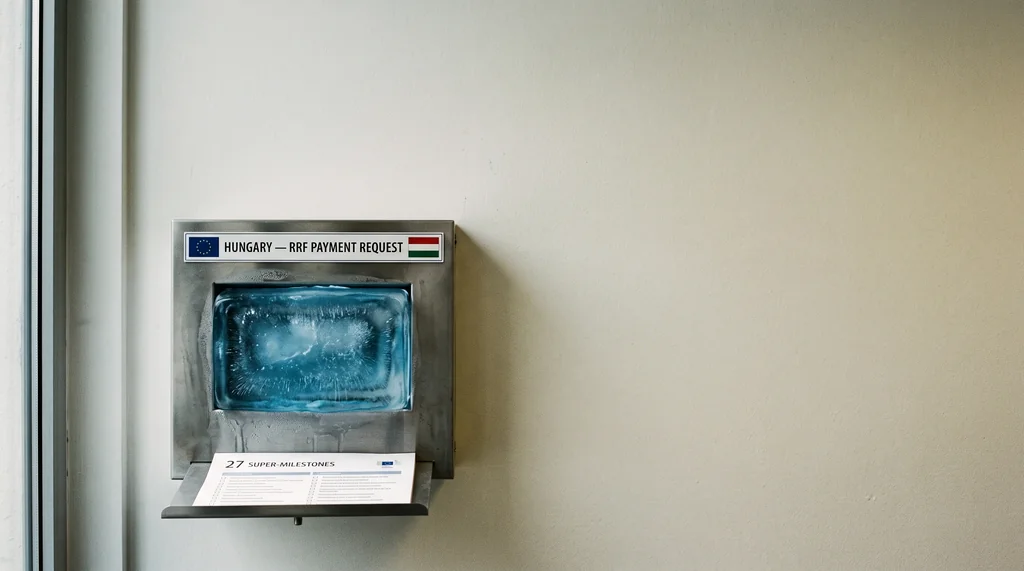
Hungary preserves the funds, but Brussels still awaits proof.
Kompożizzjoni tal-immaġni · tobriefBudapest revised its EU recovery plan twice before the August deadline, keeping open access to roughly €10 billion in frozen EU money. The route is open, but the account is still empty. The European Commission has not yet judged whether Hungary has met the conditions attached to the funds, and cannot do so until Budapest files a formal payment request, expected by the end of September.
Approved route, empty account
On 10 July, the Council of the EU, where national ministers approve EU decisions, endorsed Hungary’s revised recovery plan (Council press release, EUR-Lex COM(2026)316). That gave Budapest a route back to about €6.5 billion in grants and €3.5 billion in loans (Commission staff assessment).
For Malta, this is the part of EU politics that often matters more than the press conference: the legal step is not the same as the money moving. The Recovery and Resilience Facility, created after the pandemic, pays member states only after agreed reforms and investments are completed. In Hungary’s case, the money is tied to rule-of-law safeguards, anti-corruption enforcement and control over EU funds.
A second revision followed in August. Budapest submitted 36 further measures on 25 July, and the Commission backed that change on 5 August (Telex, EUR-Lex COM(2026)432). But support for a revised plan is not approval for payment. As the Commission said in briefings in April and July, the formal assessment of Hungary’s 27 super-milestones begins only once Budapest submits its official payment request.
Those super-milestones are the rule-of-law and anti-corruption conditions blocking the money. According to a Commission response reported by Infostart, no transfer has taken place. When Hungary claimed at the end of August that it had met every condition, that was Budapest’s political position, not a Commission finding.
What Budapest still has to prove
The 27 super-milestones cover anti-corruption enforcement, judicial independence, university governance and checks on EU funds. HVG reported that 21 are linked to corruption and transparency, four to the judiciary, and two to financial controls.
Péter Magyar’s government, which replaced Viktor Orbán’s Fidesz after last year’s political earthquake, has moved quickly. Budapest has passed laws allowing judicial review when corruption cases are dropped, returned assets from Orbán-era public-interest foundations to the state, and joined the European Public Prosecutor’s Office, the EU body that investigates crimes against the EU budget. EU Law Live confirmed Hungary’s EPPO accession.
But accession to EPPO is the start of the test, not the end of it. The question is whether Hungary appoints prosecutors, gives them resources, and allows access to politically sensitive cases. Maltese readers know this distinction well: institutional reform means little if the office exists but the leverage sits elsewhere.
Speed also creates weakness. Hungary’s Constitutional Court is reviewing an opposition challenge to the EU compliance package, the bundle of laws Budapest is presenting as evidence that it met the milestones. If the court strikes parts of it down, the Commission may be left assessing reforms that exist in legal drafting but not in enforceable law.
The timetable now pressures both sides
Three deadlines now govern the endgame. Reforms and investments had to be completed by 31 August 2026. Final payment requests are due by the end of September. The Commission must issue final payments by 31 December (Commission closure guidance, EU Perspectives).
That leaves Brussels with little room to verify complex reforms. It must either delay payment, accept a thinner evidentiary record, or conclude that the conditions have not been met. For smaller member states such as Malta, which rely heavily on EU funding but also live with intense scrutiny over governance, the precedent matters. EU money is domestic policy once it reaches the ground.
The Dutch government has been the clearest voice of caution. In parliamentary answers, it said blocked funds should not flow without full compliance, and that wrongly released money should be recovered. Dutch budget documents noted that Hungary had already lost €1 billion at the end of 2024 and another €1 billion at the end of 2025 for missing earlier deadlines. Under the RRF, missed deadlines can destroy access permanently, not merely postpone it.
Poland is the closest precedent. After its own rule-of-law freeze, a change of government reopened the recovery fund route. But the money arrived in stages, not in one transfer: each tranche followed a separate payment request, Commission assessment, and opinion from the Economic and Financial Committee, the expert body advising EU finance ministers before money is released (TVN24).
Poland shows the sequence, not the likely result. Its conditions were mainly judicial. Hungary’s cover corruption, transparency, prosecution capacity, university governance and financial controls, a broader reform package being assessed under tighter time pressure (Cambridge, European Journal of Risk Regulation).
Hungary no longer controls the main uncertainty. The proof test now sits with the Commission: whether 27 conditions can be verified, the advisory committee consulted, and a disbursement decision issued before December without turning approval into a rubber stamp.
Details about this article
- Model:
- claude-opus-4-6
- Generated:
- 9/4/2026, 6:33:58 AM
- Pipeline run:
- eu_pipeline_20260904_005006
- Watermark:
- SynthID (Google's invisible watermark)
- Human review:
- None before publication