Hungary’s €10 billion test
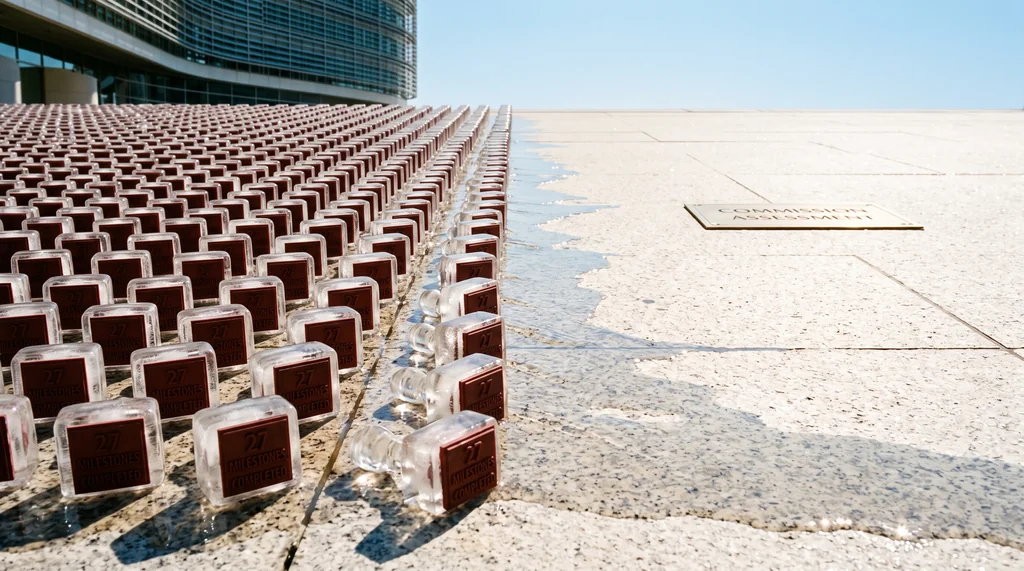
Hungary’s reforms multiply on paper while Brussels waits for proof.
Kompożizzjoni tal-immaġni · tobriefReports that Hungary is "on track" to unlock roughly €10 billion in EU recovery funds have travelled quickly through European media. The record says something more limited. Budapest says it is completing the reforms. The European Commission has not yet assessed them, has not received a payment request, and has not approved a single euro for payment (Commission Hungary page, Commission briefing, 30 July).
For Malta, this distinction matters. EU money is not released because a government says it has ticked the boxes. It is released through a legal sequence, with evidence, verification and political consequences if Brussels bends its own rules.
Council approval is a doorway, not a bank transfer
The EU Council, where national governments vote, approved Hungary's revised recovery plan on 10 July (Council). That decision opened the route to about €6.5 billion in grants and €3.5 billion in loans under the Recovery and Resilience Facility, the EU's post-pandemic fund that pays governments only after agreed reforms are shown to be complete (RRF Regulation).
But Council approval is not the money. Hungary must clear 27 "super milestones" by 31 August, most of them linked to corruption controls, transparency and judicial independence (Euronews, HVG). Budapest then has to submit a formal payment request by the end of September. Only after that can the Commission assess whether the milestones have actually been met. It said so plainly on 30 July: no formal assessment starts before the request arrives (Commission briefing).
Hungary's Transport and Investment Ministry told Euronews that roughly two-thirds of the commitments are already complete. That may turn out to be true. But "we are finishing" is a government line. It is not a Commission finding.
Real reforms, unverified controls
Péter Magyar's government has moved quickly. Hungary published stricter audit rules on 7 August, making the EU's ARACHNE+ fraud-detection tool compulsory for all recovery-fund spending (Schoenherr). The Integrity Authority, the watchdog Budapest created under EU pressure to examine public contracts for corruption, has launched a register of companies barred from procurement.
These are not cosmetic steps. The issue for the Commission is whether they create anti-corruption systems that work and can be checked, or whether they are hurried legal fixes that can be diluted once the pressure passes.
That question matters because part of the legal structure is already under strain. Act XVIII of 2026, the omnibus law bundling transparency and energy reforms, remains before Hungary's Constitutional Court (To Brief). If the court strikes down provisions before the Commission assesses them, the legal basis for some milestones may fall away. Brussels checks whether a reform was adopted and whether it still stands. A reform passed on paper and weakened afterwards can fail verification as surely as one never passed.
Hungary is not alone in facing this late-stage test. The Commission warned Romania that reversing a decarbonisation law it had already validated could carry financial consequences (Adevarul). The same discipline is being tested across the region.
The Commission's credibility is exposed
Brussels is under pressure from both sides. An Advocate General at the Court of Justice, a senior legal adviser whose opinions are not binding but often shape judgments, has already concluded that the Commission released frozen Hungarian funds too early in an earlier conditionality dispute (Ouest-France). The European Parliament sued over that decision.
If the Commission now accepts weak evidence because the deadline is tight, the recovery fund starts to look less like a pay-for-results instrument and more like a political bargain. Malta knows why that distinction matters. EU conditionality is not an abstract Brussels habit; it is the mechanism that decides whether public money follows enforceable rules or political convenience.
If the Commission applies the standard properly, it strengthens conditionality for every member state rushing to close its plan before the facility expires. The next factual answer belongs to Brussels, sometime after September: did Hungary prove the reforms work, or only that they were passed?
Details about this article
- Model:
- claude-opus-4-6
- Generated:
- 8/25/2026, 2:07:43 AM
- Pipeline run:
- eu_pipeline_20260825_005008
- Watermark:
- SynthID (Google's invisible watermark)
- Human review:
- None before publication