Hungary Signs, Grid Still Waits
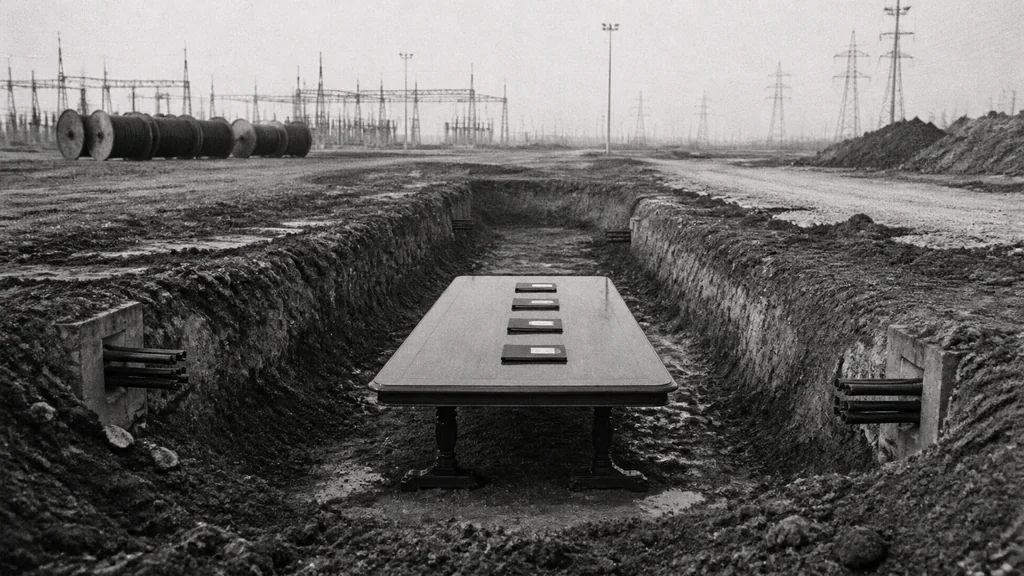
Hungary’s contracts are in place; its new grid remains underground.
Kompożizzjoni tal-immaġni · tobriefHungary's state development bank has signed five contracts to move EU recovery money into electricity grid upgrades and smart meters. A politically connected company has been kept out on transparency grounds. The 31 August compliance deadline is nine days away. What the contracts have not yet delivered is one kilometre of new cable or one installed meter.
The paperwork is done. The grid is not.
On 22 August, minister István Kapitány announced that the deals had been signed (24.hu, Telex). The parties are Magyar Fejlesztési Bank, or MFB, Hungary's state development bank; MAVIR, the national transmission operator; E.ON, the German-origin utility that runs Hungarian distribution; and MVM, the state energy group.
The money comes from the Recovery and Resilience Facility, the EU's post-pandemic fund. It does not work like an ordinary grant pot. Brussels pays out only after it checks that a member state has met agreed reform and investment milestones (European Commission). For Malta, which has lived through years of EU scrutiny over financial regulation and the sale of citizenship, the mechanism is familiar enough: the money is there, but access depends on whether the Commission accepts that the rules have been met.
The Hungarian government described the nearly HUF 500 billion package, roughly €1.2 billion, as another step in "bringing EU funds home" (Népszava). That phrase needs reading with care. As To Brief reported three days ago, Hungary's constitutional court is still reviewing one of the laws behind its compliance package, and the Commission has not yet issued a disbursement decision on these milestones.
About HUF 486 billion goes into upgrading the electricity network so it can take more solar and wind power (444.hu). Another HUF 54 billion pays for smart electricity meters. The support rates vary: distribution companies can have up to 75% of their costs covered, MAVIR up to 90%, and smart meters are financed at 100% (Portfolio). For the grid work, operators still need to put in their own capital. That immediately favours companies with large balance sheets.
These are domestic grant agreements. MFB acts as the intermediary; MAVIR, E.ON and MVM are the companies that will spend the money (kormany.hu). Portfolio, a Hungarian financial outlet, put it plainly: the signatures complete the administrative phase, and "practical implementation can now begin" (Portfolio). The physical work starts after the announcement.
EU conditions changed who gets the money
One company was excluded. MFB barred OPUS TITÁSZ, linked in the Hungarian business press to oligarch Lőrinc Mészáros, from both the grid and smart-meter schemes on transparency grounds (Világgazdaság). OPUS TITÁSZ said the withdrawal was unfounded (Alternativ Energia).
That exclusion is the clearest evidence so far that EU conditions changed who could receive the money. Hungary also tightened fund controls in August, including mandatory use of ARACHNE+, the Commission's anti-fraud data-mining tool, and conflict-of-interest checks (Schoenherr).
Brussels now has to decide whether these checks can actually block conflicted spending, rather than simply make the file look better before the deadline. The milestones deadline is 31 August. The final payment request deadline is 30 September. Commission disbursements run through 31 December (Schoenherr). After that, unspent RRF money is permanently lost.
Why the grid matters beyond Hungary
Hungary's grid bottleneck is more than a construction delay. If the network is too weak, solar and wind farms cannot connect, or they have to be switched off when supply exceeds what the grid can take. That wastes clean power and pushes up system costs.
The problem is also regional. Across Central Europe, RRF money is being pushed into grids that take years to expand physically. Romania's Transelectrica has connected more than 2,500 MW of new production and storage capacity in 2026 (InvesTenergy), and Romanian exports towards Hungary have peaked near 3,974 MW during high solar output (xchg.ro). A stronger Hungarian grid would allow the country to absorb or move that imported power instead of running into local bottlenecks. The corridor would then matter for both countries.
The contracts are not just presentation. Named operators have signed agreements, a politically connected company has been screened out, and the grid investment is real. But the accountability test starts in the gap between a signed contract and working infrastructure.
The next evidence will come later and separately: Commission-verified disbursement, procurement awards, installed meters, commissioned substations, and measured capacity gains. Until then, Hungary has completed the paperwork. The grid is still waiting.
Details about this article
- Model:
- claude-opus-4-6
- Generated:
- 8/23/2026, 1:57:18 AM
- Pipeline run:
- eu_pipeline_20260823_005006
- Watermark:
- SynthID (Google's invisible watermark)
- Human review:
- None before publication