Ireland’s Export Drop Misreads Europe
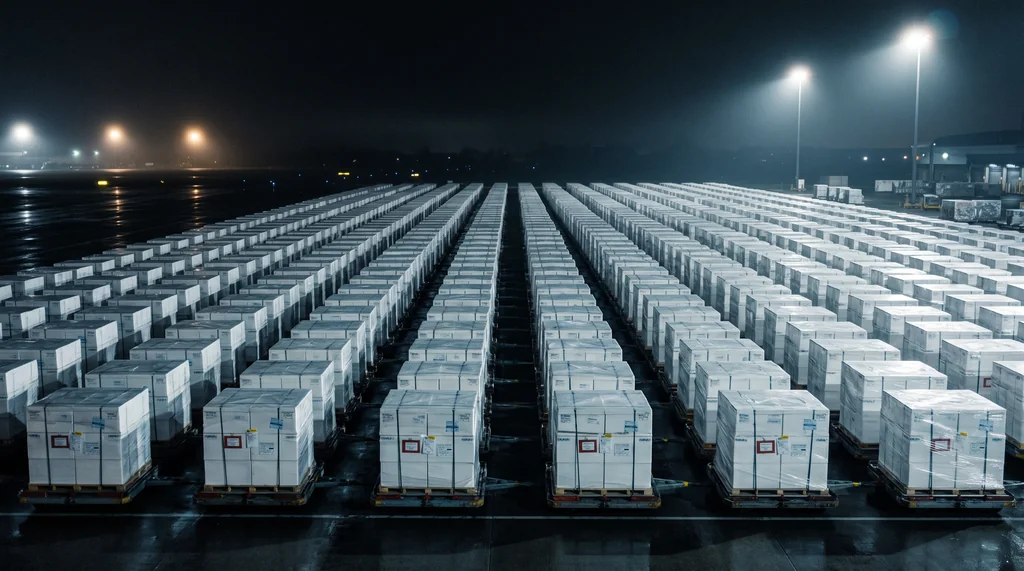
A rush of shipments leaves Ireland counting an artificial collapse.
Kompożizzjoni tal-immaġni · tobriefIrish goods exports to the United States fell 65.1% in the first half of 2026 compared with the same period last year. The provisional figure, published by Ireland's Central Statistics Office, is real (CSO, The Journal). It is also a poor guide to what is happening in Europe’s trade with America.
The reason is the base year. In early 2025, pharmaceutical companies sent large volumes of goods into the US before expected tariff increases. This is front-loading: moving shipments forward to beat a deadline. That rush lifted Irish exports to the US in January-June 2025 to about €75.1 billion. Once the stockpiling passed, exports in the first half of 2026 dropped to €26.2 billion (CSO, Irish Examiner). The 65.1% fall is therefore measuring the gap between an inflated peak and a more normal shipping pattern.
June gives a better sense of the present pace. Ireland shipped around €4.3 billion of goods to the US that month, only 1% below June last year. A CSO spokesperson said comparison with 2025 "remains difficult" because last year’s figures were swollen by tariff-related movements (Irish Times).
Why Ireland exaggerates the signal
Ireland’s export data are unusually exposed to a small number of multinationals in pharmaceuticals, chemicals and technology. One inventory decision by one large company can move the national figures by billions. Malta knows a version of this problem well: when a small economy hosts large internationally mobile sectors, the headline data can say as much about corporate structuring as about domestic economic strength.
Medical and pharmaceutical exports fell by more than half to €38.8 billion in the first half of the year. Computer exports moved the other way, rising from €3.5 billion to €8.8 billion (Independent.ie). That increase was not a tariff story. It reflected AI hardware demand linked to the product cycles of a few firms. Both movements show that Irish trade figures are tracking multinational logistics more than the underlying economy.
Ireland’s GDP followed the same rhythm. The economy recorded a 7% fall in the first quarter as stockpiling unwound, then a 3.9% rebound in the second quarter, according to CSO estimates (RTE). This is familiar territory for Ireland: GDP there is already unusually sensitive to multinational accounting, intellectual property movements and inventory shifts.
The US route collapsed on paper, but other destinations expanded. The fall in exports to the US alone was €48.9 billion. Total Irish goods exports, however, fell by €45.4 billion (CSO, The Journal). Exports to Great Britain rose 42.6%, while exports to the rest of the world rose 23% (Irish Examiner). Non-US markets together added roughly €3.5 billion.
At EU level, the picture is much less dramatic. Eurostat’s first estimate shows extra-EU goods exports down just 2.1% in the first half of 2026. In June, EU exports to the US rose 10.8% year-on-year to €45.7 billion (Eurostat). Ireland magnifies the transatlantic signal because its exports are concentrated in a few multinational balance sheets. The European average is far calmer.
Where the damage is quieter and more real
The tariff damage is clearer in places where front-loading cannot hide the impact. Germany’s goods exports to the US fell by about 6% in the first half of the year. That is a smaller headline than Ireland’s, but it is spread across a much broader industrial base. German direct investment into the US dropped 65% to €4.3 billion, according to IW analysis of Bundesbank data (WirtschaftsWoche, Zeit). By the end of June, the German car industry had lost 42,300 jobs, a 5.8% fall from a year earlier (Handelsblatt). These are factory workers, not accounting entries.
Italian wine exporters are also feeling the squeeze. Exports to the US fell 15.4% in value between January and May, while the average price per litre dropped from €5.57 to €5.01 (Vinetur). When volume and price fall together, the issue is not only timing. It is pressure on margins.
Scale decides who can carry the cost. In the Netherlands, multinationals including Heineken and Philips recovered US tariff overpayments through import subsidiaries (NRC). Brouwerij Huyghe, a Flemish brewer, received several hundred thousand euro back, but told reporters the commercial damage had already been done: lost orders and customer relationships that a refund months later could not repair (Nieuwsblad).
The Irish numbers are provisional and will be revised. Even as they stand, the 65.1% figure overstates the current collapse while exposing the real advantage created by tariff uncertainty. Firms large enough to front-load shipments, absorb delays and reclaim duties can turn volatility into a managed cost. European exporters without that scale face a harsher calculation. Lost orders and thinner margins do not correct themselves.
Details about this article
- Model:
- claude-opus-4-6
- Generated:
- 8/19/2026, 1:58:27 AM
- Pipeline run:
- eu_pipeline_20260819_005007
- Watermark:
- SynthID (Google's invisible watermark)
- Human review:
- None before publication