Kaub Gauge Strangles Rhine Freight
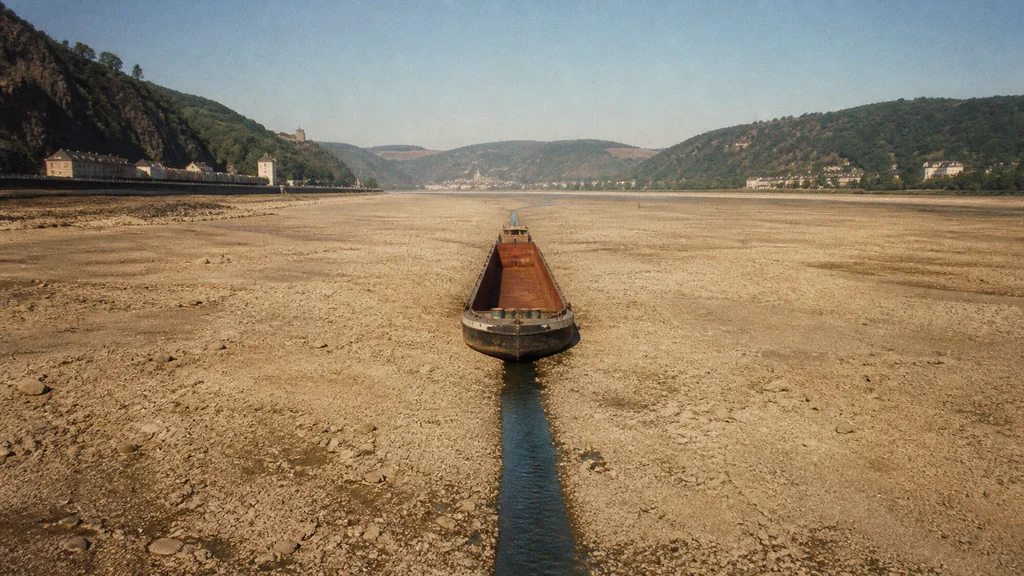
The Rhine stays open as its carrying power disappears.
Kompożizzjoni tal-immaġni · tobriefA cargo vessel passed Kaub this week carrying about 180 tonnes of freight. It was built for 1,200 (Argus). The Rhine has not been formally closed. It does not have to be. Once the water falls this far, barges must sit higher in the river to avoid scraping the bed, which means leaving most of their cargo behind. Capacity disappears before any official ban is issued. The bill is already moving through the chain, from petrol stations in eastern France to chemical plants in Germany and building sites in Belgium.
Six centimetres at the chokepoint
Kaub, the narrow stretch between Koblenz and Mainz, is the point that decides how much traffic can move between the North Sea ports and the Upper Rhine. Its gauge fell to six centimetres on 14 August and went lower the next morning (Tagesschau, nrw-lokal). The gauge is not the actual depth of the river. It is a measurement against a fixed reference point, so vessels can still pass even when the figure is in single digits (n-tv). But they pass almost empty.
Barges are carrying roughly 15–35% of their normal payload (Reuters/WSAU). For western Europe, the Rhine is not a scenic river in an EU transport strategy. It is an industrial conveyor belt, moving about 300 million tonnes of cargo a year: chemicals, fuel, steel, grain and construction materials (CCNR). When a vessel carries a quarter of its usual load, the cost per tonne rises immediately. A barge that once brought 2,400 tonnes of diesel now brings a few hundred, and every reduced trip adds another surcharge.
Where the costs land
Eastern France felt it first. Petrol for Alsace normally comes by barge from northern European ports, but low water upstream of Strasbourg has broken that supply line. On 14 August, 14% of petrol stations in Grand Est reported problems, and about a third of Alsatian stations were missing at least one type of fuel (Boursorama, TF1). French authorities responded by allowing heavy tanker trucks to run over the 15 August holiday weekend, drawing fuel from depots further west (Le Parisien).
The cost of moving fuel by barge from Rotterdam to Karlsruhe has roughly tripled since late June. By mid-August, surcharges were being quoted at 150–215 euros per tonne, depending on the source (RFI, France24). BASF, whose Ludwigshafen complex receives 75% of its European raw materials by water, has issued force-majeure notices on some product lines. In plain terms, it is warning customers that it may not be able to deliver because the river can no longer bring in inputs reliably (C&EN, Insurance Journal).
Belgian construction firms are paying low-water surcharges of €8–17 per tonne on sand and gravel, with barges making four trips for cargo that once fitted into one (GVA). The Netherlands is less exposed because it sits closer to the sea and has more coastal waterway alternatives. Rotterdam reported Rhine-bound volumes more than 10% below normal, with vessels loaded at 30–35% rather than the usual 70% (WNL), but ING economist Rico Luman argued Dutch firms can reroute through those alternatives before the shallow middle Rhine becomes the binding constraint (BusinessWise).
Every fallback has its own bottleneck
DB Cargo said it could make 900 freight wagons available, enough on paper to replace about 200 inland vessels (Tagesschau, Zeit). That is a planning figure, not capacity already delivered. Rail works are restricting a key Rhine corridor (Kuehne+Nagel), and road has its own arithmetic: replacing one full diesel barge takes roughly 89 tanker trucks (ingenieur.de). Germany has about twelve dedicated low-water vessels in its entire fleet (ZDFheute). These flat-bottomed barges can work in shallow stretches, but a dozen vessels cannot replace a national waterway.
The Kiel Institute estimated that 30 days of low water on the Rhine is associated with roughly a 1% fall in German industrial production (DW). For an economy already close to stagnation, that is material. Rail and road can take some urgent cargo, as Malta knows from every supply-chain shock that turns a distant logistics problem into a domestic price rise. But they cannot replace 300 million tonnes a year of cheap bulk freight. The Rhine corridor has far less spare capacity than Europe’s industrial planning assumes.
Details about this article
- Model:
- claude-opus-4-6
- Generated:
- 8/16/2026, 2:03:59 AM
- Pipeline run:
- eu_pipeline_20260816_005006
- Watermark:
- SynthID (Google's invisible watermark)
- Human review:
- None before publication