Patriot pipeline leaves PAC-3 gap
Washington opens a supply line that may not survive Ukraine’s winter.
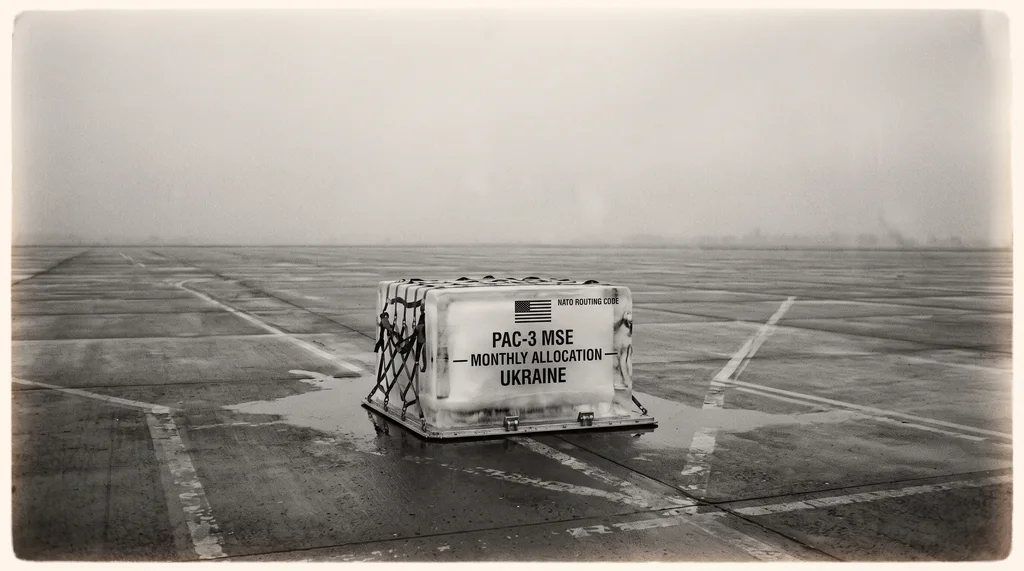
Kompożizzjoni tal-immaġni · tobriefVolodymyr Zelensky said on 8 August that the United States will allocate Patriot interceptor missiles to Ukraine every month (President of Ukraine, Ukrainska Pravda). Speaking in Belgrade alongside Serbian President Aleksandar Vucic, he also made clear that the quantities would not be enough. He gave no figure, no missile type and no duration. The announcement shows that a supply channel exists. It does not show that Ukraine can shield its cities through winter.
The shortage had already become deadly. On 1 August, Russia fired 27 ballistic missiles at Kyiv. Ukraine intercepted one (European Pravda). Nine people were killed (SBS/Reuters). Reuters reported that allied interceptor deliveries have fallen to one-third of last year's level (Agerpres). Zelensky told the Ukraine-NATO Council, where Kyiv meets all 32 allies, that Russia produces about 120 ballistic missiles per month (President of Ukraine). Each successful interception can consume one to three interceptors (Le Monde). The numbers do not bend in Kyiv's favour.
Europe Pays. Washington Decides Who Gets the Missiles.
The constraint is not simply European willingness. It is control. European governments can donate from their own stocks and finance US-made air-defence packages through NATO. What they cannot do is produce, allocate or approve transfers of PAC-3 MSE missiles, the Patriot variant designed to destroy ballistic missiles by direct impact, without prior written US approval under American export-control rules (22 CFR 123.9, NATO).
For Malta, which sits outside NATO but inside the EU debate on Ukraine, this is the uncomfortable shape of European security policy: Europe can pay, but the final lever often sits elsewhere. The same dynamic runs through defence procurement across the continent. Small states know it well. Buying protection is not the same as controlling the supply line.
European stockpiles show how tight the rationing has become. Germany, the largest European Patriot donor, has sent three complete systems, four extra launchers and missiles (Bundesregierung). With partners, Berlin managed to pull together 35 interceptors from national reserves (Tagesschau). The Netherlands gave systems, radar and interceptors, plus €500 million for air defence, but Dutch defence spokesman Kees Bakhuys told Radio Svoboda that no extra Patriot missiles remain in stock. Romania donated a full system and is now waiting for replacement equipment, while Romanian analysts warn that allies are weakening their own air defences as they help Kyiv (Digi24).
The message is the same from capital to capital: governments are prepared to give, but they are running out, and they need Washington to refill what they send.
Poland, which Zelensky described as a country that "can really help," signed a statement of intent at NATO's Ankara summit for a European PAC-3 service centre and wants Patriot co-production on Polish territory (gov.pl, Bankier). Warsaw has a plan for future maintenance and production. It does not yet have missiles ready to send. US Ambassador to NATO Matthew Whitaker said no long-term production agreement would be ready before winter (Euronews).
The Factory Won't Outrun the War
Production is rising, but not fast enough to change the immediate balance. Every missile sent to Ukraine competes with NATO countries trying to rebuild their own stocks. Lockheed Martin delivered more than 600 PAC-3 MSE interceptors in 2025 and is aiming for 2,000 a year by 2030 (Lockheed Martin). PBS described the expansion as real, but still insufficient before the end of the decade (PBS). Even Japan's co-production line is being held back by shortages of Boeing-made components (Kyiv Independent).
The Franco-Italian SAMP/T system, which uses Aster missiles, offers some relief. MBDA says it doubled missile production between 2023 and 2025 (MBDA). But Ukrainian air-force commanders say only Patriot currently stops certain Russian ballistic threats, including Iskander-M and Zircon (AP).
Zelensky's statement in Belgrade confirms that a monthly US allocation exists. It does not say whether the allocation is large enough to close the gap. The scarce item is the interceptor itself, and the decision on that interceptor sits in Washington. Until European allies know how many PAC-3 rounds they will receive, when they will arrive and what those transfers will do to their own defences, "monthly" is not a guarantee. It is rationing with a diplomatic name.
Details about this article
- Model:
- claude-opus-4-6
- Generated:
- 8/9/2026, 1:58:17 AM
- Pipeline run:
- eu_pipeline_20260809_005005
- Watermark:
- SynthID (Google's invisible watermark)
- Human review:
- None before publication